
UK Greyhound Results Explained
 Available in US
A complete guide to reading form, interpreting GBGB grades, analysing trap statistics, and turning raw race data into sharper betting decisions.
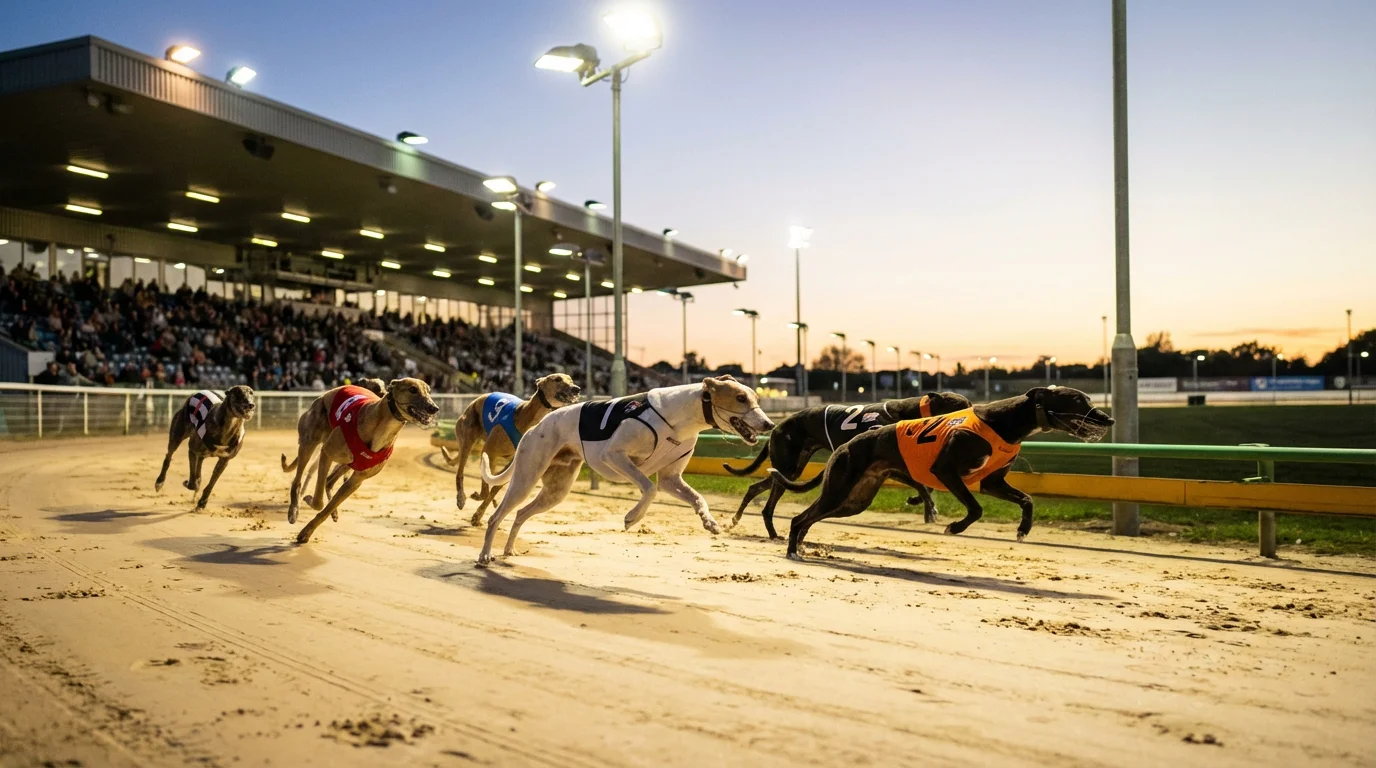
Inside the Numbers: What UK Greyhound Results Actually Tell You
A finishing position is the least interesting thing on a greyhound results page. That might sound counterintuitive, given that the entire point of a race is to see which dog crosses the line first. But if you are betting on UK greyhound racing with any seriousness, the number in the "position" column is where analysis begins, not where it ends.
Every race staged at a GBGB-licensed track generates a dense packet of information: starting prices, forecast and tricast dividends, sectional times, official distances, race comments, weight data, trap draws, and going reports. Most punters glance at the winner, perhaps note the SP, and move on. The sharper ones mine those results for patterns that repeat across meetings, tracks, and conditions. They treat each result not as a standalone event but as a data point in a much longer sequence. That is the difference between checking results and reading them.
In the centenary year of British greyhound racing, the sport's data infrastructure is better than it has ever been. The GBGB publishes results through its official database, Timeform supplies advanced form and ratings, and live broadcasts from licensed tracks are streamed to bookmakers in real time by SIS and Premier Greyhound Racing. The raw material is freely available. What separates profitable punters from the rest is understanding what that material actually means and knowing which pieces to discard.
This guide breaks down every component of a UK greyhound result, explains the grading system that shapes race quality, shows how to extract form from raw data, and connects all of it to practical betting decisions. Whether you are checking tonight's greyhound racing results or building a long-term form study, the approach is the same: look past the finishing order and into the numbers behind it.
Computer Forecast Dividend — the payout for correctly predicting the first two dogs home in exact order. Unlike fixed-odds prices, the forecast dividend is calculated after the race from the returned starting prices of the first and second-placed greyhounds. It is generated by a formula, not by a bookmaker's margin, which means the dividend reflects the actual market rather than a pre-race estimate. Understanding how forecast dividends are derived is essential for anyone betting forecasts or reverse forecasts on UK greyhound racing.
Anatomy of a Greyhound Result
Every published result carries seven layers of data most punters scroll straight past. A typical result line from a GBGB meeting includes the finishing position, the dog's name and trap number, the starting price, the race time, sectional time, the winning distance, and in-running comments. Each element tells a different part of the story. Taken together, they form a compressed race narrative that, once you learn to decompose it, reveals far more than "who won."
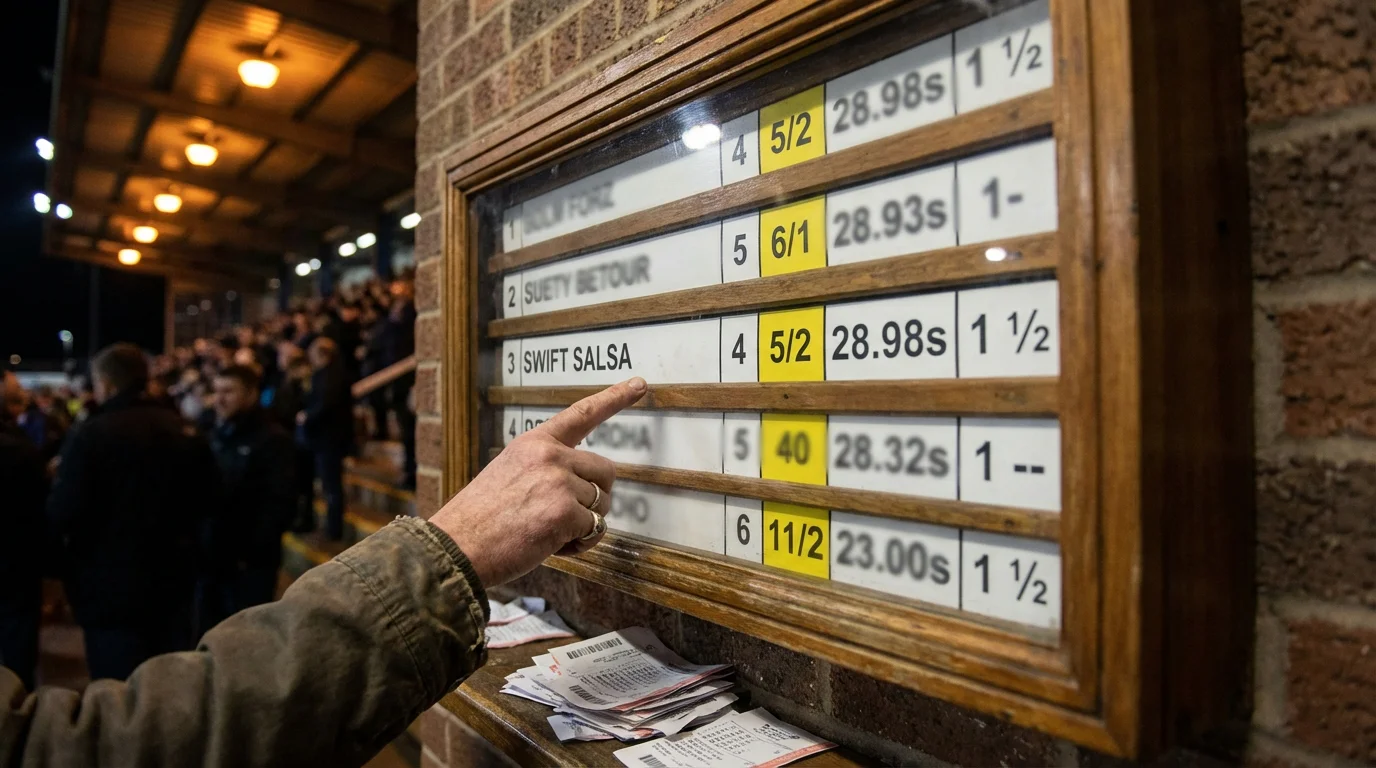
SP — Starting Price — the official odds of a greyhound at the moment the traps open. The SP is the baseline for calculating forecast and tricast dividends and is the price returned to punters who take "SP" rather than a fixed early price.
Finishing Positions and Official Distances
Greyhound results list finishing positions from first to sixth, sometimes with an additional line for a non-finisher or disqualified runner. Alongside each position sits the official distance — measured in lengths, short heads, heads, and necks. These distance measurements matter more than they might appear. A dog beaten a short head at Towcester over 500 metres was, for practical purposes, level at the line. A dog beaten eight lengths was never competitive. Yet both carry the same finishing position: second. If you are comparing two dogs' recent form and one finished second by a nose at A2 grade while the other finished second by six lengths in an A6, their form figures will look identical. The distance column is where the distinction lives.
SP, Betfair SP and Forecast Returns
The starting price is the backbone of greyhound result data. On-course SPs are determined by the on-course market just before the traps open, and they dictate the returns for anyone who bet at SP rather than taking an early fixed price. Betfair SP operates differently — it is the price at which a greyhound is matched at the close of the Betfair exchange market, often providing a more efficient reflection of true probability because it removes the bookmaker's overround.
The gap between traditional SP and Betfair SP can be significant, particularly in lower-grade races where on-course markets are thin. A dog returned at 5/1 SP might show a Betfair SP of 6.4, which represents a meaningful difference in implied probability. For punters interested in value identification, comparing these two prices across a dog's recent results is one of the most underused tools available. A consistent pattern where Betfair SP exceeds traditional SP suggests the on-course market is underestimating the dog, often because the layers in the Betfair market have access to data the on-course bookmakers do not.
Interactive Tool
SP vs Betfair SP Gap, and Trap Win Rate Spread
Calculate the exact implied probability gap between SP and Betfair SP, and the win rate spread between inside and outside traps.
Implied Probability Gap
-
-
SP Implied
-
Betfair SP Implied
-
Ratio
-
What this guide describes but never quantifies: "A dog returned at 5/1 SP might show a Betfair SP of 6.4, which represents a meaningful difference in implied probability." The actual gap is never calculated — it's 1.04 percentage points (16.67% vs 15.62%).
Win Rate Spread
-
-
Inside Midpoint
-
Outside Midpoint
-
Ratio
-
What this guide gives as two separate ranges: "Inside Traps... Win rates typically 18–22%" and separately "Outside Traps... Win rates often sit at 14–17%." The spread between them is never calculated — using midpoints, it's 4.5 percentage points, meaning inside traps win 1.29x as often.
Forecast returns — the dividend paid for predicting first and second in correct order — are derived from the SPs of the two placed dogs. The formula is standardised, but the resulting dividends vary wildly depending on how the market priced the combination. Understanding how the dividend is generated helps separate genuinely valuable forecasts from those that merely look large because the race was open and unpredictable.
Winning Time and Sectional Splits
The winning time records how quickly the first dog completed the distance. On its own, a time is almost meaningless — track surfaces, weather, going, and even the speed of the mechanical hare all affect it. What makes time data useful is comparison within the same track, over the same distance, under similar conditions. A 29.45-second 480m at Romford on a standard going is a reasonable benchmark, but only against other 480m runs at Romford on similar nights.
Sectional splits, where available, break the race into segments — typically the run to the first bend and the run from the last bend to the line. These splits expose qualities that finishing positions cannot. A dog that clocks a fast sectional to the first bend but fades in the home straight has early pace but lacks stamina over the trip. A dog that posts a moderate first sectional but a rapid closing split is a strong finisher who may have been hampered or slow into stride. Sectional data is particularly valuable for identifying dogs that ran better than their finishing position suggests — the kind of dog that gets bumped at the first bend, loses three lengths, and still finishes third. The result says third. The sectionals say unlucky.
| Dog / Trap | SP Odds | Returns |
|---|---|---|
| Ballymac Doris (T1) | 5/2 | Win: 3.50 to a 1.00 stake |
| Droopys Expert (T4) | 7/2 | Place: 1.90 |
| Skywalker Logan (T6) | 11/1 | — |
Forecast dividend (T1-T4): 18.40
Tricast dividend (T1-T4-T6): 247.62
The forecast and tricast returns above are calculated from the SPs of the placed greyhounds, not from early market prices. A punter who took 5/2 about Ballymac Doris before the off received the same win return as one who took SP — but the forecast dividend is fixed by the formula regardless of when the bet was placed.
How UK Greyhound Grades Shape Every Result
Grade alone does not tell you how fast a dog is — it tells you what company it has been keeping. The GBGB grading system is a sorting mechanism designed to produce competitive, evenly matched races. Every greyhound registered with the GBGB is assigned a grade based on its recent performances at a specific track, and that grade determines which races it is eligible to enter. The system is not a league table. It is closer to a handicapping framework: dogs are moved up when they win and down when they lose, with the goal of keeping fields competitive rather than letting the fastest animals dominate week after week.
For bettors, understanding grades is essential because two identical-looking results carry completely different weight depending on the grade. A 29.50-second win in an A1 race came against the fastest graded animals at the track. A 29.50 in an A7 came against considerably weaker opposition. The result is the same. The context is not.
The A-Grade Ladder: A1 Through A10
The standard A-grade structure runs from A1 at the top to A10 at the bottom, though not every track uses all ten grades. Smaller tracks might compress the range to A1 through A6 or A7. The grade a dog receives depends on its calculated time — essentially its best recent performances adjusted for weight, going, and other factors — and where that time sits relative to the other dogs at the same track. An A1 dog at Nottingham is not necessarily the same standard as an A1 dog at Towcester; grades are track-specific, which is one of the most commonly misunderstood aspects of the system.
Promotion and relegation follows a simple logic: win a race, and you are likely to be moved up a grade; finish out of the places repeatedly, and you drop. The grading process is managed by the racing office at each track and published in advance on racecards. A dog moving from A4 to A3 will face faster rivals. A dog dropping from A3 to A4 gets a theoretically easier assignment. Both scenarios matter for betting: the promoted dog faces a tougher test, while the relegated dog may find the competition more manageable.
Open Races, Sprints, Stays and Hurdles
Above the A-grade ladder sit Open Races, the highest tier of graded competition. Open races are classified as OR1, OR2, and OR3, with OR1 being the elite level. These races attract the best dogs from multiple tracks and form the centrepiece of the GBGB's category one calendar. In 2026, the centenary open race programme features 50 category one competitions spread across the licensed tracks, including the Greyhound Derby — the sport's most prestigious event, with heats and finals running through May and June.
Beyond the standard distance A-grades, the calendar includes sprint races (typically 260m to 285m), staying races (630m to 900m and beyond), and hurdle races, which add a set of low obstacles to the flat track. Each distance category produces distinct result profiles. Sprint results tend to be heavily influenced by trap position and early pace, since the race is effectively decided by the first bend. Staying results reward stamina and tactical speed over a longer distance, and the form tends to be more reliable because the race unfolds over more ground. Hurdle results introduce a variable that flat racing does not have: jumping ability. A dog with perfect flat form may be useless over hurdles if it fails to clear the obstacles cleanly.
Grade A1 Race
Typical winning time (480m): 28.90–29.20
Field quality: Track's fastest graded dogs. Tight finishing margins, low variance.
Predictability: Higher. Top-grade dogs have consistent form lines and reliable early pace data.
Betting market: Shorter prices across the field. Forecast dividends tend to be lower because the market reflects genuine quality separation.
Grade A6 Race
Typical winning time (480m): 29.80–30.30
Field quality: Mid-range runners. Wider spread of ability, more inconsistent form.
Predictability: Lower. Dogs at this level are more prone to form reversals, with larger gaps between best and worst runs.
Betting market: More open prices. Forecast and tricast dividends can be significantly larger, but the underlying unpredictability means strike rates fall.
Reading Greyhound Form From Results Data
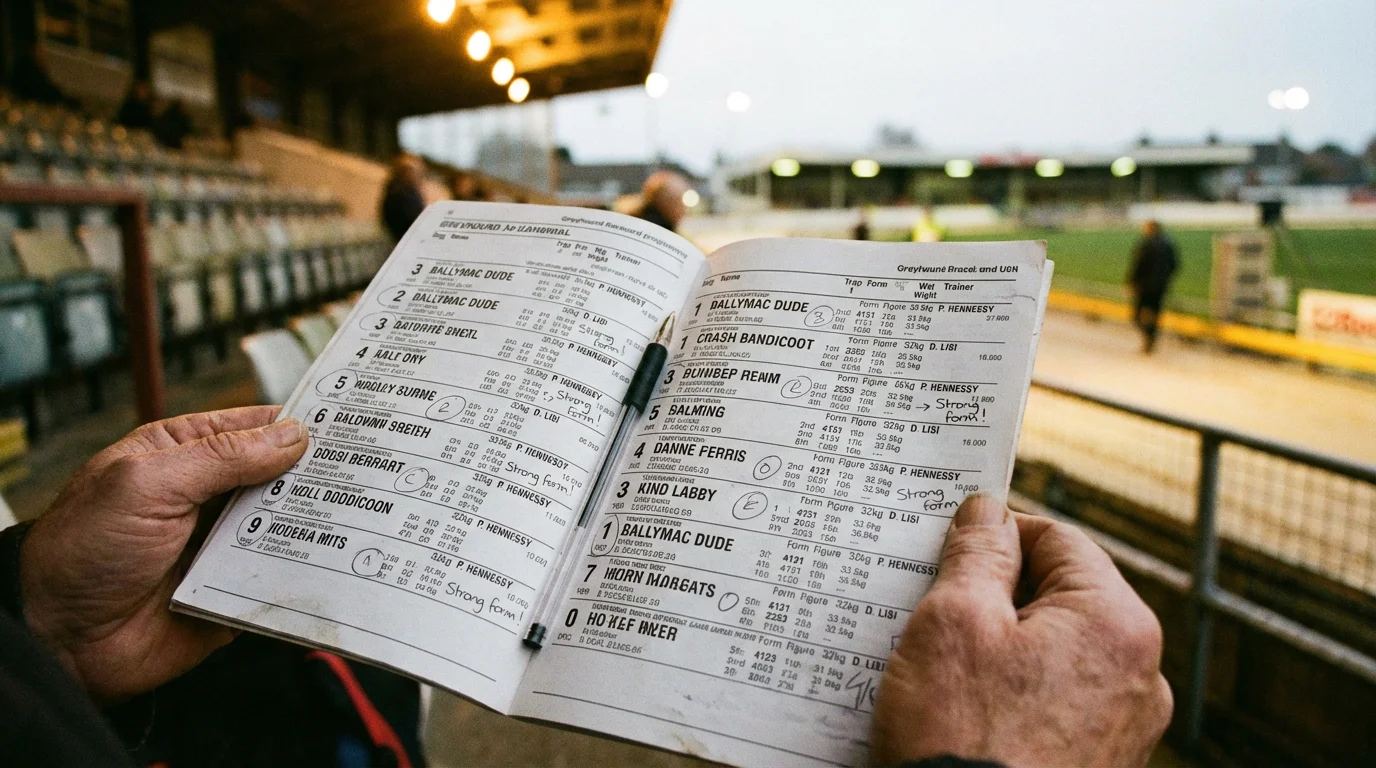
Form reading is pattern recognition under pressure — you are looking for the signal inside noise. Every greyhound racecard in the UK shows a form line: a sequence of digits representing finishing positions in recent races, read from left to right with the most recent run on the right. A form line of 321143 tells you a dog has been competitive over its last six starts, finishing first once, second once, third twice, and fourth twice. But the digits alone are a sketch, not a portrait. The real form reading starts when you look behind each number to find out what actually happened in each race.
The GBGB results database, Timeform, and Sporting Life all provide the raw data: trap, distance, time, grade, going, weight, and race comments for each run. Your job is to extract a trajectory. Is the dog improving, declining, or holding steady? Is there a pattern in which traps produce its best results? Did a poor run coincide with a change of trainer, a weight shift, or a step up in grade?
Form Figures and What the Numbers Mean
The standard form line uses digits 1 through 6 corresponding to finishing positions, plus a handful of letter codes. "m" typically indicates a dog that was unseated or failed to complete the course. "0" may denote a run in a trial or non-competitive outing. Some services use additional abbreviations for specific incidents — baulked, stumbled, slow away — which appear in the detailed race comments rather than the form line itself.
Read the figures from left to right: older runs first, newest run last. A form line of 664321 shows a dog that started poorly and has improved steadily — a classic upgrade profile. A line of 112365 shows the opposite: a dog that was winning but has lost form. The trajectory is more important than any individual digit. One bad run in an otherwise solid line is usually noise. Three consecutive bad runs after a grade rise is a pattern worth noting.
Numbers carry different weight depending on grade. A "1" in an A2 race is more impressive than a "1" in an A8, but both appear as the same digit on the form line. Always cross-reference the grade in which each run took place. This context is available on the racecard and should be the first thing you check after scanning the form line itself.
Trap Draws and Running Lines
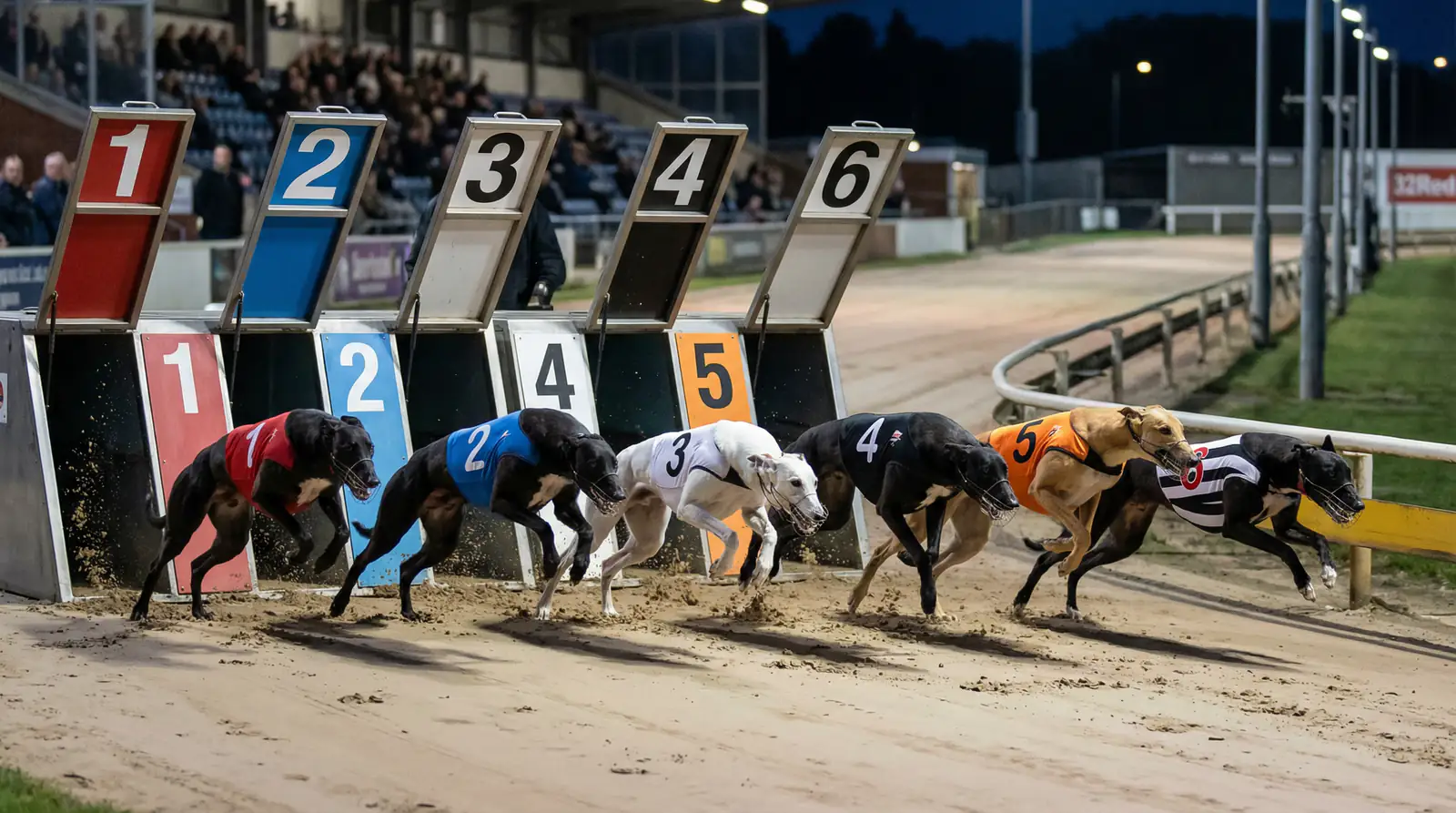
The trap a dog is drawn in affects its running line through the race, and the running line determines how much clear ground it gets through the bends. Inside traps (1 and 2) offer the shortest route around the first bend but require the dog to break sharply and hold its position on the rail. If a railer breaks slowly from trap 1, it risks being crowded by the middle seeds and losing its positional advantage before the first bend. Outside traps (5 and 6) have a longer initial route but more clear running space, which suits wide runners — dogs that naturally take an outside path through the bends and can accelerate in the home straight without traffic.
Running line comments in the results — phrases like "led to line," "challenged wide," "baulked second bend," or "ran on strongly" — are the qualitative layer over the quantitative finish position. A dog that finished fourth but was "baulked at the first bend and ran on well in the straight" ran a much better race than a dog that finished fourth and "always behind, never in contention." Both are recorded as a "4" in the form line. The comments separate them. Getting into the habit of reading race comments for every run in a dog's form line is one of the most reliable ways to improve your form assessment.
Weight Changes, Trainer Moves and Time Gaps
Greyhound weights are recorded on the racecard and in the result data. Under GBGB rules, a dog must weigh within a set tolerance of its racing weight to be eligible to run; significant deviations trigger a stewards' inquiry or withdrawal. Small weight changes between races — a kilogram up or down — can indicate shifts in fitness or condition that are not visible in the form line.
A greyhound's optimal racing weight can fluctuate by less than 0.5kg between peak performances. A shift of even 1kg from a dog's established running weight is often enough to alter finishing times by several lengths, making the weight column one of the most overlooked predictors on the racecard.
Trainer moves are another signal. When a dog transfers from one kennel to another, its next run is effectively a new data point. The new trainer may alter the dog's preparation, racing schedule, or even preferred distance. A dog that was average under trainer A might suddenly win under trainer B — not because the dog has improved overnight, but because the new kennel suits it better. Check the trainer column alongside the form line, and pay particular attention to first runs for a new trainer: the market often underprices these because the form under the previous trainer looks unimpressive.
Time gaps between races also matter. A greyhound that has not run for three or more weeks may be returning from injury, a trial period, or a deliberate rest. First runs back after a break carry higher variance — the dog might be sharper for the rest or might need a run to regain race fitness. Racecards usually display the date of the last run, making it straightforward to spot the gap. A long absence followed by a trial (noted in the form line or racecard) suggests the connections wanted to check the dog's fitness before committing it to a graded race.
Step-by-step form read: three recent results of one dog
Step 1: Scan the form line
Dog: Cabra Tornado. Form: 532. Three runs, finishing fifth, third, then second most recently. The trajectory is upward.
Step 2: Check grade and trap for each run
Run 1 (5th): A4 grade, trap 6, time 29.87, comment: "slow away, crowded first." Run 2 (3rd): A4 grade, trap 3, time 29.62, comment: "midtrack throughout, ran on." Run 3 (2nd): A4 grade, trap 1, time 29.48, comment: "led to third bend, headed close home."
Step 3: Identify the pattern
Times are improving with each run: 29.87 to 29.62 to 29.48. The first run was compromised by a slow start and trouble at the first bend from an outside draw. The move to an inside trap for the third run produced the best performance, and the dog led for most of the race. The form line says 532. The data says this dog is in improving form, runs best from an inside trap, and was half a length from winning at A4 grade.
Step 4: Apply to tonight's race
If Cabra Tornado is drawn in trap 1 or 2 tonight in the same A4 grade, the form read is positive: improving times, inside draw preference confirmed, and the most recent run nearly resulted in a win. If the dog is drawn in trap 5 or 6, the positive trajectory still applies but the trap draw works against its established running style. The bet becomes less compelling, not because the form is worse, but because the context has shifted.
Trap Statistics: What the Data Shows Across UK Tracks
Trap 1 does not win more often — it wins differently. That distinction is the starting point for any honest reading of UK greyhound trap statistics. Across the licensed GBGB tracks, trap biases exist, but they are not uniform, not static, and not nearly as simple as "back the inside draw." Trap statistics are track-specific, distance-specific, and condition-dependent. A blanket assumption that one trap is "best" is the kind of shortcut that costs money.
What the aggregate data does show is that inside traps (1 and 2) tend to produce slightly higher win percentages across most tracks at standard distances. The reason is geometric: the inside rail is the shortest path around the first bend, and greyhound races are frequently decided by first-bend position. A dog that reaches the bend ahead on the rail has a clear run. A dog that reaches the bend from trap 6 has to cover more ground and may encounter traffic. But "slightly higher" means a few percentage points over a large sample — not a guaranteed edge, and certainly not enough to bet on blindly.
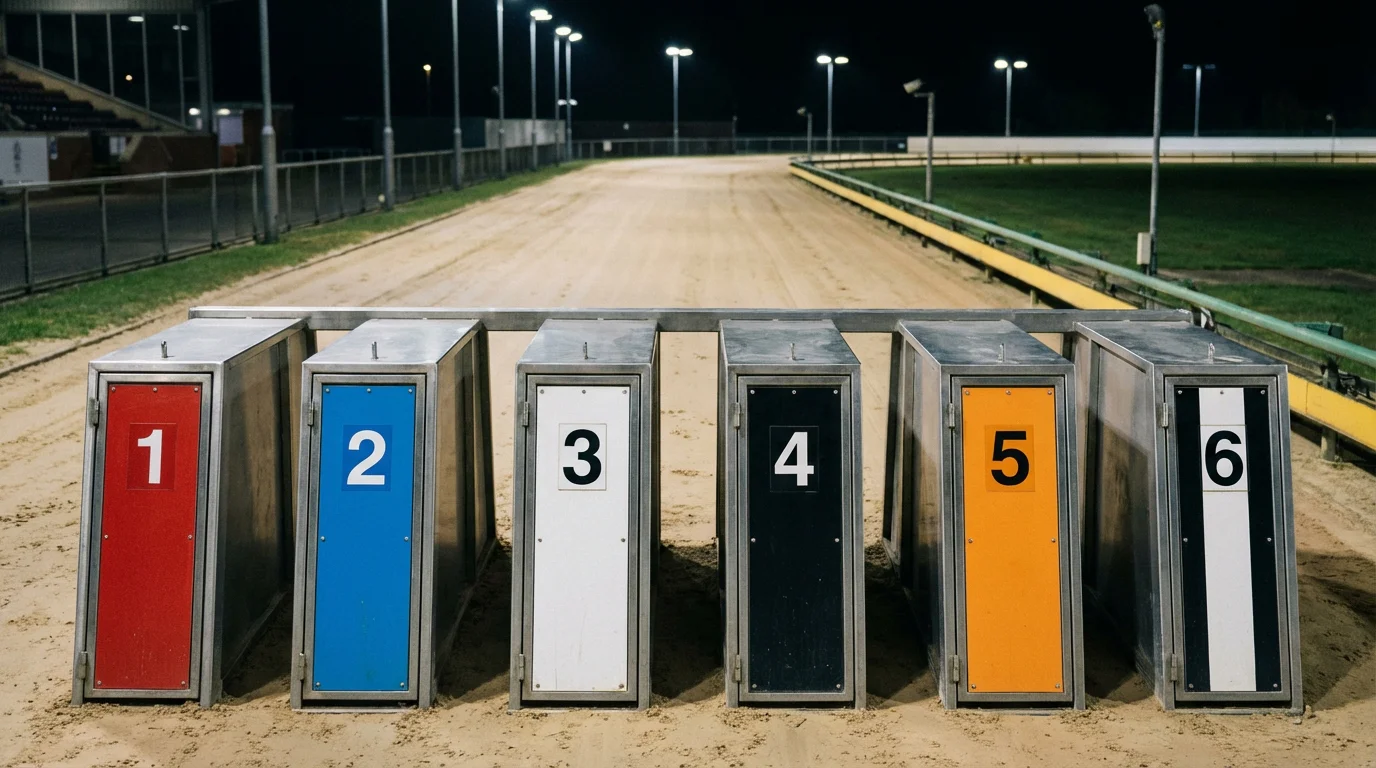
The more useful application of trap data is identifying track-specific anomalies. Some tracks have pronounced biases that persist over hundreds of races. Towcester's 500m course, for instance, has historically favoured wider draws because of the camber on its first bend — the opposite of what naive trap analysis would predict. Romford's tight turns amplify the inside draw advantage. Nottingham's long run to the first bend dilutes it. Each track has its own geometry, surface, hare rail position, and bend profile, and these physical characteristics create persistent biases that are measurable in the results data.
The smartest way to use trap statistics is in combination with individual dog data. If a dog has a proven preference for a wide running line and is drawn in trap 1, the trap statistic and the dog's style are in conflict. That conflict is where betting decisions get interesting — and where most punters go wrong, because they default to one data source without checking whether it applies to the specific animal in the specific race.
Inside Traps: 1 and 2
Shortest route to the first bend. Best suited to early-pace dogs that break cleanly and hold the rail. Win rates typically 18–22% at standard distances on most tracks. Vulnerable when a dog breaks slowly and loses its rail position — trapped on the inside with nowhere to go.
Middle Traps: 3 and 4
The neutral draws. Middle seeds have the most tactical flexibility: they can switch inside or outside depending on early pace around them. Win rates cluster around 15–18%, close to the theoretical 16.7% average for a six-runner field. Dogs drawn here need adaptability more than outright speed.
Outside Traps: 5 and 6
Longer initial path but more clean air on the outside. Suits wide-running dogs that accelerate through the bends without interference. Win rates often sit at 14–17% in aggregate, but at tracks with long straights or sweeping bends, the outside draw can outperform the inside.
Weather Impact on Trap Bias
Wet conditions affect inside traps disproportionately. Standing water collects on the rail at many tracks, slowing dogs that run tight to the inside. Heavy rain can shift the optimal draw outward by two positions. Always check the going report before applying dry-track trap statistics to a wet meeting.
Greyhound Bet Types That Use Results Data
Every bet type asks a different question of the results page. A win bet asks: which dog finishes first? A forecast asks: which two dogs finish first and second, in order? A tricast asks the same for the first three. Each escalation in complexity demands a deeper read of the results data, and each carries a different risk-to-reward profile. The bet types available on UK greyhound racing are not just a menu of options — they are a framework for how you engage with the form. Choosing the wrong type for the race in front of you is as damaging as backing the wrong dog.
Forecasts and tricasts are calculated from SP, not early prices — the timing of your bet matters less than the final market position. If you take a forecast at early prices, your return is still determined by the SPs of the first two dogs home. This means early-price forecast bets carry the risk that the SP shifts unfavourably before the off.
Win, Each-Way and Place Markets
Win betting is the simplest form: back a dog to finish first. Each-way splits your stake into two halves — one on the win, one on the place (usually first or second in a six-runner field, at a quarter of the win odds). The each-way option exists because six-runner fields are small enough that place-only markets are rarely offered separately by bookmakers. The value in each-way greyhound betting depends entirely on the place terms. At quarter odds for a place, a dog at 6/1 each-way returns 2.50 for a 1.00 place stake — modest, but enough to recoup most of the outlay on a near-miss. The question to ask is always whether the dog's chance of placing justifies the price, independent of its win chance.
Forecasts and Tricasts: Reading the Dividends
The forecast dividend is the payout for naming the first two dogs in correct order. A reverse forecast covers both permutations — A first, B second, and B first, A second — for double the stake of a straight forecast. A combination forecast covers all possible first-and-second permutations for a selection of three or more dogs; the stake multiplies with each additional dog included.
Tricast dividends work on the same principle but require the first three in exact order. Straight tricasts pay the most but demand precision. Combination tricasts cover all permutations of three or more selected dogs, at a cost that rises steeply — a combination tricast on four dogs costs 24 unit stakes. The dividends are calculated after the race from the SPs of the placed dogs, using a standardised industry formula. Large tricast dividends often appear in lower-grade races where the SPs are longer and the market is less certain, not because these races are inherently better for tricast betting but because the pool of possible outcomes is wider. The skill is in identifying races where the probable first three can be narrowed down despite the open market.
Trap Challenges and Accumulators
Trap challenge betting asks you to pick which trap number will produce the most winners across a full meeting card — typically twelve races. It is a bet on volume and probability rather than form. The trap challenge market is offered by most major UK bookmakers and provides a way to stay involved across an entire meeting without individual race-by-race analysis. It rewards understanding of track-specific trap biases more than individual dog form, which makes the trap statistics discussed earlier directly applicable.
Accumulators chain two or more win selections together, with the returns from each winner rolling into the next. Greyhound accumulators are popular because the short intervals between races at a single meeting mean a four-fold acca can be resolved in under an hour. The mathematics, however, are unforgiving: each additional leg multiplies the probability of failure. A four-fold acca combining four selections at 2/1 pays 80/1, but the implied probability of all four winning is roughly 1.2%. Accumulators are the entertainment wing of greyhound betting — not the profit centre.
How Track Conditions Change the Numbers
The same dog at the same track on two different nights can produce results that look like they belong to different animals. The variable is track conditions, and it is one of the most influential yet most casually treated factors in UK greyhound betting. Going reports — the official assessment of the track surface on race night — range from "fast" through "standard" to "slow" and "heavy," and the impact on race times, trap biases, and finishing margins can be dramatic.
Sand-based tracks, which make up the majority of GBGB-licensed venues, are particularly sensitive to moisture. Rainfall saturates the surface, slows the going, and adds several lengths to race times over standard distances. A dog that clocked 29.30 at Romford on fast going might return 29.80 on the same course on a slow night — and the difference is the track, not the dog. Bettors who compare times across different going conditions without adjustment are making one of the most common analytical errors in greyhound form study.
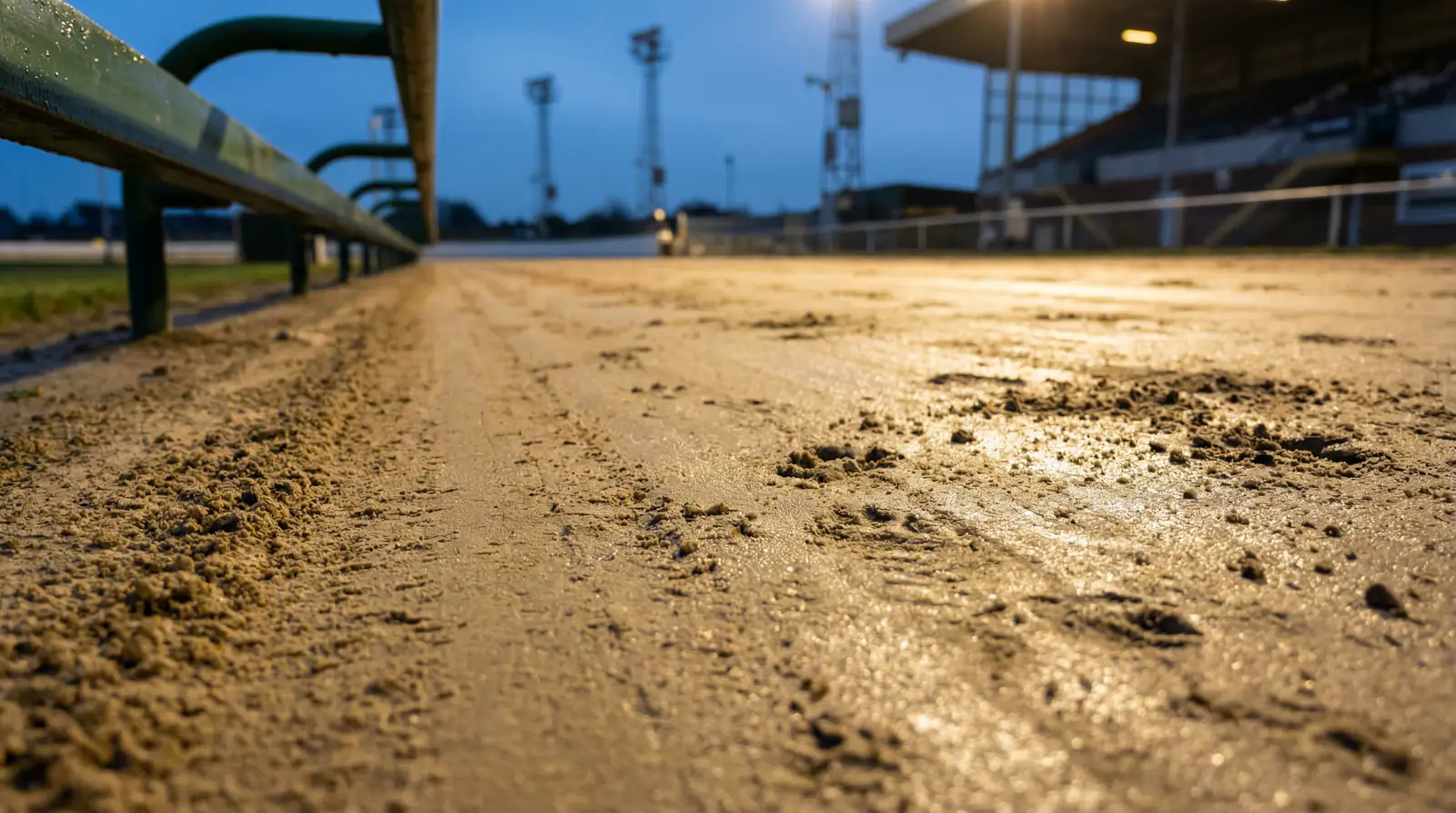
Temperature plays a secondary role. Cold winter evenings tend to produce firmer, faster surfaces, while warm summer nights can soften a sand track that has been watered. Wind direction affects early pace dynamics at exposed tracks, with headwinds into the home straight favouring strong closers over front-runners. These conditions are measurable, appear in the going report and sectional data, and ignoring them means ignoring a significant portion of what the results are trying to tell you.
The practical application is straightforward: before comparing any two results, check whether the going was similar. If it was not, adjust your expectations. A dog that looked slow on a heavy night might be perfectly capable of competitive times on standard going.
Do
- Check the going report before comparing race times from different meetings at the same track.
- Adjust time expectations when conditions shift from standard to slow or heavy — add at least 0.3 to 0.5 seconds per 480m as a rough baseline.
- Use going-specific form when assessing a dog for a meeting where rain is expected: some dogs handle wet surfaces better than others, and this shows up in their results on slow or heavy going.
- Note which dogs maintain their finishing positions regardless of conditions — consistency across different going is a strong form indicator.
Don't
- Compare times across different track surfaces directly. Sand tracks and turf tracks produce fundamentally different time ranges.
- Assume a slow time means a slow dog — the going may have been heavy, the hare slow, or the track waterlogged on the rail.
- Ignore the going when a dog's form appears to drop suddenly. A sharp decline in finishing positions after a change in conditions usually reflects the surface, not the dog's ability.
- Apply trap statistics from dry meetings to wet meetings without checking whether the bias holds in changed conditions.
From interpreting data to applying it — here is where results become decisions.
Using Results to Build a Greyhound Betting Strategy
Strategy is not picking winners — it is deciding which races to ignore. That distinction is where most greyhound bettors go wrong. The natural instinct is to find a selection in every race on the card, work through twelve races in a night, and hope that volume produces profit. It rarely does. A disciplined strategy built on results data starts with filtering: which races offer conditions that favour a confident assessment, and which races are too open, too low-grade, or too data-poor to justify a stake?
The results you have studied throughout this guide — form lines, sectional times, trap data, going reports, weight changes — are the raw inputs for this filtering process. A race where two or three dogs have clear, consistent recent form on the right going with favourable trap draws is a candidate for a bet. A race where every dog has patchy form, the going has changed, and the grade is unfamiliar territory for most of the field is a race to skip. The best greyhound punters in the UK typically bet on fewer than a third of the races they analyse.
Identifying Value From Recent Form
Value exists when the odds offered by the market are longer than the dog's actual probability of winning, as estimated by your analysis of the results data. This is not the same as finding a "good thing" — it is finding a mispricing. A dog at 4/1 that you assess as having a 30% chance of winning represents value, because the implied probability at 4/1 is 20%. A dog at 6/4 that you assess as having a 35% chance does not, even though it might well win, because the price already reflects a higher probability than your analysis supports.
Recent form is the primary tool for estimating probability. A dog that has finished first or second in three of its last four runs at the same grade, from a similar trap draw, on comparable going, is demonstrably more likely to perform well than a dog whose form reads 5643 over the same period. The further the market price strays from what the form data suggests, the greater the potential value. But form assessment is not just counting positions — it is weighting each run by its context. A "1" achieved in a weak A6 field on fast going is worth less than a "3" in a strong A3 field on slow going, even though the form line makes the first look superior.
When to Trust and When to Discount a Result
Not every result deserves equal weight in your analysis. Some results are reliable indicators of current ability; others are noise. Learning which is which is perhaps the single most important skill in greyhound form study. Results to trust include those where the dog ran its race cleanly — no in-running incidents, no trouble at bends, a clean break from the trap. Results achieved on standard going at the dog's home track in its current grade are the most reliable baseline data points.
Results to discount or at least treat with caution include first runs back from a layoff (the dog may need a race to regain sharpness), runs where the race comments note significant interference (baulked, checked, fell, or was badly hampered), runs on going that was markedly different from the norm, and runs in a grade or at a distance the dog has never tried before. A poor result under any of these conditions tells you less about the dog's ability and more about the circumstances. Conversely, a good result achieved despite a troubled run — "bumped first bend, ran on well to finish third" — may actually be more valuable than a win from the front with no trouble, because it demonstrates that the dog has the ability and the temperament to recover from setbacks.
The winter-spring transition period that UK racing is currently in brings its own layer of complexity to result evaluation. February and March meetings at outdoor tracks frequently see sharply variable going as temperatures fluctuate and rainfall patterns shift from week to week. A dog's most recent run might have been on slow going after heavy overnight rain, while tonight's surface has dried to standard. The 2026 GBGB rule amendments, which came into force on 1 January, now require Local Stewards to publish reasons for all withdrawals, giving bettors a clearer picture of non-runner decisions — useful context when a dog is suddenly scratched from a card you were planning to bet on.
FAQ: Greyhound Results and Betting
How is the forecast dividend calculated in greyhound racing?
The forecast dividend is calculated from the starting prices of the first and second-placed greyhounds using a standardised industry formula known as the Computer Straight Forecast. The formula takes the SP odds of both dogs and applies a mathematical model that accounts for the probability implied by each price. Longer-priced winners combined with longer-priced second-placed dogs produce higher dividends, while short-priced favourites finishing first and second produce lower ones. The key point for bettors is that forecast dividends are determined after the race, based on the final SP — not on any price taken earlier in the market. A reverse forecast covers both finishing orders and costs double the stake, with the dividend adjusted accordingly. The formula is applied consistently across all GBGB-licensed tracks, so the same SPs will always produce the same dividend regardless of venue.
What do the grades A1 to A10, OR, D and S mean on greyhound racecards?
Grades are the GBGB's system for sorting greyhounds into competitive bands at each track. A-grades run from A1 (the highest) to A10 (the lowest), though most tracks use a narrower range — typically A1 to A6 or A7. A dog's grade is determined by its recent race times and finishing positions at that specific track, and it can change after each race: winners are promoted, consistent losers are relegated. OR stands for Open Race, the elite tier above A-grades, subdivided into OR1, OR2, and OR3. D grades denote staying races over longer distances, while S grades indicate sprint races over shorter trips. The grade on the racecard tells you the quality band the dog is currently competing in, which is essential for contextualising its form — a dog winning at A6 is not performing at the same level as one winning at A2, even if the form line shows the same digit.
Does trap position actually affect greyhound race results?
Yes, but the effect is track-specific and condition-dependent rather than universal. Across most UK tracks at standard distances, inside traps (1 and 2) produce a slightly higher win percentage than outside traps because the inner rail is the shortest route to the first bend. However, the advantage typically amounts to a few percentage points over a large sample and is not consistent across all tracks or conditions. Some tracks have bend profiles, cambers, or hare rail positions that favour wider draws. Wet conditions can shift the bias outward as standing water collects on the inside rail. The most productive use of trap statistics is not to bet blindly on inside draws but to combine track-specific trap data with individual dog preferences — a proven wide runner drawn in trap 1 may actually be disadvantaged, while a natural railer in the same trap has an enhanced chance. The data matters, but only when applied to the specific dog and the specific track on the night.
The Line Between Data and Decision
The best greyhound punters are not the ones who study the most results — they are the ones who know which results to ignore. That distinction is worth sitting with, because it runs against the instinct that more data always means better decisions. In greyhound racing, the opposite is often true. The punters who drown in every result from every meeting, chasing patterns in noise, tend to bet too much and too often. The ones who filter ruthlessly — selecting only the races where the data is clear, the conditions are right, and the market price reflects a genuine mispricing — are the ones who stay solvent over the long run.
Everything in this guide has been aimed at building that filter. Understanding what each component of a greyhound result means, how grades shape the context of every finishing position, why trap statistics vary from venue to venue rather than applying universally, how weather and going change the reliability of time comparisons, and which bet types match which situations — all of it serves the same purpose. It turns the results page from a wall of numbers into a structured information source that supports or undermines a betting decision.
The information is there. The GBGB publishes comprehensive result data for every licensed meeting, and third-party services like Timeform add analytical layers on top. In the sport's centenary year, with 50 category one open races on the 2026 calendar and meetings running daily across the country, there is no shortage of racing to analyse. The challenge was never access to data. It was always knowing what to do with it — and, just as importantly, knowing when to do nothing at all.
Results are evidence, not instructions. The edge comes from what you don't bet on.
