

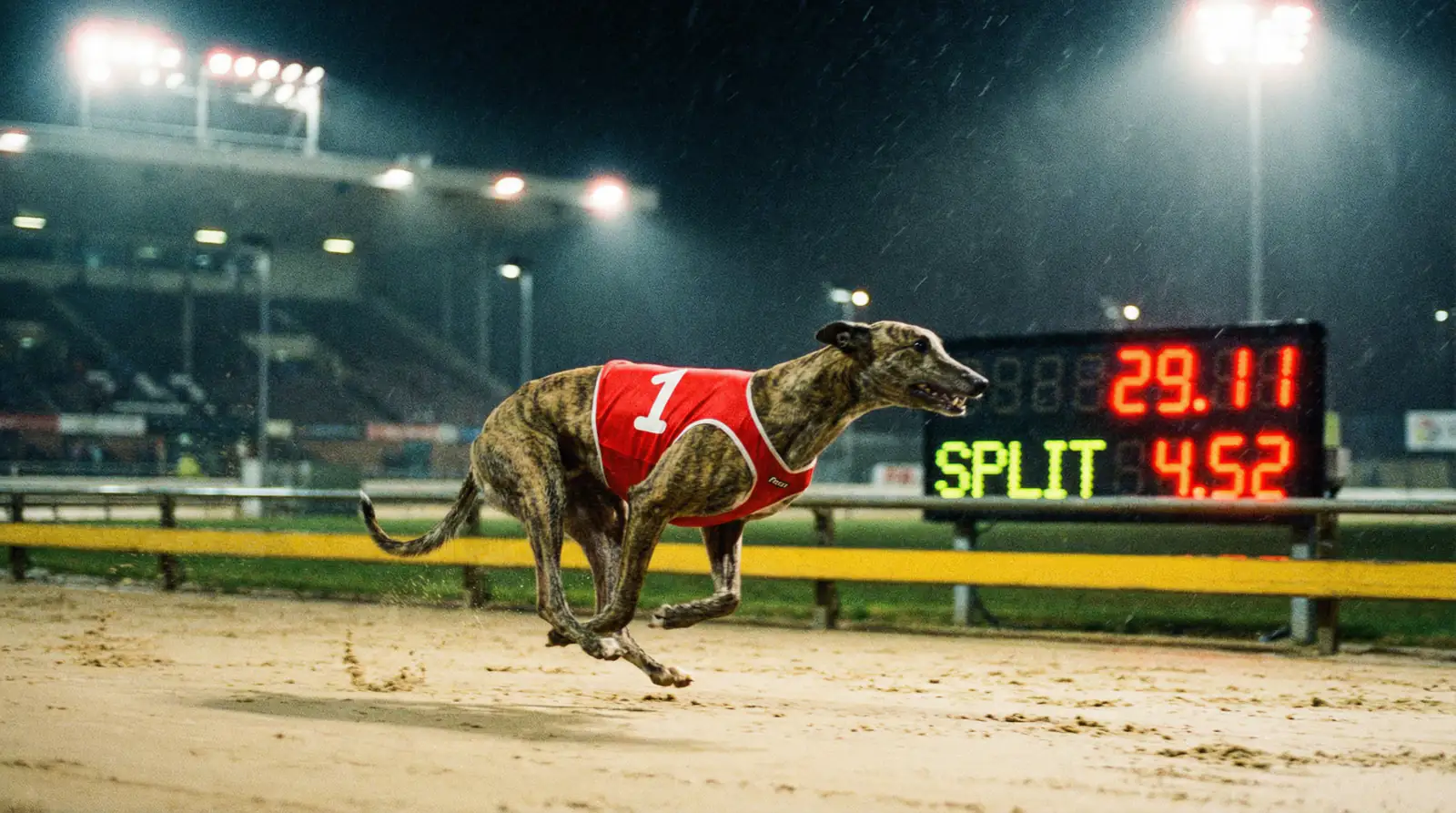
Sectional Times Strip a Race Down to Its Components
The finishing time is a summary. The sectionals are the full report. When you look at a greyhound result and see a single time next to the winner — say, 29.43 seconds over 480 metres — you get a fact but not the story. That number tells you the race happened and roughly how fast it was. It doesn’t tell you how it unfolded, where the pace was hottest, or which dog was actually travelling strongest when it mattered.
Sectional times break that single figure into its constituent parts. They record how long a dog takes to cover distinct portions of the track: the run to the first bend, the middle section through the turns, and the closing straight to the finish line. Each segment isolates a different athletic demand. The first section tests trap speed and early acceleration. The middle tests pace maintenance around bends. The final section tests closing speed, stamina and willingness under pressure.
For punters, these splits are where the real edges live. Two dogs can cross the line together and produce identical overall times, yet their sectional profiles might look entirely different — one blazing early and clinging on, the other starting slowly and powering through. The overall time treats them as equals. The sectionals tell you one of them is improving and the other is flattering to deceive. In UK greyhound racing, where six dogs are separated by margins measured in fractions of a second, that kind of detail separates punters who react to results from punters who read them.
Not every results service publishes sectional data. Timeform and some track-specific services provide split times for races at GBGB-licensed venues, though availability varies by meeting and broadcast platform. When sectionals are available, they reward close attention. When they aren’t, understanding the principles behind them still shapes how you interpret a race you’ve only seen in summary form.
What Sectional Times Measure
Each section of a greyhound race covers a distinct phase of the contest. The standard four-bend race over 400 to 500 metres is typically split into two or three sections, depending on the level of data the track provides. At a minimum, you’ll see a first-section time (from traps to the first timing point, usually around the second bend) and a run-in time (from that timing point to the finish). Some services add a middle section, giving you a three-way breakdown that offers considerably more nuance.
The key is understanding what each section rewards. The first section is dominated by trap speed: how cleanly the dog breaks, how quickly it reaches racing pace, and whether it secures a favourable early position. The final section is about finishing effort: whether the dog is sustaining its run, accelerating into the line, or beginning to tire and shorten its stride. In between, the middle section — where it exists — captures bend-running ability and pace judgement, often the least glamorous but most revealing portion of the race.
First-Section Speed and Trap Break
The first-section time is the most straightforward to interpret. A fast opening split generally means the dog broke cleanly, found room early and reached the front or a prominent position without significant interference. In sprint races over 270 to 350 metres, first-section speed is overwhelmingly the single most important performance indicator. There simply isn’t enough track left for a slow beginner to recover.
In middle-distance races, the picture is more nuanced. A dog that posts the fastest first-section time in a 480-metre race has done something significant: it’s spent energy. If it also posts the fastest overall time, that’s a strong performance. If it fades to third or fourth despite leading early, the sectional profile tells you this dog is burning out — probably running at a grade where the pace is slightly beyond its sustainable level. Conversely, a dog posting a middling first section but finishing with the fastest overall time has almost certainly produced an impressive closing split, even if you don’t see it broken out separately.
Trap break data also matters contextually. A dog drawn in trap one that posts an identical first-section time to a dog drawn in trap six has actually broken better — the inside trap has a marginally shorter run to the first bend, so the same split time from a wider draw means faster raw acceleration. These small contextual adjustments are where sectional analysis starts to separate itself from surface-level form reading.
Final Section and Closing Speed
The closing split reveals the character of the performance. A dog that records a fast final section relative to the field has been strong where others are weakening. In greyhound racing, the last 100 to 150 metres is where fatigue separates the contenders from the also-rans, and closing speed data identifies dogs that are either improving in fitness, well suited to the distance, or simply better athletes than their finishing position suggests.
This is the section where the most profitable betting information tends to hide. A dog that finishes third but posts the fastest closing split in the race has very likely encountered trouble — a blocked run on a bend, a bump at a crucial moment, or simply a poor trap draw that left it with too much ground to make up. The result says third. The sectional says it was the best dog in the race over the final third of the trip. That’s the kind of discrepancy that creates value next time the dog runs, particularly if it draws a more favourable trap or faces slightly weaker opposition.
One practical note: closing splits can be distorted by dogs that are eased down once the race is effectively decided. A dog in a clear lead approaching the line may produce a slower closing section not because it’s tiring, but because there’s no competitive stimulus to maintain full speed. This is relatively common in lower-grade races where margins between dogs are larger. Always compare the closing split against the winning margin and the position of the dog in the race at the time.
How to Compare Sectionals Across Races
Raw times mean nothing without context. A first-section time of 3.82 seconds at Romford is not comparable to 3.82 seconds at Towcester, because the tracks have different configurations, different distances to the first timing point, and different surfaces. Even at the same venue, comparing sectionals across different meetings requires adjusting for track conditions on the night. A heavy, rain-soaked surface will produce slower times across the board, and the effect isn’t uniform — wet conditions tend to slow the first section disproportionately because dogs lose traction out of the traps.
The most reliable way to use sectionals comparatively is within the same race, on the same night. Compare each dog’s first section against the field average for that race. Compare closing sections the same way. This tells you which dogs were relatively fast or slow at each phase, regardless of the absolute times. A dog posting a first section 0.15 seconds faster than the field average is a sharp breaker in that context. One posting a closing split 0.20 seconds faster than average was the strongest finisher. These relative comparisons travel better than raw numbers.
When comparing across races at the same track, the best approach is to use adjusted times. Some analysts work with a going allowance — a correction factor based on the average winning time at the meeting compared to a standard. If the average winner at a particular Monmore fixture ran 0.10 seconds slower than the standard benchmark, you’d subtract 0.10 from every time recorded that evening to get a weather-adjusted figure. This isn’t a perfect science, but it removes the worst distortions and makes weekly comparisons at the same venue considerably more meaningful.
Cross-track comparison is a rougher exercise. The most useful method is converting sectional times into a ranking — fastest 10%, top quarter, average, below average — rather than treating the actual times as directly comparable. A dog consistently posting top-10% first sections at Nottingham is a quick breaker, period. Whether its raw time translates to Romford is a separate question that depends on trap draw, track geometry and distance.
Sectionals Reveal What the Result Hides
A dog that finishes third can produce a faster closing sectional than the winner. That sentence should be the starting point for anyone who wants to bet more effectively on UK greyhound racing. Results record outcomes; sectionals record performances. The two are related, obviously, but they are not the same thing. Outcomes are affected by trap draws, interference, track position, luck at the bends and the specific dogs in the field on that night. Performance — how fast the dog actually ran through each phase — is closer to a measure of underlying ability.
Consider a practical example. A dog runs from trap six at Hove over 480 metres. It breaks level but gets squeezed wide on the first bend, losing two lengths. Through the middle section it begins to make ground steadily. Off the final bend it switches inside and closes fast, finishing half a length behind the winner in third. The result reads: third, beaten half a length, 29.61 seconds. An unremarkable result. The sectionals might read: first section 8.51 (fourth fastest), final section 10.83 (fastest in race). That closing split tells you the dog was producing the best raw speed in the field when it mattered most. Next time it draws trap two at the same track, with an unimpeded run to the first bend, the story could be very different.
Sectional analysis also identifies dogs that are beginning to tire at a particular distance. If a greyhound consistently posts fast first sections but its closing splits are deteriorating race on race, it may be better suited to a shorter trip. This kind of pattern is invisible in overall times, which average out the highs and lows, but obvious in the split data. The same logic applies in reverse: a dog whose closing sections are improving while its early speed remains steady is likely getting fitter and may be about to string together a sequence of better results.
Trainers and graders may not have access to the same sectional data you do, or they may weight it differently. This asymmetry is part of what creates betting value. A dog can be dropped a grade based on finishing positions while its sectional profile is actually improving. The grading system responds to outcomes. You can respond to performance.
The Clock Isn’t Everything — But It’s Close
Sectional data won’t give you the winner. It will tell you who’s been running better than they’ve been finishing, and in greyhound betting, that distinction is where the value sits. Backing a dog that has been unlucky — identifiably unlucky, through sectional evidence rather than wishful thinking — is one of the more reliable routes to sustained profitability in this sport.
The limitation is availability. Not every race at every meeting generates published sectional data, and when it does appear, it can lag behind the initial result. Building a sectional database for tracks you bet on regularly is time-consuming but genuinely useful. Even a simple spreadsheet tracking first-section and closing splits for a handful of regular racers at your preferred venue will, over a few weeks, start to show patterns that raw results alone would never reveal.
There’s also the question of how much weight to give sectional evidence versus other form factors. A dog posting strong closing splits consistently is a positive signal, but if it’s drawn wide on a track that heavily favours inside runners, the sectionals might not be enough to overcome the structural disadvantage. Sectional times are an input, not an answer. They add a layer of information to the form picture — a powerful layer, but one that works best alongside trap draw analysis, grade assessment and an understanding of the specific track.
If you remember one principle from this guide, make it this: the finishing position is what happened; the sectional time is why it happened. The punters who consistently find value are the ones asking why.
Get more race analysis at latestgreyhoundresults.
Explore our track stats.
