

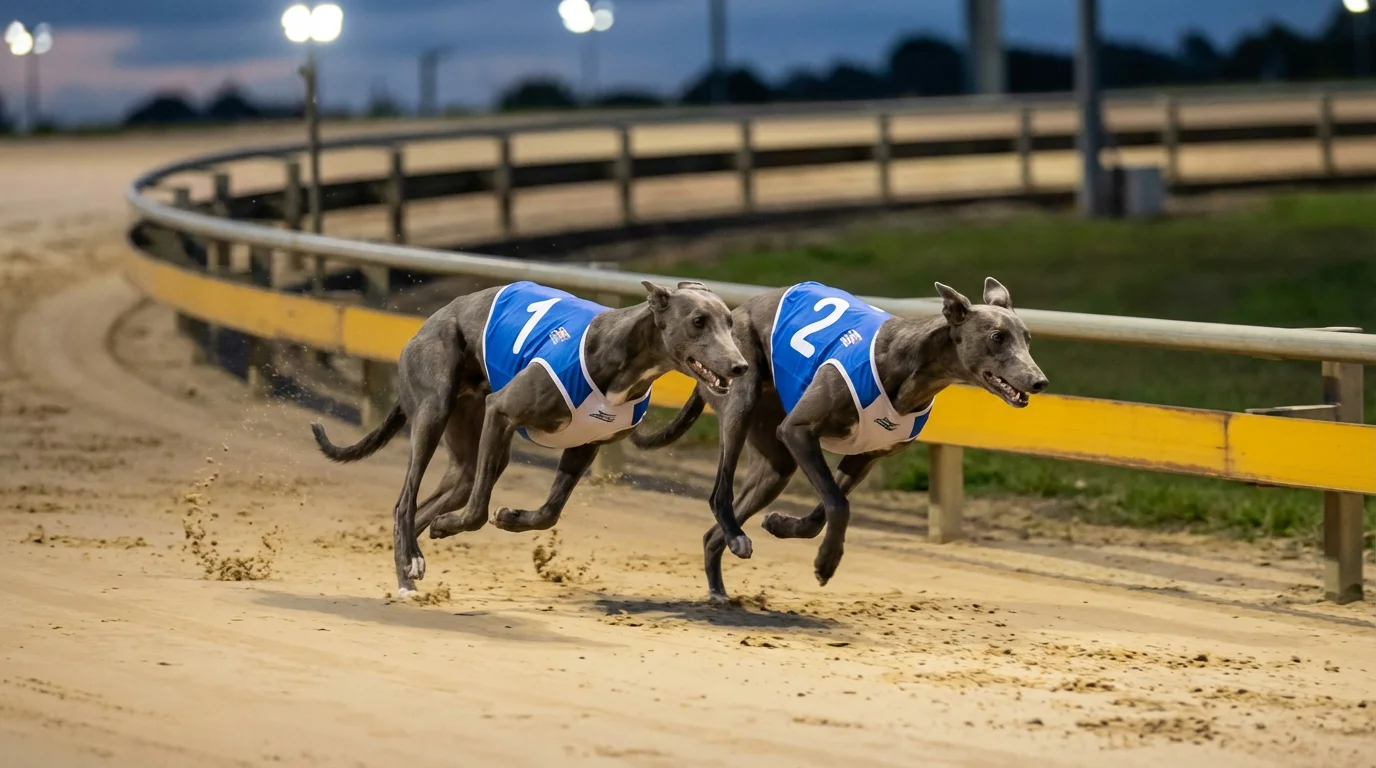
Puppy Racing Is Where Form Meets Guesswork
Puppy greyhound races feature dogs under the age of two, and the fundamental challenge they present to bettors is a shortage of reliable data. An experienced A3-graded dog might have fifty or sixty races on its form card — a detailed record of performances across different traps, tracks, conditions and levels of competition. A puppy entering its third or fourth race has almost nothing: a couple of form lines, a trial time, and whatever you can infer from its breeding and kennel.
This information asymmetry is what makes puppy racing simultaneously risky and potentially rewarding. The market is pricing dogs based on very limited evidence, which means the odds are more likely to be wrong — in both directions — than in fully graded racing. A puppy whose first two runs looked moderate might be dramatically better than those runs suggest, because it was still learning to race. Equally, a puppy that broke fast and won on debut might have been flattered by a weak field and a generous draw, and its next run could tell a completely different story.
For bettors who are comfortable with ambiguity, puppy races offer a market where independent form judgement carries more weight than it does in open races with well-established dogs. The bookmaker’s pricing is based on the same thin evidence available to everyone. If you can read that evidence more accurately — or supplement it with knowledge of the kennel, the sire line, or the trainer’s record with young dogs — you have a genuine edge. But it’s an edge built on interpretation rather than data, and that distinction matters.
The volatility of puppy racing is not a flaw in the market. It’s the product itself. Prices are wider, results are more unpredictable, and form reversals happen more frequently than in any other division of the sport. Accepting this volatility as a feature rather than a problem is the first step toward betting on puppy races effectively.
Puppy Grades and How They Differ
Puppy races at GBGB-licensed tracks are categorised separately from the standard A-grade system. The most common designations are puppy stakes, puppy cups and maiden puppy events, though the specific naming conventions vary between venues. What unites all puppy categories is the age restriction: dogs must be within 24 months of their whelping date at the time of racing. Beyond that, the structure is less uniform than the A1-to-A10 grading ladder.
At most tracks, puppy races are graded by ability within the puppy population rather than against the broader racing population. This means a puppy that looks exceptional in puppy company may still be below the standard required for even a mid-grade open event. The best puppies are fast-tracked out of puppy racing into the standard grading system, where they compete against dogs of all ages. A puppy that wins its first three puppy races convincingly will typically be moved up to A-grade racing rather than continuing to dominate the puppy division.
This fast-tracking mechanism creates a selection effect that punters need to understand. The dogs that remain in puppy races beyond their first few outings are, on average, the ones that haven’t shown enough to be promoted. There are exceptions — dogs held back by injury, late developers, or puppies that need more experience before a trainer moves them up — but the general principle holds. A puppy still competing in puppy races after eight or nine runs has probably reached a level that the trainer doesn’t consider promotion-worthy.
Maiden puppy events — races restricted to puppies that haven’t won — are the rawest division. Every runner is inexperienced, most are still learning how to race, and the results are the least predictable on any card. Maiden puppy races are where the greatest pricing errors occur, because the market is working with the absolute minimum of form data. They’re also where casual bettors are most likely to lose money, because the temptation to bet on the fastest trial time or the most impressive pedigree often overrides the reality that maiden puppies are unpredictable by nature.
Reading Limited Form in Puppy Races
When a puppy has only two or three races on its card, every piece of information carries disproportionate weight. The challenge is knowing which pieces to prioritise and which to treat with caution.
Trial times are the first data point most punters see, and they’re the most commonly overvalued. A puppy’s trial — a solo or paired run designed to assess its speed and racing style — is conducted in controlled conditions without the interference, adrenaline and competitive dynamics of an actual race. Some dogs trial brilliantly and race poorly because they lose composure in a field. Others trial modestly and race well because competition sharpens their focus. Treat trial times as a baseline, not a prediction. They tell you what the dog can do in ideal conditions, not what it will do when six dogs are jostling for position at the first bend.
The trap break is the most informative element of a puppy’s early form. How a young dog leaves the traps — confidently, hesitantly, explosively, clumsily — tends to be relatively consistent from the outset. Dogs that break well as puppies usually break well throughout their careers. Dogs that are slow away in their first few races often remain slow breakers. This means trap-break comments (QAw, SAw, MsdBrk) in a puppy’s form carry more predictive weight than finishing positions, which are more susceptible to random variation in small samples.
Running style is the second element to focus on. Does the puppy run rails, middle or wide? Does it show early pace or finish from off the speed? These tendencies crystallise quickly in a young dog’s career and tend to persist. A puppy that hugged the rail in its first two runs and led into the first bend is showing you its racing character. A puppy that sat mid-pack and closed late is showing you a different character entirely. Both are useful — but only if you match the running style to the trap draw and race conditions.
Improvement between runs is the third and most valuable signal. A puppy that finishes fourth on debut and third second time out might not look impressive in isolation, but the direction of travel is positive. More importantly, the rate of improvement in young dogs can be sharp. A half-second improvement in finishing time between a first and third race is common in puppies and would be remarkable in an experienced dog. Look for the trend, not the absolute level — and give particular attention to puppies whose closing splits are improving, as this suggests growing race fitness and confidence.
Betting on Puppies: Volatility Is the Product
Staking strategy in puppy races should reflect the elevated uncertainty. If your standard bet on a graded A-race is £10, your standard bet on a puppy race should be smaller — perhaps £3 to £5 — because the probability of your assessment being wrong is higher. This isn’t a lack of confidence; it’s an honest calibration of the information quality. You’re betting with less data, so you should bet with less money.
The most profitable angle in puppy racing is identifying dogs whose early form underestimates their ability. This happens frequently for specific, identifiable reasons. A puppy that encountered interference on its first two runs (Crd, Blk in the form comments) may have produced finishing positions of fourth and fifth despite having the speed to win. The market will price it based on those finishing positions. Your edge comes from reading the comments, recognising the interference, and assessing the dog’s true ability as higher than its results suggest.
Another productive approach is to follow specific trainers. Some kennels have a strong track record of preparing puppies effectively, producing young dogs that improve rapidly through their first few races. If a particular trainer’s puppies consistently show marked improvement between their second and fourth starts, backing their runners on their third and fourth outings can be systematically profitable. This is a kennel-level observation rather than a dog-level one, and it requires tracking results over time rather than analysing individual racecards.
Avoid the temptation to chase value on long-priced puppies in maiden races simply because the odds are attractive. A 10/1 shot in a maiden puppy race is 10/1 because nobody knows whether it can race. The price reflects genuine uncertainty, and genuine uncertainty is not the same as value. Value exists when the price is wrong relative to the true probability. In maiden puppy races, the true probability is essentially unknowable for most runners, which makes value identification unreliable regardless of the price.
Puppy Races Are the Proving Ground — for Dogs and Punters
Puppy racing sits at the frontier of greyhound form analysis. It’s where the least information is available, where prices are most likely to be wrong, and where the punters who profit tend to be those who process limited data more carefully rather than those with the most data. In that sense, it’s a test of analytical judgement rather than research volume.
The dogs that emerge from puppy racing into the senior grading system are the ones worth tracking long-term. A puppy that dominated its age group and was fast-tracked to A3 or A4 racing carries information about its ceiling that other dogs in that grade don’t provide. You know this dog was exceptional as a puppy, which gives you a baseline for assessing whether its early open form represents its true level or whether there’s more to come. Punters who follow dogs from their puppy careers into senior racing have a richer form picture than those who only pick up the form card when the dog appears on tonight’s racecard.
Treat puppy races as a learning environment. Bet small, read the form comments carefully, track the trainers, and pay attention to improvement rates rather than raw finishing positions. The dogs will develop. So will your ability to assess them — provided you approach the division with the patience and reduced stakes that its inherent unpredictability demands.
Get more betting guides at latestgreyhoundresults.
Also read our greyhound breeding and pedigree.
