

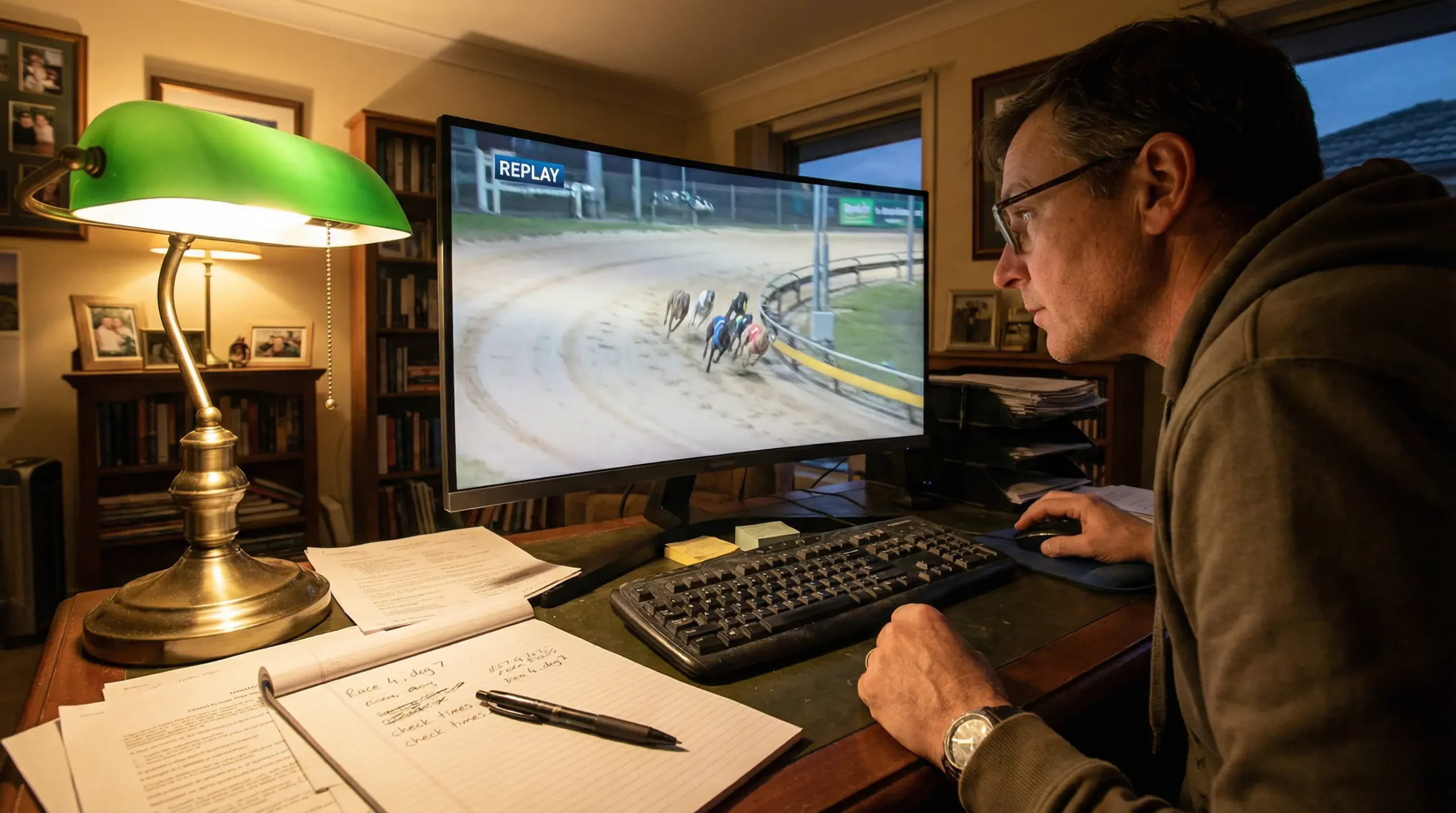
The Replay Shows What the Result Sheet Can’t
A finishing position is a verdict with no explanation. It tells you where the dog crossed the line but nothing about the journey. A replay tells the full story — the trap break, the first-bend positioning, the mid-race traffic, the closing effort — and within that story are details that the racecard abbreviations and form figures can only approximate. Punters who rely solely on results data are working with a compressed summary. Punters who watch replays are reading the source material.
The gap between result and replay is where betting value hides. A dog that finishes fourth looks like a moderate performance on the form card. But the replay might show that it was badly baulked at the second bend, lost three lengths recovering, and then closed faster than anything else in the field over the final 100 metres. That fourth-place finish, viewed through the replay, becomes evidence of a dog running significantly better than the bare result suggests. The next time this dog runs — perhaps from a better draw, on a clearer track — the market will price it based on the form figure. You’ll price it based on what you actually saw.
The reverse is equally important. A winning dog might cross the line first but do so after an uncontested lead in a race where every other runner encountered interference. The form card shows a winner. The replay shows a dog that was fortunate rather than dominant. Backing that dog at a short price next time, on the assumption that a win is a win, misses the context that the replay provides.
Replay analysis isn’t a replacement for form study. It’s an enhancement — a layer of visual evidence that sits on top of the numbers and either confirms or challenges the conclusions you’ve drawn from the data. The most effective form assessment combines both: statistical patterns identified from the form card, validated or revised by what you observe in the race footage.
Where to Find UK Greyhound Race Replays
UK greyhound race replays are available through several channels, most of them free or included with a bookmaker account. The most accessible source is the bookmaker you already use. bet365, Coral, Betfred, Ladbrokes and William Hill all provide race replays for greyhound meetings covered by SIS, which includes the vast majority of GBGB-licensed fixtures. Replays typically become available within minutes of the race finishing and remain accessible for at least 48 hours, often longer.
The Racing Post and Sporting Life websites offer replays alongside their racecard and results services. Timeform, which provides the most detailed greyhound form analysis in the UK, includes replay links integrated with its race-by-race data, allowing you to move directly from the form figures to the visual evidence. This integration is particularly useful because you can read the race comments — QAw, Crd, RnOn — and then immediately watch the replay to see whether the comment matches what actually happened. Occasionally it doesn’t, and that discrepancy is itself useful information.
Individual tracks maintain their own replay archives as well. Romford, Monmore, Hove, Crayford and other major venues publish replays on their websites and social media channels, sometimes with additional camera angles not available through the standard SIS feed. If you follow specific tracks, bookmarking the venue’s media page gives you a direct route to replays without navigating through a bookmaker or results service.
For punters who bet across multiple tracks on the same evening, the most efficient workflow is to use a results service that centralises replays from all venues — Sporting Life and the Racing Post both offer this — rather than switching between individual track or bookmaker platforms. The time saved in navigation adds up across a card of twelve or more races, and anything that makes the replay-watching process more efficient increases the likelihood that you’ll actually do it consistently rather than treating it as an occasional supplement.
What to Watch For in a Replay
Watching a replay without a specific focus is entertainment, not analysis. The dogs run, one wins, you nod and move on. Productive replay-watching requires a checklist of observations, applied systematically to every race you review. Over time, this systematic approach becomes automatic, but in the early stages, working through the list deliberately is the best way to extract actionable information from each replay.
The trap break is the first observation point. Watch the moment the traps open. Which dogs break cleanly? Which hesitate? Which stumble or drift sideways? The trap break is often the most poorly captured element in written form comments because the grader’s attention is split across six dogs in a fraction of a second. The replay lets you focus on one dog at a time, rewinding if necessary. A dog that consistently gets its front feet out cleanly and drives forward immediately is a reliable breaker. A dog that lifts its head, pauses, or gets bumped in the traps is a vulnerable starter — and that vulnerability might not be fully reflected in the form comments.
First-bend positioning is the second critical point. Watch how the dogs negotiate the first turn. Who gets the rail? Who is forced wide? Who gets squeezed between two runners? The first bend in a greyhound race is the highest-interference point, and much of the race is decided there. A dog that runs into trouble at the first bend may produce a poor finishing position that has nothing to do with its speed. The replay shows whether the trouble was caused by the dog’s own running line (a genuine weakness) or by the draw and the behaviour of adjacent runners (bad luck that may not recur).
The mid-race section — bends two through four in a standard four-bend race — is where running styles reveal themselves most clearly. Watch for dogs that maintain position effortlessly versus dogs that are working hard to hold their place. Watch for dogs that shift from the rail to the middle, or from the middle to the outside, suggesting they’re being impeded or looking for racing room. Watch for dogs that are being carried along by the pace versus dogs that are actively racing. These distinctions are difficult to capture in written form but obvious on screen.
The closing stages deserve the most careful observation. This is where you identify the dogs with the strongest finishing efforts — the ones that accelerate in the final straight, pass tiring leaders, and cross the line with momentum. A dog that finishes fourth but is visibly the fastest dog in the final 50 metres is a better prospect next time than a dog that finishes second by holding position without accelerating. The replay makes this distinction visible in a way that finishing positions alone cannot.
Finally, watch the entire field, not just the dog you backed or the winner. The most valuable replay insights often come from dogs that finished mid-pack in anonymity. A fifth-placed finisher that encountered trouble twice and still produced a competitive closing section might be the best bet on next week’s card — but only if someone watched the replay closely enough to notice.
Marking Up a Replay: Notes That Pay
Watching replays without recording your observations is wasted effort. The human memory is unreliable over the timescales that matter in greyhound form: you might watch a race on Tuesday, and the same dog might not appear on a racecard for another ten days. If you haven’t written down what you saw, the detail will have faded by the time it becomes relevant.
The most effective replay note-taking system is simple: a spreadsheet or notebook with columns for the dog’s name, the date, the track, the trap, the finishing position, and a free-text comment describing what you observed in the replay. The comment doesn’t need to be elaborate. “Baulked bend 2, strongest closer in field” is enough. “Led easily, never challenged — race looked weak” is enough. The point is to capture the key observation in a format you can retrieve when the dog appears again.
Over time, these replay notes become a personal form book that sits alongside the public data. When a dog appears on a future racecard, you can cross-reference its official form line with your own observations. If the form card says “4th, Crd 2, RnOn” and your replay note says “strongest closer in the field, would have won without the bend-2 incident,” you have a stronger basis for assessing the dog’s true ability than anyone relying solely on the published form.
The most disciplined replay analysts maintain a “tracker” list — a shortlist of dogs identified through replay analysis as running better than their results suggest. These are dogs to monitor on future racecards, with the intention of backing them when the price reflects the poor form figure rather than the actual performance you witnessed. This tracker approach turns replay analysis from a passive exercise into an active betting system, with the replay notes providing the evidence base for each selection.
One Replay Can Overturn Ten Results
A dog’s form card is a list of outcomes. A replay is the evidence behind a single outcome. And evidence, closely examined, can challenge the conclusions you’d draw from the headline figures. One hard-luck story on video — a clear run blocked, a bump at the wrong moment, a dog finishing with more speed than anything else in the race — can reframe an entire form line. The numbers say this dog is an underperformer. The footage says it’s been unlucky, and the market hasn’t noticed.
That asymmetry is the point. Replays are available to everyone, but most punters don’t watch them. They look at the form, check the price, and bet. The minority who invest twenty minutes per card watching key replays are working with richer information, and richer information — applied consistently — translates into better selections. The edge isn’t large on any single race. But compounded across hundreds of bets, the habit of watching replays separates the punters who find value from the punters who hope for it.
Find more betting tips at latestgreyhoundresults.
Also read our how greyhound handicap races work.
