

Odds Are the Language — Learn It or Lose in Translation
Every greyhound bet begins with a price, and that price is expressed as odds. In UK greyhound racing, you’ll encounter three formats: fractional (the traditional British system), decimal (used on exchanges and increasingly popular with online bookmakers), and starting price (the official settlement price determined at the off). Each format conveys the same underlying information — the implied probability of the dog winning and the return you’ll receive if it does — but they express it differently, and switching fluently between them is a basic requirement for anyone betting across multiple platforms.
The format itself doesn’t change the value of a bet. A dog at 3/1 fractional, 4.00 decimal, and an SP of 3/1 represents exactly the same proposition in each case. But the format does affect how quickly and accurately you can compare prices, calculate returns, and assess whether a bet offers value. Punters who are comfortable with only one format limit themselves to the platforms that use it. Punters who can read all three have access to every market, every exchange, and every bookmaker — and the ability to identify the best price wherever it appears.
Most UK bookmakers allow you to toggle between fractional and decimal odds in your account settings. The Betfair Exchange defaults to decimal. On-course bookmakers and traditional tote displays use fractional. Racecards published in the Racing Post and Sporting Life typically show fractional odds for forecast returns and SP data. Understanding all three isn’t optional — it’s the cost of participation in a multi-platform betting environment.
Fractional Odds Explained
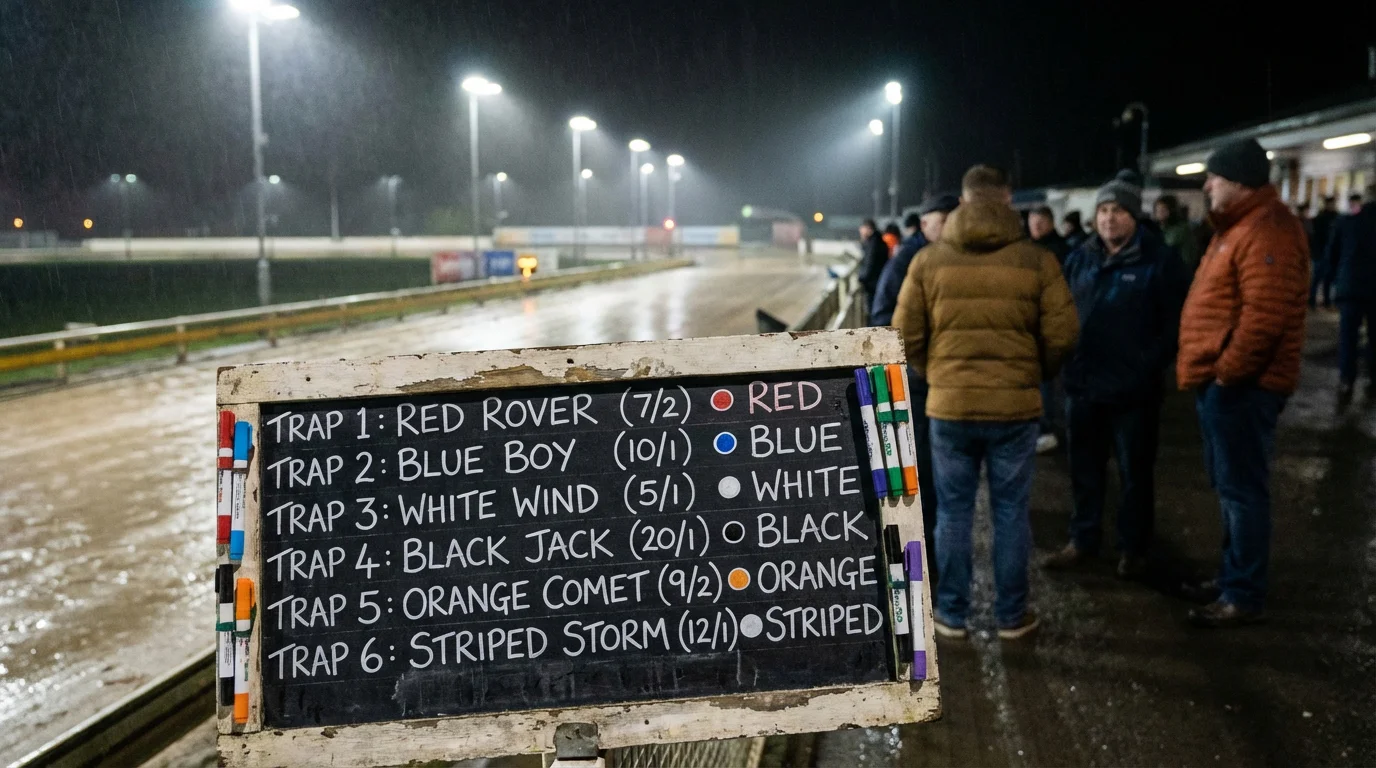
Fractional odds are the traditional format in British racing and remain the most commonly displayed system at UK greyhound tracks, in the racing press, and across high-street bookmakers. They express the profit you stand to make relative to your stake. At 3/1 (spoken as “three to one”), you win £3 for every £1 staked, plus your stake back. At 5/2 (“five to two”), you win £5 for every £2 staked. At 1/3 (“one to three” or “three to one on”), you win £1 for every £3 staked — a short price reflecting a strong favourite.
The structure of a fractional price tells you immediately whether the dog is a favourite or an outsider. When the first number is larger than the second (5/1, 7/2, 10/1), the dog is “against” — an outsider expected to lose more often than it wins. When the second number is larger (1/2, 4/7, 2/5), the dog is “odds on” — a favourite expected to win more often than it loses. Evens (1/1) is the midpoint: the dog is equally likely to win or lose according to the market’s assessment.
Calculating total returns from fractional odds requires a two-step process: multiply your stake by the fraction to get the profit, then add the stake back. A £10 bet at 7/2 returns (10 x 7/2) + 10 = £35 + £10 = £45 total. A £10 bet at 4/6 returns (10 x 4/6) + 10 = £6.67 + £10 = £16.67 total. This extra step — adding the stake back — is the main practical difference from decimal odds, where the return calculation is a single multiplication.
Fractional odds have one advantage that many experienced punters value: they express relationships between profit and risk in a way that’s intuitively graspable. “Three to one” means you risk one to win three. “Five to two” means you risk two to win five. This ratio-based thinking maps naturally onto value assessment: is this dog genuinely a 3/1 chance, or is it more like 5/2? The fractional format encourages this kind of comparative thinking more naturally than decimal odds do, though this is a matter of familiarity rather than any mathematical superiority.
Decimal Odds Explained
Decimal odds express the total return per unit staked, including the stake. A price of 4.00 means you receive £4 for every £1 wagered — £3 profit plus £1 stake. A price of 2.50 means £2.50 total return per pound: £1.50 profit plus £1 stake. The calculation is a single multiplication: stake x decimal odds = total return. No adding the stake back, no fractions, no two-step process.
This simplicity is why the Betfair Exchange and most European bookmakers default to decimal. When you’re comparing prices across multiple dogs in a six-runner race, decimal odds allow faster comparison. Is 4.20 better than 4.00? Obviously yes, by inspection. Is 17/4 better than 4/1? Same comparison, slightly slower to process because the fractional format requires conversion to a common denominator or a mental translation step.
Converting between fractional and decimal is straightforward. Divide the first fractional number by the second, then add 1. So 3/1 becomes (3 ÷ 1) + 1 = 4.00. And 5/2 becomes (5 ÷ 2) + 1 = 3.50. For odds-on prices: 4/6 becomes (4 ÷ 6) + 1 = 1.67. Going from decimal to fractional reverses the process: subtract 1, then express as a fraction. So 3.50 becomes 3.50 – 1 = 2.50, which is 5/2. The conversion becomes automatic with practice, but during the learning period, many punters keep a reference table on their phone or printed near their betting setup.
Decimal odds also make implied probability calculation trivial: divide 1 by the decimal price. A price of 4.00 implies a 25% win probability (1 ÷ 4.00 = 0.25). A price of 2.50 implies 40%. A price of 1.67 implies roughly 60%. This conversion from price to probability is the foundation of value assessment — comparing the bookmaker’s implied probability with your own estimated probability — and decimal odds make it a one-step calculation.
If you’re new to decimal odds and find fractional more natural, the recommendation is simple: switch your bookmaker account to decimal for one month. The initial discomfort fades within a few days, and by the end of the month, you’ll find yourself thinking in decimals without conscious effort. The analytical advantages — faster comparison, simpler returns calculation, direct probability conversion — are worth the short adjustment period.
Starting Price and How It Compares
Starting Price is not a format in the same sense as fractional or decimal — it’s a specific price determined at a specific moment. The SP is the price at which a dog is trading when the traps open, and it serves as the default settlement price for bets placed without taking a fixed price. If you walk into a bookmaker and say “£10 to win on trap 3” without specifying odds, your bet settles at SP. If you place an online bet and select “SP” rather than taking the displayed price, the same applies.
In traditional UK greyhound racing, the SP is determined by on-course bookmakers. A representative of the SP reporting service observes the prices offered by the on-course betting ring at the moment the traps open and calculates the industry SP — the “official” starting price used for settlement by all bookmakers. On the Betfair Exchange, a separate product called Betfair SP (BSP) is calculated using a volume-weighted algorithm based on unmatched bets at the off. The two numbers — industry SP and Betfair SP — are often similar but not identical, and each serves a different settlement purpose.
The industry SP is used for settling forecast and tricast dividends. The Computer Straight Forecast and Computer Tricast formulas both use the SPs of the placed dogs as inputs. This means the SP directly affects the size of your forecast or tricast payout, even if you took a fixed price on a win bet in the same race. Understanding this distinction matters: you might take 5/1 on your win bet and be happy with the price, but the forecast dividend is still calculated using the SP, which could be shorter or longer than 5/1 depending on late market moves.
Comparing SP with early prices reveals market dynamics. A dog that opens at 5/1 in the morning and starts at 3/1 SP has been “steamed” — money has come for it throughout the day, shortening its price. A dog that opens at 3/1 and drifts to 5/1 SP has been “friendless” — the market has moved against it. These movements carry information about where the informed money is going, and tracking SP movements over time helps identify dogs that the market consistently backs late (a sign of insider confidence) and dogs that the market consistently lets drift (a sign of indifference or concern).
The Format Doesn’t Matter — the Value Does
Whether you prefer fractional or decimal odds is a matter of personal comfort. Neither format gives you a mathematical advantage. What matters is the number behind the format — the implied probability and whether it accurately reflects the dog’s actual chance of winning.
A dog at 4/1 (5.00 decimal) is being priced at a 20% implied probability. If your form analysis suggests the dog has a 30% chance of winning, the bet has positive expected value regardless of whether you express the price as 4/1 or 5.00. The value isn’t in the format — it’s in the gap between the market’s probability estimate and yours.
The practical skill isn’t format conversion. It’s probability assessment. Can you look at a greyhound race and estimate, with reasonable accuracy, how likely each dog is to win? If you can, the odds format is just the language in which you read the market’s opinion, and you’ll spot the discrepancies — the value bets — whether the price is displayed as a fraction, a decimal, or a starting price. If you can’t make that probability assessment, no amount of format fluency will compensate.
Master one format first. Become comfortable converting to the others. Then focus your energy on what actually drives profitability: form analysis, trap assessment, conditions evaluation, and the disciplined comparison of your estimated probability with the bookmaker’s implied probability. The odds are the vocabulary. The value assessment is the argument. And it’s the argument that determines whether you win or lose.
Find more betting guides at latestgreyhoundresults.
Also read our what SP means in greyhound racing.
