

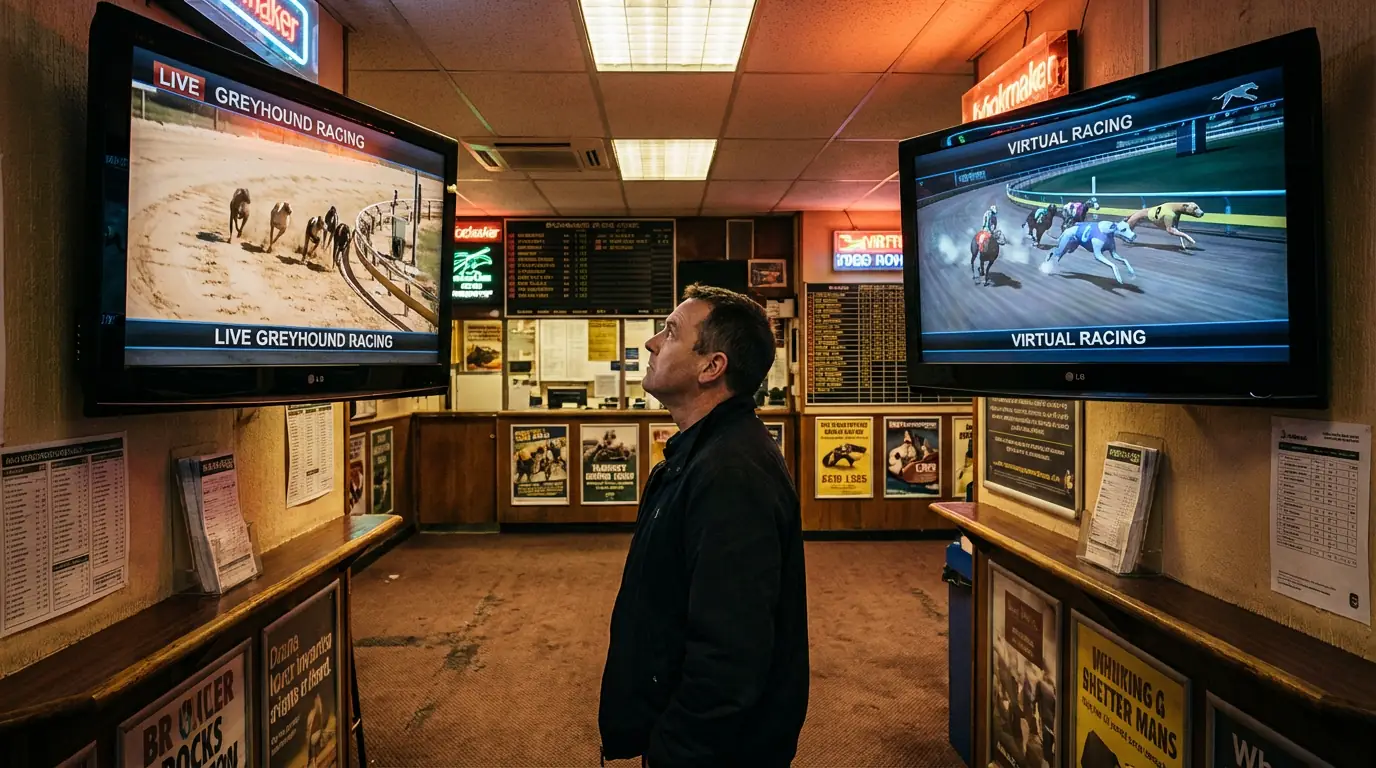
Virtual Greyhounds Look Like Racing — They Aren’t
Virtual greyhound racing is a computer-generated product available on most major UK bookmaker platforms. It looks like greyhound racing — six animated dogs break from traps, run around a track, and cross a finish line — and it’s presented alongside real racing in the bookmaker’s menu. But the resemblance is cosmetic. Virtual greyhound racing has no dogs, no track, no form, no trap bias, no weather effects and no competitive dynamics. It’s a random number generator with a visual wrapper, and understanding this distinction is essential before you place a bet on it.
The appeal of virtual racing is accessibility and speed. Virtual races run every few minutes, around the clock, with no dependence on real-world fixtures, weather or animal welfare considerations. If real greyhound racing has finished for the night and you want to keep betting, virtual greyhounds are available. If you’re waiting for the next real race in twenty minutes, a virtual race can fill the gap. This constant availability makes virtuals a revenue driver for bookmakers and a temptation for punters who find themselves with time to fill between real events.
The critical point for anyone who bets on real greyhound racing: the skills, knowledge and analytical methods that make you profitable in real racing are completely irrelevant in virtual racing. There is no form to study, no trap draw to assess, no trainer to follow, no conditions to evaluate. The outcome is determined by a random number generator (RNG) before the visual animation begins. The animation is a presentation of a pre-determined result, not a simulation of a competitive event. Watching the virtual race unfold adds entertainment value but provides zero information — the winner was decided by the algorithm before the virtual traps opened.
How Virtual Greyhound Racing Works
Virtual greyhound products are developed by specialist software companies — the most prominent in the UK market being Inspired Entertainment and Leap Gaming — and licensed to bookmakers for integration into their platforms. The software generates a random result using a certified RNG, assigns finishing positions to the six virtual runners, then renders an animation that depicts the race in a visually plausible way.
Each virtual race has a set of runners with names, trap numbers and form-like data displayed on the virtual racecard. This data — recent “results,” “ratings,” and “form figures” — is entirely fictional. It’s generated by the software to create the appearance of a form guide, but it has no predictive value whatsoever. The fictional form data does not influence the RNG outcome. Runner “Midnight Storm” with three virtual wins and a rating of 95 has exactly the same chance of winning as runner “Lucky Spark” with no virtual wins and a rating of 72 — unless the software specifically weights the RNG to favour higher-rated virtual dogs, which some products do. Even in that case, the weighting is built into the advertised odds, so no edge exists from reading the virtual form.
The odds on virtual greyhound races are set by the software, not by a market. There’s no bookmaker forming a view, no exchange matching backers and layers, no supply-and-demand dynamic. The prices are algorithmic outputs designed to produce a specific theoretical margin for the bookmaker. The overround on virtual greyhound markets — the bookmaker’s built-in profit margin — is typically higher than on real racing, often significantly so. This means the expected return per pound staked is lower in virtual racing than in real racing, even before you account for the complete absence of form-based edge.
The RNG used in virtual racing products is certified by independent testing agencies (such as eCOGRA, GLI or BMM Testlabs) to ensure randomness and fairness. “Fairness” in this context means that the outcomes are genuinely random within the parameters set by the software — it does not mean that the odds offered are fair to the bettor. The house edge is explicit and unavoidable, and no amount of study or strategy can reduce it.
Why Form Doesn’t Apply to Virtuals
The fundamental difference between real and virtual greyhound racing is the presence or absence of persistent identity. In real racing, each dog is a physical animal with consistent characteristics: a running style, a preferred distance, a trap preference, a fitness level, a weight, a trainer and a form history. These characteristics persist from race to race, creating patterns that can be analysed, predicted and profited from. A dog that runs rails in every race will probably run rails in its next race. A dog that fades in the final section has a stamina issue that will recur. These patterns are the raw material of form analysis.
Virtual greyhounds have no persistent characteristics. “Trap 3” in the 7:45 virtual race at “Romford” is not the same entity as “Trap 3” in the 7:48 race. The name on the screen might persist for a few virtual races, and the fictional form figures might suggest continuity, but the RNG generates each result independently. There is no “form” to study because there is no underlying entity whose behaviour produces patterns. Each virtual race is a fresh random event, unconnected to any previous or subsequent event.
This is why punters who try to apply real-racing analytical methods to virtuals — studying the virtual form, looking for trends, following virtual “in-form” dogs — are wasting their effort. The methods are designed to exploit persistent patterns in physical systems. Virtual racing has no physical system and no persistent patterns. The visual presentation deliberately mimics real racing to create the psychological impression that analysis is possible and worthwhile, but this impression is an artefact of the animation, not a reflection of the underlying process.
The practical takeaway is stark: there is no strategy for virtual greyhound betting. No system, no form study, no trap analysis, and no running-style assessment will produce a long-term positive return. The expected value of every bet is negative by the amount of the bookmaker’s margin, and nothing a bettor does can change this. You can win individual virtual bets through luck — the RNG will occasionally deliver results at odds that exceed the implied probability — but over any meaningful sample size, the house edge will assert itself.
The Odds Model Behind Virtual Racing
Understanding how virtual racing odds are constructed clarifies why no betting edge is possible. In real racing, odds are formed by a market — the collective activity of bookmakers, exchange users, and on-course bettors produces prices that reflect an aggregated view of each dog’s chances. This market can be wrong, and finding where it’s wrong is how punters profit. In virtual racing, odds are set by an algorithm that knows the probability of each outcome (because it controls the RNG) and applies a margin to those probabilities.
The simplest virtual racing model assigns each of the six runners an equal probability of winning (16.67%) and applies a margin of, say, 15%. This produces odds of approximately 4.33 for each runner — slightly shorter than the “fair” price of 5.00 that an equal-probability market without margin would produce. The difference between 4.33 and 5.00 is the bookmaker’s edge, and it’s unbeatable because it’s built into the mathematics of the product.
More sophisticated virtual products vary the probabilities between runners, creating a “favourite” and “outsiders” that mirror the market structure of real racing. The favourite might be assigned a 30% win probability and priced at 2.60 (implying roughly 38% after margin), while the outsider might be assigned a 10% win probability and priced at 8.00 (implying 12.5%). The margin is distributed across all runners such that the total implied probability exceeds 100%, just as in real bookmaking. But unlike real bookmaking, there’s no independent information source that can identify when the margin is applied unevenly or when a specific runner is overpriced — because the software controls both the probabilities and the outcomes.
Some virtual products use a “ratings” system where higher-rated dogs have genuinely higher RNG probabilities, and the odds reflect these ratings accurately. Even in this case, no edge exists: the ratings are known to the software, the odds are set accordingly, and no external analysis can improve on the information already embedded in the price. You’re betting against a system that has perfect information about its own outcomes.
Real Data Beats Random Numbers
If you’re reading this article as someone who bets on real greyhound racing, the message is simple: spend your time and money on real racing, where your knowledge creates a genuine edge, rather than on virtual racing, where no edge is possible. The analytical skills you’ve developed — form reading, trap analysis, conditions assessment, value identification — are valuable assets in a real-racing context. They’re worthless in a virtual one.
Virtual greyhound racing exists as entertainment, not as a betting opportunity in any strategic sense. If you enjoy it as entertainment and set a strict budget for it — the same way you might budget for a lottery ticket or a visit to a casino — there’s no harm in it. The harm comes when virtual racing absorbs time and money that would be more productively spent on real racing, where the edge you’ve worked to develop can actually translate into returns.
Real dogs run real races with real form. That form can be studied, patterns can be identified, and value can be found. None of this is true for virtual greyhounds, regardless of how convincingly the animation mimics the real thing. Keep your bankroll where your knowledge works, and treat virtual racing for what it is: a random number with pictures attached.
Get more racing guides at latestgreyhoundresults.
Also read our greyhound racing on Sky Sports.
