

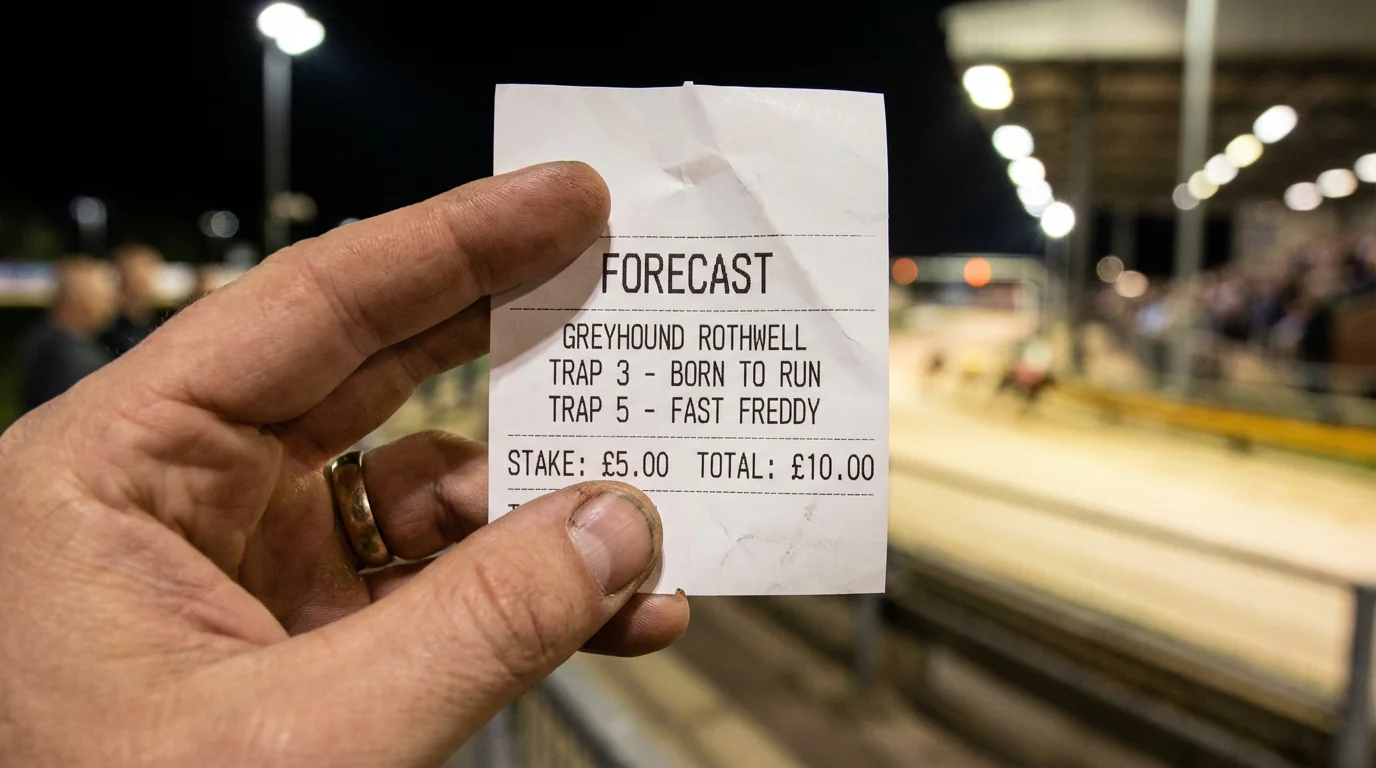
The Forecast Dividend Is Calculated — Not Chosen
No bookmaker sets the forecast price. A formula does. This is one of the most misunderstood aspects of greyhound betting. When you place a straight forecast — picking the first and second in correct order — the return isn’t determined by odds that a bookmaker has priced up in advance. It’s calculated after the race, using a mathematical formula applied to the starting prices of the dogs that finished first and second.
The system is called the Computer Straight Forecast, or CSF. It replaced the old manual method of forecast calculation decades ago and is now the standard settlement mechanism for all forecast bets in UK greyhound racing. Every bookmaker, whether high-street or online, settles forecast bets using the same CSF dividend. There’s no shopping around for a better forecast price — the number is the number, and it’s the same everywhere.
For bettors, this has significant implications. Unlike a win bet, where you can compare odds across bookmakers and take the best available price, forecast betting removes that competitive element. Your skill lies not in finding the best odds, but in identifying races where the likely CSF return offers value relative to the difficulty of predicting the exact 1-2. Understanding how the formula works helps you assess, before the race, whether a forecast bet is worth the stake. Most punters skip this step entirely and treat forecast betting as a punt. The ones who profit from it treat it as arithmetic.
The CSF formula is also the reason why forecast dividends can feel unpredictable. Two races with seemingly similar results can produce wildly different returns. A 2/1 favourite beating a 5/1 second favourite will return considerably less than a 5/1 shot beating a 10/1 outsider. The inputs are the SPs and the number of runners, and once you understand how those inputs interact, the mystery disappears and the strategic opportunities become visible.
The Computer Straight Forecast Formula
The CSF uses the SP odds of the first two home and the number of runners in the race to generate a dividend. The exact formula is complex in its full mathematical expression, but its logic is intuitive: the less likely the combination, the higher the payout.
At its core, the formula converts each dog’s SP into an implied probability, then calculates what a fair return would be for correctly predicting that specific 1-2 outcome. It factors in the number of runners because more runners means more possible finishing combinations, which makes any single combination less probable and therefore more valuable.
In a standard UK greyhound race with six runners, there are 30 possible straight forecast outcomes (6 dogs that could finish first, multiplied by 5 that could finish second). The CSF effectively calculates the probability of the specific 1-2 you’ve predicted and returns a dividend that reflects that probability after deducting a margin. This margin — built into the formula rather than set by a bookmaker — is why the CSF return is always somewhat less than a purely mathematical fair-odds payout would be.
Here’s a simplified illustration. Suppose a race finishes with the 2/1 favourite first and the 4/1 shot second. The implied probabilities (ignoring overround) are roughly 33% for the winner and 20% for the second. The combined probability of that exact 1-2 is considerably smaller than either individual probability, because you need both events to occur in sequence. The CSF formula computes this combined probability, applies its built-in deduction, and returns the dividend — typically somewhere in the region of 8/1 to 12/1 for that kind of result, depending on the exact SPs and field size.
Now consider the same race but the 10/1 outsider finishes first and the 8/1 shot comes second. Both dogs have much lower implied probabilities of winning, meaning the combined probability of that specific 1-2 is tiny. The CSF payout jumps dramatically — potentially into the 80/1 to 150/1 range. The arithmetic is doing the work. When longshots fill the first two places, the formula rewards you proportionally to how improbable that outcome was.
One detail that catches people out: the CSF is calculated to a £1 stake. The published dividend in results is what a £1 straight forecast returns. If your actual stake was different, you multiply accordingly. And because the CSF is based on SP, it doesn’t matter what early prices were available. Two punters backing the same straight forecast at different times of day, one at 10am and one at 7pm, receive exactly the same return per pound staked. The CSF doesn’t care when you bet, only what the SP was at the off.
It’s worth noting that the CSF formula includes what statisticians call an “interaction term” — an adjustment for the fact that if one particular dog wins, the probabilities for every other dog change. If the 2/1 favourite wins, the remaining five dogs are now competing for second place, and their relative chances shift compared to the pre-race market. The formula accounts for this conditional probability, which is why the CSF isn’t simply the product of the two individual SPs.
Why Some Forecasts Pay More Than Expected
When an outsider fills second, the dividend can dwarf single-bet returns. This is the mechanical truth of forecast betting, and it’s the reason experienced greyhound punters use forecasts strategically rather than casually. The CSF formula is exponentially sensitive to the SP of the second-placed dog. A short-priced runner finishing second compresses the dividend. A long-priced runner finishing second inflates it.
Think about it from a probability standpoint. If the favourite wins, that’s the most likely outcome — so the first part of the forecast equation is contributing a moderate amount to the payout. What makes or breaks the dividend is the second part: who finishes second. If another well-backed dog fills the runner-up spot, the combination was relatively predictable, and the dividend reflects that. If an unfancied outsider runs second, the combination was improbable, and the payout spikes.
This creates a practical strategy. If you have strong confidence in a particular dog winning a race but less certainty about the second-placed runner, a field forecast — your selection first, with the field to fill second — covers all five remaining outcomes. It costs five times your unit stake but gives you exposure to the upside if an outsider runs into second. The potential dividend from a 3/1 winner followed by a 12/1 second will comfortably cover the additional outlay in most scenarios.
Equally, races where the first two in the betting are significantly shorter than the rest of the field tend to produce smaller CSF dividends. If the 6/4 favourite beats the 2/1 second favourite, the forecast return might only be 5/1 or 6/1 — barely better than a win-only bet at decent odds. In races like this, a straight win bet on your preferred selection often offers better risk-adjusted value than a forecast.
The lesson is to be selective. Forecast bets offer disproportionate returns in open, competitive races where no single dog dominates the market. They offer modest returns in two-dog races where the result looks binary. Matching the bet type to the race structure is half the battle in greyhound betting, and nowhere is this more true than in the forecast market.
Forecast Value: When to Play the 1-2 Market
Forecasts reward pattern recognition more than prediction. The best forecast punters aren’t trying to nail the exact 1-2 through gut instinct. They’re identifying races with a structural setup that favours certain outcomes. Specifically, they’re looking for races where one dog is a clear standout but the second-placed finish is wide open, creating the conditions for a large CSF return if they get the winner right and an outsider fills the runner-up spot.
There are practical signals to look for. Races at smaller tracks with less competitive fields often see a single class dog dominate, while the remaining five are closely matched in ability. If you can identify the likely winner, a banker forecast (your dog first, permutated with two or three other runners to fill second) gives you a good chance at a generous dividend without requiring you to predict the exact order of the rest of the field.
Combination forecasts expand this further. Selecting three dogs and covering all six possible 1-2 permutations costs more but catches unexpected outcomes. The key is that at least one of your selections should be an outsider — a dog at a price that, if it finishes in the top two, will generate a CSF payout large enough to cover the additional stake. Three 2/1 shots permutated in a combination forecast rarely produces a dividend worth the six-unit outlay. One 2/1 shot combined with two 8/1 or 10/1 runners creates the potential for meaningful returns.
Another angle worth considering is reverse forecasts, which cover both orderings of two selections. If you think two specific dogs will fill the first two places but can’t separate them, a reverse forecast (two bets, covering both possible orders) gives you a safety net. The dividend will differ depending on which dog finishes first — because their SPs differ — but both outcomes are covered. Reverse forecasts are particularly useful in races where two dogs from the same kennel are drawn on opposite sides of the track and one is likely to benefit from a better run depending on how the race develops.
The Dividend Reflects the Market — Not the Race
A tight forecast dividend tells you the market saw it coming. A big one tells you it didn’t. This is a useful frame for interpreting forecast results after the fact, but it’s also a lens for assessing your own betting performance. If your successful forecasts consistently return small dividends, it means you’re predicting outcomes the market already rated as likely. You’re right, but so is everyone else — and the returns reflect that.
The most profitable forecast bettors over time are those whose winners include a meaningful proportion of higher-priced results. Not because they’re throwing darts at the racecard, but because they’re identifying form angles that the market hasn’t fully priced in. A dog dropping in grade after being hampered in its last two runs might return an SP of 5/1 despite being the best dog in the race on adjusted form. If it wins and a moderate outsider runs second, the CSF dividend will be substantial because the market underestimated the winner.
Keeping a record of your forecast returns is instructive. Track the CSF dividend each time you land a forecast and compare it against the average CSF for that grade and track. Over time, a positive trend — your winning forecasts paying above-average dividends — indicates you’re finding value the market is missing. A flat or negative trend suggests your selections are too obvious and the forecast market isn’t rewarding your accuracy sufficiently to overcome the losing bets.
Ultimately, the CSF formula is neutral. It doesn’t know or care about form, trap draws, or trainer patterns. It takes the SPs, runs the calculation, and produces a number. Your job as a bettor is to find races where that number, when it pays out, will be large enough to justify the frequency of your losses. That calculation happens before the race, not after. If you can’t see a path to a dividend worth chasing, the smartest forecast bet is the one you don’t place.
Find more betting guides at latestgreyhoundresults.
Also read our greyhound tricast betting guide.
