

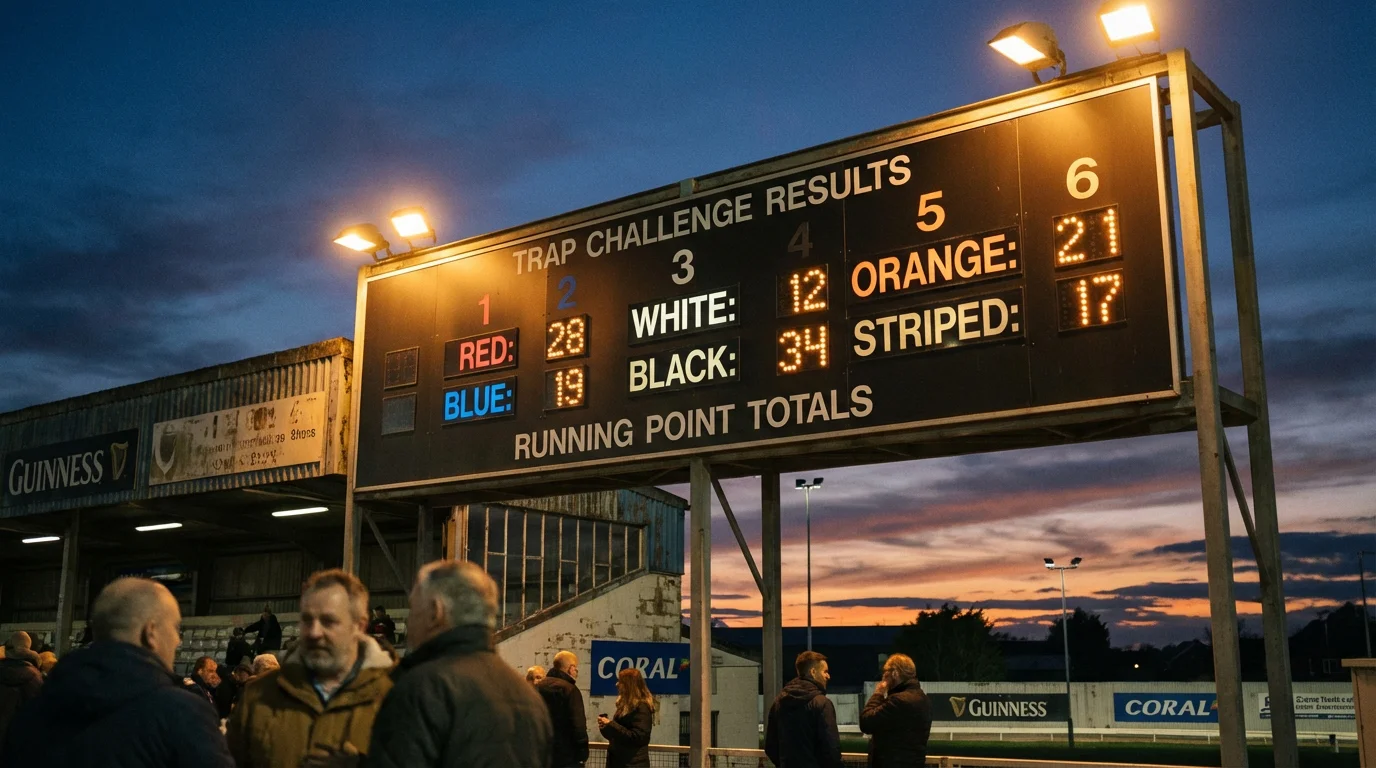
Trap Challenge Bets: One Trap, Entire Card
Trap challenges keep you in the game across an entire meeting card. Unlike standard win or forecast bets that settle after a single race, a trap challenge runs across every race at a meeting — sometimes across multiple meetings on the same day. You pick a trap number, and if that trap produces the most winners across the card, you collect. It’s a simple concept that turns an evening of greyhound racing into a single, sustained position.
The mechanics are straightforward. Most major bookmakers offer trap challenge markets on evening and afternoon cards at UK greyhound tracks. You select trap 1, 2, 3, 4, 5 or 6, and your bet settles based on which trap number produces the highest number of winning dogs across all races at the specified meeting. If your chosen trap finishes the card with the most wins, you’re paid out at the advertised odds. If two or more traps tie for the most wins, dead-heat rules apply — your payout is divided proportionally.
A typical UK greyhound meeting features between ten and fourteen races. With six traps and, say, twelve races, the average trap would produce two winners. In practice, one or two traps usually outperform the average and end the card with three or four wins. Trap challenges are essentially a bet on which trap will land in that upper band. The randomness inherent in a small sample — twelve races is not a large dataset — is what makes the bet unpredictable, but also what keeps the odds attractive. Most bookmakers price each trap at around 4/1 to 5/1, with slight variations reflecting historical track data.
The appeal of trap challenge betting is partly practical and partly psychological. Practically, it gives you a single bet that sustains interest across an entire evening without requiring you to analyse and stake on each individual race. Psychologically, it transforms every race into an event that matters to your position, even if you haven’t studied the specific dogs. Both of these qualities make trap challenges popular with punters who enjoy watching greyhound racing socially rather than studying it intensively.
How Trap Challenge Odds Are Set
Bookmakers price trap challenge markets using a combination of historical data and margin requirements. The theoretical probability of any single trap winning the most races at a meeting is approximately 16.7% — one in six — assuming no trap bias exists. In practice, track-specific biases adjust those theoretical odds, and bookmakers factor this into their pricing.
At tracks where a particular trap has a strong historical record — trap 1 at Towcester, for instance, or trap 6 at Harlow — that trap’s odds in the trap challenge market will be marginally shorter than the others. The bookmaker knows, based on years of data, that this trap wins a higher proportion of races at the venue, making it more likely to accumulate the most wins across a full card. The adjustment is typically small — perhaps 7/2 for the favoured trap versus 5/1 for the least favoured — but it reflects real data.
The overround on trap challenge markets tends to be significant. With six possible outcomes and each priced at roughly 4/1 to 5/1, the bookmaker’s margin is built into every price. This makes trap challenges structurally less favourable than individual race betting in terms of expected value. The bookmaker’s edge is higher because the market is simpler (six outcomes, one bet) and less scrutinised by professional punters, who generally focus on individual race analysis rather than meeting-wide trap bets.
Some bookmakers offer in-play trap challenge betting, adjusting odds as the meeting progresses and certain traps accumulate wins. If trap 3 wins the first two races, its in-play price shortens dramatically while the other traps drift. This in-play dimension adds a layer of tactical interest — you can wait to see how the early races unfold before committing, though the prices offered at that point will reflect the updated probabilities rather than the pre-meeting odds.
Historical Trap Performance by Track
The data behind trap challenge decisions is the same trap statistics used for individual race analysis, but applied differently. For individual races, trap statistics help you assess whether a specific dog’s draw is favourable. For trap challenges, you need the aggregate picture: which trap, across all races at a venue over a sustained period, produces the highest proportion of winners.
This is where things get interesting, because aggregate data can diverge from individual-race data. A trap might have the highest winning percentage in graded A-races at a track but underperform in sprints and stays. If the meeting card is heavy on sprints, the overall winning trap for the evening might not be the one with the best aggregate percentage. The composition of the card — how many middle-distance races, how many sprints, how many handicaps — affects which trap is likely to accumulate the most wins on any given night.
Published trap statistics from sources like OLBG and Timeform provide the raw data. These tables show winning percentages for each trap at each track, typically calculated over the current calendar year. For trap challenge purposes, the most useful figure is the absolute winning percentage rather than the percentage-point difference from expected. A trap winning 19% of races at a twelve-race meeting is expected to produce 2.28 winners — essentially two, with a decent chance of three. A trap winning 15% is expected to produce 1.8 — essentially two, with a decent chance of only one. That four-percentage-point gap doesn’t sound like much, but over many meetings, it tilts the odds.
Weather adjustments apply here too. If you’ve read the conditions and determined that wet weather tends to favour outside traps at the venue you’re betting on, the historical aggregate for traps 5 and 6 in wet conditions is more relevant than the all-weather average. Separating your trap challenge data by conditions gives you a sharper picture, though it requires either maintaining your own records or finding a data source that breaks down stats by going.
One caution: don’t extrapolate from single meetings. A trap that produces five winners at a twelve-race meeting hasn’t suddenly become the “best trap” at the venue. It’s had a good night. The statistics that matter are the ones built over hundreds of races, not the ones from last Tuesday.
In-Play Trap Challenge Strategy
The in-play trap challenge market, offered by bookmakers like Betfair and Paddy Power, introduces a tactical dimension that pre-meeting betting lacks. You can watch the first few races, assess how the card is developing, and place your trap challenge bet with more information than was available before the first race.
The basic approach is patience. Let the first two or three races run without committing. Watch which traps produce winners and, more importantly, which traps are running consistently — finishing second or third without winning. A trap that has placed in four of the first five races without winning is due for regression to the mean, and statistically it has a reasonable chance of producing a winner or two from the remaining races. The in-play price on that trap will likely be generous because the market focuses on traps that have already won.
Conversely, a trap that wins the first two races will see its in-play price collapse. The market will often overprice the probability that this trap will maintain its dominance. Two wins from twelve races puts a trap on pace for four total wins, which is well above average — but it’s also a small sample from which the market is extrapolating aggressively. If the two early winners were simply the best dogs in their respective races rather than a reflection of trap advantage, the in-play price may overestimate the trap’s chances of sustaining that rate.
The sweet spot for in-play trap challenge betting is after roughly one-third of the card has been completed. At that point, you have enough data to see emerging patterns without being so late that the prices reflect near-certainty. Look for traps that are running well (places, near-misses) but haven’t yet won, where the in-play price hasn’t shortened to reflect the underlying form. These traps offer the best risk-reward ratio: the market is undervaluing them because it’s focused on the trap that’s already on the scoreboard.
Trap Challenges Work Best as Bonus Bets
The structural overround on trap challenge markets means they are rarely the most efficient use of a betting bankroll. If your goal is long-term profitability through greyhound betting, your edge is almost certainly larger in individual race analysis — win bets, forecasts and tricasts where your form knowledge translates directly into selections — than in a meeting-wide market where the outcome is heavily influenced by randomness over a small sample.
Where trap challenges shine is as a supplementary bet that adds interest to an evening’s racing without requiring per-race analysis. If you’re already at the track or watching a full card at home, a small trap challenge stake keeps you engaged in every race even when you don’t have a strong opinion on the individual contests. Treat it as entertainment with a structural cost — similar to an accumulator — rather than a core part of your betting strategy.
The best bookmaker promotions sometimes improve the maths. Bet-of-the-day offers, enhanced odds, or money-back specials on trap challenges can tilt the value equation back in your favour. If a bookmaker is offering 6/1 on a trap that historically wins at a venue with a true probability closer to 19%, the enhanced price creates positive expected value that the standard market doesn’t offer. These promotions are the trap challenge punter’s best friend, and they’re worth monitoring even if you don’t bet the market regularly.
Keep your stakes modest and your expectations realistic. A trap challenge is a single bet on a six-way market with significant variance. It’s possible to go weeks without a winner, and the dividends when you do win are moderate rather than transformative. As an add-on to an evening’s racing, it’s enjoyable and occasionally profitable. As a primary strategy, it’s a slow way to learn that randomness over small samples is unkind to systematic bettors.
Find more betting guides at latestgreyhoundresults.
Also read our best trap statistics and analysis.
