

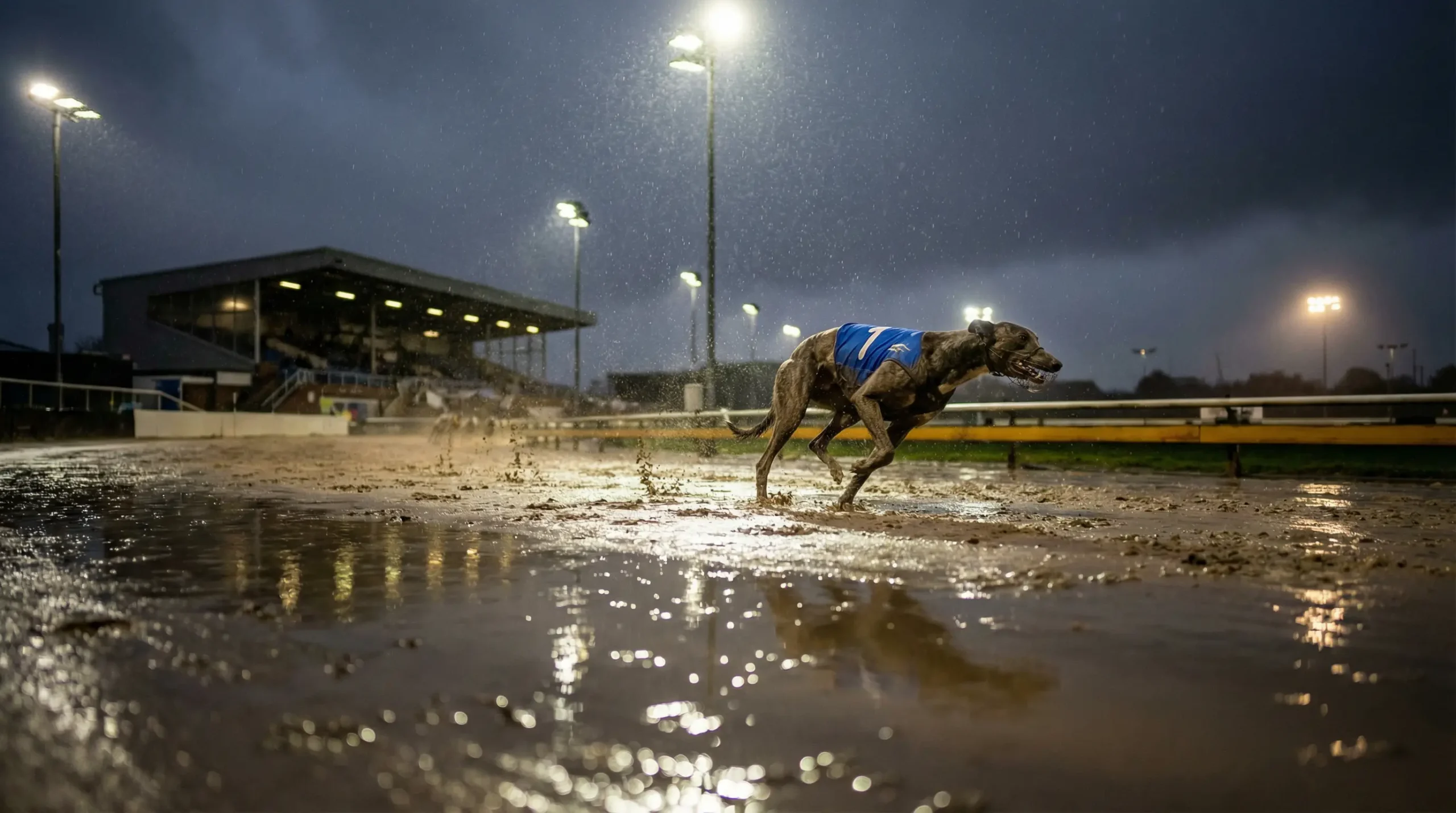
Sand, Water, and Speed — the Weather Equation
All UK greyhound racing takes place on sand, and sand behaves very differently depending on how much water it’s absorbed. This single fact underpins the entire relationship between weather and greyhound racing results. On a dry evening in July, the track is firm and fast — times are sharp, early speed is rewarded, and the form book tends to play out predictably. On a waterlogged January night, the same track becomes heavy, slow and unpredictable — grip is reduced, front-runners struggle for traction out of the traps, and dogs with stamina profiles get their chance to shine.
Understanding this dynamic isn’t optional for anyone betting seriously on UK greyhound racing. Weather conditions affect finishing times, trap biases, the relative advantage of different running styles, and the reliability of recent form as a predictor of future performance. A dog that looks unbeatable based on its last three dry-weather runs might be entirely wrong for a heavy track. A dog whose recent form looks moderate might have been running on surfaces that didn’t suit it, and a change in conditions could be the catalyst for a better performance.
Unlike horse racing, where official going descriptions are published before racing and updated through the card, greyhound racing doesn’t have a formal going classification system. There’s no “good to soft” or “heavy” call. What you get is the weather report and your own assessment — or, if you’re watching from home, the evidence of the first few races: if times are significantly slower than standard, the track is riding heavy. If they’re bang on or faster than standard, conditions are fast. This absence of a formal going report creates an information advantage for punters who track conditions independently rather than waiting for the results to confirm what the weather already told them.
Wet Track Racing: What Changes
Rain is the most significant weather variable in UK greyhound racing. When the track absorbs water, the sand becomes heavier and provides less grip. Dogs that rely on explosive acceleration out of the traps — the sharp breakers, the front-runners, the dogs that win their races in the first 50 metres — find that their biggest asset is blunted. They spin their legs slightly, lose a fraction of a second in the initial burst, and that fraction is often the difference between leading into the first bend and being second or third.
The effect is most pronounced on the inside of the track. Drainage at most greyhound venues is less efficient close to the inside rail, where the surface is lower and water tends to pool. This means the inside running line — the shortest route around the bends and the one favoured by rails runners — becomes the heaviest, most energy-sapping part of the track. Dogs drawn in traps 1 and 2, which naturally gravitate to the inside, are disproportionately affected. Their usual positional advantage is compromised by the ground they have to cover it on.
Finishing times in wet conditions can be a full second or more slower than the track standard. That sounds small, but in greyhound terms it’s substantial — equivalent to five or six lengths. And the slowdown isn’t evenly distributed across the race. The first section, where dogs are accelerating from a standing start and need maximum traction, is typically affected more than the closing stages, where the dogs are already at speed and the reduced grip has less impact on their stride.
Which dogs benefit from wet conditions? Generally, strong-running types with stamina-based profiles. Dogs that sit in behind the pace and finish powerfully are less dependent on early traction and more dependent on sustained effort — exactly what heavy ground rewards. Heavier dogs can also gain a relative advantage, as their extra mass provides more downforce on soft ground, improving grip at the expense of pure speed. This is one of the few scenarios in greyhound racing where a slight weight gain between races can be a positive rather than a concern.
One practical note: the degree of wetness matters enormously. Light drizzle that starts during a meeting will affect the later races more than the earlier ones as moisture accumulates. Persistent heavy rain throughout the day creates a uniformly heavy surface from the first race. And a track that was soaked earlier but has dried for two hours before racing will ride differently from one still being rained on. Timing matters as much as volume when assessing how wet a track actually is.
Dry and Hard Track Conditions
At the other extreme, prolonged dry weather creates a firm, fast surface that plays to a different set of strengths. On hard ground, the sand is compact, traction is high, and dogs reach top speed faster out of the traps. Finishing times drop, sometimes significantly — a dog that runs 29.60 on a standard night might clock 29.30 or quicker on a fast summer surface.
Dry conditions tend to favour the form book. Dogs with established early speed are more likely to reproduce their running style because the surface supports clean trap breaks. The predictability of race dynamics increases — front-runners lead, closers close, and the margins between dogs reflect genuine ability differences rather than surface-induced randomness. For bettors, this means your form analysis is more likely to be accurate. The dog you expect to lead probably will lead. The dog you expect to stay on probably will stay on.
The inside rail regains its advantage on dry tracks. Without waterlogging, the inside running line is the fastest route around the bends, and dogs drawn in traps 1 and 2 benefit from the shorter distance and tighter racing line. Trap statistics from dry-weather racing tend to show a noticeable inside-trap bias that isn’t present in wet-weather data. If you’re adjusting your bets for conditions, give extra credit to inside draws on firm ground and be more sceptical of them when it’s been raining.
Extremely dry conditions can occasionally create their own problems. A very hard surface is less forgiving on dogs’ joints and paws, and some greyhounds are noticeably reluctant to extend fully on tracks that feel harsh underfoot. This is difficult to spot from a results sheet alone, but if a dog that usually runs with enthusiasm produces a flat performance on an unusually hard track, fitness may not be the issue — discomfort might be. Watch for dogs that run poorly on very fast ground but bounce back on softer surfaces.
Adjusting Your Bets for Weather
The practical question for any punter: how do you turn weather knowledge into better bets? The answer is to build weather into your form assessment before you look at prices, not after.
Start by checking the forecast for the track’s location on the afternoon of racing. If rain is expected, ask three questions about each dog you’re considering. First, how does this dog break? Sharp breakers lose their edge on wet ground, while steady breakers lose less. Second, what’s this dog’s running style? Closers are relatively advantaged; front-runners are relatively disadvantaged. Third, how does this dog’s weight compare to the field? Heavier dogs may handle soft ground better, lighter dogs may struggle for grip.
Then compare the current conditions to the conditions under which each dog’s recent form was produced. If a dog’s last three strong runs all came on dry summer evenings and tonight’s card is on a soaked December track, that form is less reliable than it appears. Conversely, if a dog has been running poorly on hard ground throughout August but the first autumn rain has arrived, its recent figures might understate its ability on tonight’s surface.
Timing comparisons across conditions require adjustment. Don’t directly compare a 29.40 run from a dry night to a 29.90 run from a wet night and conclude the dog has lost half a second of speed. Compare each time against the meeting average for that night. If the average winning time on the wet night was 0.50 seconds slower than standard, then 29.90 in those conditions is roughly equivalent to 29.40 on a dry night. This adjusted time comparison is the only fair way to assess form across different conditions.
One underrated approach: watch the first two or three races of a meeting before committing your stakes for the rest of the card. The early races act as a conditions test. If times are uniformly slow, you know the track is riding heavy and can adjust your selections for the later races accordingly. If times are fast despite afternoon rain, the track has dried more than expected and the form book is more reliable. This patience costs you nothing — you skip a few races — and gains you information that the pre-meeting market hasn’t fully absorbed.
The Forecast Outside Matters as Much as the Forecast Inside
There’s an irony in greyhound betting that never quite gets old: punters will spend twenty minutes studying form, sectional times and trap statistics, then place their bet without checking whether it’s raining at the track. The weather forecast is free, available on every phone, and directly relevant to the outcome. Yet it remains one of the most consistently underused pieces of information in the sport.
Part of the reason is that weather effects are probabilistic, not deterministic. Rain doesn’t guarantee that outside traps will win. A dry track doesn’t guarantee the favourite will break cleanly and lead throughout. Weather shifts the odds — it tilts the probabilities slightly in favour of certain types of dogs and away from others. Over a single race, that tilt might not be visible. Over a full card, or a month of betting, it’s the kind of edge that separates break-even punters from profitable ones.
Specificity matters. A general “rain across the UK” headline tells you less than “persistent rain in the West Midlands from 3pm” when you’re betting on the Monmore evening card. And if you’re betting across multiple venues on the same night, remember that conditions can vary substantially. A dry evening at Romford in Essex and a wet evening at Sunderland in the North East happen simultaneously, and your approach to each card should reflect the local picture, not a national average.
Thirty seconds of weather awareness costs nothing and adjusts every form read you make for the rest of the evening. It’s the one factor the market consistently underweights, because most punters simply don’t bother to look.
Get more race analysis at latestgreyhoundresults.
Also read our greyhound sectional times explained.
