

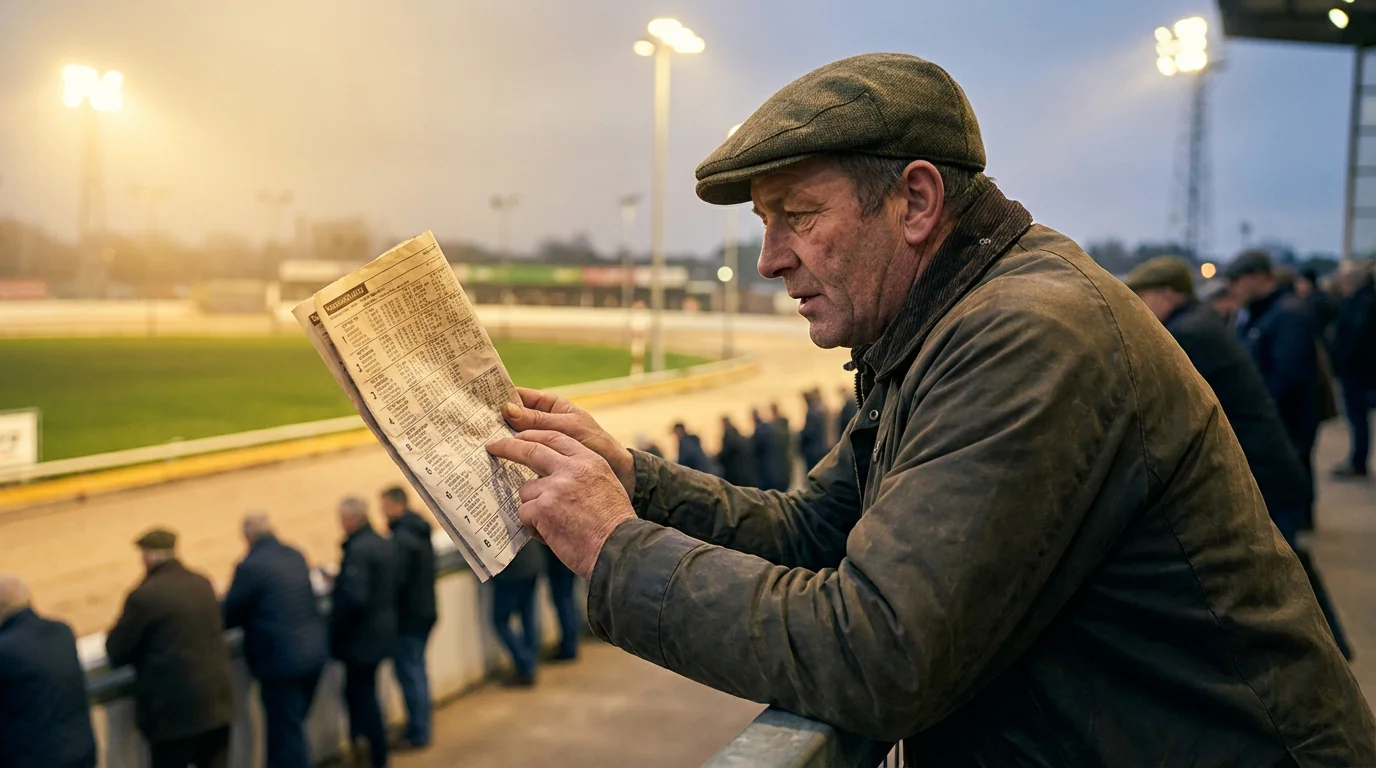
The Racecard Is a Scouting Report — Read It Like One
Everything you need to bet on a greyhound race is on the card — if you know where to look. The problem is that most people don’t. They glance at the trap draw, maybe check the last finishing position, and back whatever name sounds lucky. That’s not reading a racecard. That’s playing lottery with extra steps.
A greyhound racecard is a compressed dossier on six runners. It contains recent form, finishing times, trap records, weight data, trainer details, and enough coded shorthand to fill a codebreaker’s notebook. The information is dense because it’s meant to be. Bookmakers, professional punters, and form students all use the same card — the difference is how much of it they actually read.
This guide takes you through the UK racecard from top to bottom. Not just what each column says, but what it means — and more importantly, what it doesn’t tell you. By the end, you’ll be reading racecards the way a scout reads a player profile: systematically, critically, and with a clear idea of what you’re looking for before you start.
Every GBGB-licensed track in the UK uses a standardised racecard format. Whether you’re looking at a Monday afternoon open race at Nottingham or a Saturday evening A3 at Romford, the layout is the same. The data fields are identical. What changes is the quality of the field, the significance of the grade, and the depth of form available. Once you learn the structure, it transfers to every track and every meeting.
If you’ve ever stared at a racecard and felt like you were reading a foreign language, this is the translation guide. And if you’ve been betting on greyhounds without properly reading the card first — well, you’ve been making decisions with half the information. That ends here.
Top Section: Race Information Decoded
Before you look at a single dog, the header tells you half the story. The race header sits above the individual entries and contains the structural context for everything below. Skip it, and you’re evaluating runners without knowing what game they’re playing.
Every race header on a UK greyhound racecard includes the race number, scheduled off time, track name, distance in metres, race grade, race type, and prize money. Some sources add going reports, race conditions, or whether the event is part of a competition series. All of this matters, and it matters before you look at a single dog’s form line.
Distance, Grade & Race Type
The distance tells you the trip — and it’s always measured in metres in UK greyhound racing. Standard sprint distances are 262m, 265m, or 277m depending on the track. Middle distances run from around 450m to 500m. Staying trips go from 630m up to 900m and beyond at tracks like Towcester, which hosts hurdle races over longer distances.
Distance matters because greyhounds are specialists. A dog with excellent sprint form at 277m might struggle over 480m, and vice versa. The racecard distance tells you whether you’re looking at a pace race where early speed from the traps is decisive, or a stamina test where the dog’s ability to sustain speed into the third and fourth bends takes over. If you see a runner whose recent form is entirely over sprint trips now lining up at a middle distance, that’s a flag worth investigating.
Grade tells you the class of the race. UK greyhound racing uses an A-grade system running from A1 at the top down to A10 at the bottom, though most tracks only use a portion of that range. There are also sprint grades (D-prefix), staying grades (S-prefix), open races (OR), introductory races (IT), and puppy events. The grade on the racecard tells you how these six dogs have been grouped by the racing manager — it’s a measure of recent performance, not permanent talent. Dogs move up and down grades based on their results.
Race type adds another layer. A standard graded race means the field has been assembled by the track’s racing office based on grade and recent form. A handicap means dogs receive staggered starts to compensate for ability differences. An open race sits outside the normal grading structure and typically attracts stronger fields. Each type creates a different betting dynamic, and that dynamic starts right here in the header.
Prize Money, Track & Meeting Context
Prize money is listed in the header and, while it won’t change your form analysis, it gives you a quick read on race significance. Standard graded races at most GBGB tracks carry modest purses. Open races and competition heats carry more. The bigger the prize, the more likely trainers have specifically targeted that race — and the more likely the field represents each kennel’s best available runner at that grade.
Track and meeting context matters too. A Monday afternoon meeting at a lower-tier venue is a different animal to a Saturday evening card at a Category One track. The standard of field, the quality of the going, and the level of market attention all shift. None of this is hidden information — it’s right there in the header. But most punters scroll straight past it to look at form figures. Understanding the race before you evaluate the runners gives you a frame that makes every subsequent judgement sharper.
Individual Dog Entry: Column by Column
Fifteen columns of data, and most punters only glance at two. The individual dog entry is the centrepiece of any greyhound racecard, and it’s where the serious information lives. Each runner gets a horizontal block of data that, read properly, tells you almost everything the public record can reveal about that dog’s current form, physical condition, and suitability for the race ahead.
The layout varies slightly between providers — Timeform formats things differently to the Racing Post or SIS data feeds — but the underlying data fields are consistent. Here’s what each column actually contains and, more importantly, what to do with it.
Name, Trainer, Ownership & Runs Record
The first columns identify the dog. You’ll see the greyhound’s registered name, the trap number it’s drawn in (colour-coded: red for trap 1, blue for 2, white for 3, black for 4, orange for 5, and black-and-white stripes for 6), and the name of the trainer responsible for the dog’s preparation.
The trainer name is more useful than most casual punters realise. If you see a dog from a kennel that rarely sends runners to this track suddenly appearing on the card, it’s worth asking why. The trainer has made a deliberate choice, and that choice carries information. More on trainer patterns later — for now, note the name and move on.
Ownership details occasionally appear on extended racecards. For betting purposes, they’re less critical than trainer data, but they can signal investment level — owners running dogs at multiple Category One tracks tend to have higher-quality animals than those racing exclusively at lower-tier venues.
The runs record usually shows in shorthand: total career runs, wins, and seconds. A dog showing 45 runs with 12 wins has a win rate of roughly 27% — solid. A dog with 60 runs and three wins is a different proposition entirely. This ratio, combined with the grade, tells you whether a dog is competitive at its current level or whether it’s been placed there by a racing manager trying to find a suitable grade.
Form Figures, Finishing Positions & Trends
The form figures column is probably the single most information-dense element on the racecard, and it’s the one most often misread. It displays the dog’s finishing positions from its most recent races, typically the last six, read from left to right with the most recent run on the right.
A form line of 321141 tells you this dog finished third, then second, then first, first, fourth, and first in its last six outings. That’s useful at a glance — you can see it’s been competitive and has recent wins. But the numbers alone don’t tell you enough. What grade were those races? What distance? Were they at this track or somewhere else? Was the dog drawn on its favoured side? The form figures are a summary, not the full story.
Look for trends rather than isolated results. A sequence of 654321 might look like a dog finding form — and it might be. But it could also reflect a dog being dropped through the grades. Conversely, 112345 could be a dog losing form or one being raised in grade to a level where competition is stiffer. Context determines interpretation, and that context lives in the detailed form lines further down the card.
Letters in the form line carry specific meanings. An “F” indicates a fall. “T” means a trap-side performance (varied interpretation between providers). Characters like “-” can indicate a break between runs. Understanding these abbreviations is essential — a dog with recent form of 1F1211 has been winning frequently, but that fall might have left lingering confidence issues, particularly if it happened on a bend.
Times, Weights & Trap History
The time column shows the dog’s calculated race time for the distance, often in seconds and hundredths. These times are important, but they need to be read in context. A time of 29.45 seconds over 480m means something completely different depending on the track, the going, and the race conditions. You cannot compare a calculated time at Monmore with one at Shelbourne or even between two meetings at the same venue if the surface condition has changed.
Weight is recorded in kilograms and appears on the racecard as the dog’s race-day weight. Under GBGB rules, a greyhound can be withdrawn if its weight deviates by more than 1kg from its last recorded race weight without explanation. Weight trends matter: a dog consistently racing at 32.5kg that suddenly appears at 33.3kg might be carrying extra condition, which can slow early pace. A drop below race weight might indicate fitness issues or illness. Neither is conclusive on its own, but both are worth noting.
Trap history records show how the dog has performed from each trap position in previous races. Some dogs are strongly trap-dependent — they perform significantly better from inside draws where they can lead into the first bend, or from outside draws where they have room to run wide. The trap history column usually shows the number of wins and total runs from each trap position. If a dog has won three of its four races from trap 1 and none of its five races from trap 6, the draw for tonight’s race matters enormously. This is one of the most underused data points on the entire card.
Form Lines in Detail: The Last Six Races
The form line is a compressed narrative — every character is a plot point. Below the summary columns, most racecards include detailed form lines for each of the dog’s recent runs. This is where the real analysis begins. Each line represents a single race and typically includes the date, track, distance, grade, trap drawn, race time, finishing position, weight, going description, and a brief running comment.
Reading these lines in sequence gives you something the summary figures can’t: a story. You can see whether a dog’s improving times reflect genuine improvement or softer competition. You can track whether a change of track coincided with better or worse results. You can spot a dog that consistently runs well from one trap and struggles from another. Six lines of form, read carefully, tell you more than a hundred finishing positions listed in isolation.
The most productive approach is to read the lines chronologically — oldest first — and build a picture of where the dog has been and where it’s heading. Has it been racing frequently or returning after a break? Has the trainer moved it between distances? Has it raced at tonight’s track before? These questions have answers in the form lines, and the answers inform every subsequent decision you make about whether this dog is worth backing.
Reading Sectional Remarks & Comments
The running comment — sometimes called the race comment or sectional remark — is a brief coded description of how the dog ran its race. These comments are recorded by the judge or race analyst and follow a standardised shorthand. Phrases like “led near side,” “challenged wide third bend,” “bumped first bend,” or “always prominent” appear condensed in each form line.
These remarks matter because finishing position alone tells you nothing about how the result happened. A dog that finished third after leading until the final straight ran a completely different race from a dog that finished third after being slowly away and never getting into contention. The first dog might have been unlucky — perhaps it was headed by a faster finisher after doing all the work. The second dog might simply not have been fast enough.
Learn to read these comments as race narratives. A dog described as “mid-division, ran on” in its last three runs might be one that consistently finishes well but needs a stronger early pace to pull it into contention. A dog repeatedly noted as “led to line” is a front-runner that controls races from the front — valuable information if it draws a favourable inside trap. Comments like “crowded first bend” or “checked fourth bend” indicate trouble in running. One instance is noise; a pattern across multiple races is signal.
The sectional remarks also reveal racing styles that the bare form figures mask entirely. Two dogs with identical recent form of 211121 might have completely different running profiles — one a confirmed front-runner, the other a hold-up performer that needs to come from behind. Against each other, the race dynamic depends heavily on the pace scenario, which you can only assess by reading how each dog achieved its results.
Going, Track & Distance Indicators
Each form line records the going — the track surface condition — at the time of that race. UK greyhound tracks use sand surfaces, and conditions range from firm to soft depending on weather and maintenance. Going descriptions might appear as “normal,” “slow,” or similar shorthand.
Track and distance indicators show where each past performance occurred. This is critical for two reasons. First, times are only comparable within the same track and similar conditions. A 29.50 at Romford means nothing next to a 29.50 at Towcester — different track dimensions, different surfaces, different calculation methods. Second, some dogs have strong venue preferences. A greyhound that consistently posts its best form at Monmore Green may have something about that particular circuit — the bend profiles, the surface, the trap configuration — that suits its running style.
Distance indicators similarly flag whether a dog is racing at its preferred trip. If four of its six form lines show runs at 480m and tonight’s race is over 277m, the dog is changing its game entirely. Some dogs handle multi-distance campaigns well. Others don’t. The form lines give you the evidence to make that judgement.
Trainer Patterns & Kennel Signals
Certain trainers follow patterns so consistent you could set your watch by them. The trainer column on the racecard might look like background information, but for punters who do their homework, it’s one of the most reliable edges available in UK greyhound racing.
Professional trainers in GBGB racing operate kennels that handle multiple dogs, and each kennel develops a style. Some trainers are known for producing dogs that peak on debut at a new track — they trial extensively and only enter when they believe the dog is ready. Others rotate dogs frequently and accept that some runs are part of the preparation rather than the target. Knowing which approach a trainer takes changes how you interpret a dog’s recent form.
There are trainers with conspicuously high strike rates at certain tracks. If a kennel based in the Midlands sends a dog to a track in the South-East for the first time, that transport decision wasn’t made lightly. The entry itself is a signal. Conversely, a trainer who runs dogs at the same track week after week might be entering for the sake of keeping the dog active rather than targeting a specific opportunity.
Kennel form is also cyclical. Periods where a yard’s dogs are collectively running well — multiple winners across a meeting card, improving times across the kennel — suggest the operation is in good shape. Dogs well fed, well rested, and well prepared tend to come from the same kennel at the same time. The racecard shows the trainer name for every runner. Track that name across the full card, and you might spot that three of the evening’s six-race card features runners from the same kennel, all drawn favourably. That’s not coincidence — that’s a trainer who’s placed their team with purpose.
The detail doesn’t appear on the racecard in neon. You won’t see a column labelled “trainer intent.” But the combination of trainer name, track choice, distance selection, and trap draw — all visible on the card — gives you enough to form a view. Over time, building your own notes on trainer patterns becomes one of the most powerful tools in your armoury. The racecard gives you the raw data. The pattern is yours to recognise.
Common Racecard Abbreviations & Symbols
A lookup list you’ll want bookmarked. Greyhound racecards use a dense shorthand that’s consistent across GBGB tracks but rarely explained on the card itself. Here are the abbreviations and symbols you’ll encounter most frequently.
In the form figures column, numbers 1 through 6 represent finishing positions. “F” denotes a fall during the race — a dog that went down on a bend or in a collision. “T” or “Tn” typically indicates a trial run that didn’t count as a competitive race. “D” can indicate disqualification. A hyphen or dash usually represents a gap between racing periods, suggesting the dog had time off. “NR” means non-runner — the dog was declared but withdrawn before the race, often due to injury, season (for bitches), or weight issues.
Running comments carry their own vocabulary. “EvPc” means even pace throughout. “LED” indicates the dog led the field. “RnOn” means the dog ran on — finished strongly in the latter stages. “Crd” indicates the dog was crowded, typically at a bend. “Bmp” means bumped — contact with another runner. “SAw” means slowly away from the traps. “W” often appears as a suffix indicating a wide run, while “Rls” indicates a rails run — hugging the inside of the track.
Grade codes on racecards follow a standard system: A1 through A10 for standard distances, S for sprint grades, D for distance or staying grades, IT for introductory races, P for puppy events, and OR for open races. Handicap races are marked with an “H” prefix or noted in the race type. Each grade code immediately tells you the competitive level of the race — and therefore the standard of opposition a dog’s form has been achieved against.
Going descriptions are typically abbreviated too. “N” for normal, “Sl” for slow, and various intermediate descriptions depending on the data provider. Tracks may also record the surface condition with specific sand ratings or firmness readings on some advanced cards.
Weight is shown in kilograms, usually to one decimal place. Times are in seconds and hundredths. Distances between finishers — the official winning margin — are recorded in lengths, with standard fractions: a neck (nk), a short head (sh), half a length, one length, and so on. These distance descriptions are official measurements taken at the finish and give you a direct read on how close the race was.
No single list covers every abbreviation you’ll encounter, because some providers add their own. But the core vocabulary above covers what appears on ninety percent of UK racecards. If you hit an unfamiliar abbreviation, the context usually makes the meaning clear — and most results databases include a key or glossary somewhere in their documentation.
From Racecard to Bet: Putting It Together
The racecard gives you the raw materials. Your job is to build something from them. Everything covered so far — the race header, the dog entries, the detailed form, the trainer signals, and the abbreviation key — is useless unless you can synthesise it into an actual assessment of each runner’s chance in this specific race.
Start with elimination. Most experienced racecard readers don’t begin by looking for the winner. They begin by identifying the dogs that cannot win this race. Look for runners drawn on the wrong side — a confirmed inside runner in trap 6, for instance. Look for dogs stepping up sharply in grade with no evidence they can handle the class rise. Look for runners returning from a long absence with no trial recorded on the card. These dogs might finish, but the racecard is telling you they’re facing headwinds that make backing them a low-probability proposition.
Once you’ve narrowed the field, assess the remaining runners against the specific conditions of this race. The distance, the trap draw, the grade, the going — every piece of header information becomes a filter. A dog with strong form at this distance from this trap on similar going at this track is a different proposition from a dog with similar headline form figures achieved entirely at a different venue over a different trip.
Then look for the edge — the piece of information on the card that the market might not be pricing in. Maybe a dog has run two recent trials at this track that aren’t in its competitive form line but suggest the trainer has been preparing for this specific race. Maybe a kennel that rarely sends runners to this venue has entered tonight, suggesting confidence. Maybe a dog’s form figures look moderate, but its running comments reveal it was unlucky in three of those runs — bumped, crowded, slowly away from traps that misfired.
The goal isn’t to be right about every race. It’s to build a process that gives you better information than the average punter in the queue. The racecard is the foundation of that process. Every shortcut you take in reading it is a piece of information you’re choosing to ignore — and in a six-runner race with fine margins, ignoring information is how you lose money.
One practical habit that separates form readers from casual bettors: read the entire card before placing any bet. Don’t evaluate race one and bet, then move to race two. Read the full evening’s card first. You’ll spot trainer clusters, kennel form streaks, and dogs that look well placed in later races. You’ll also notice races where the form is too congested to separate the field — and those are the races to avoid. Betting discipline starts with the card.
The Card Doesn’t Lie — But It Does Omit
What isn’t printed on the card matters as much as what is. The racecard is a thorough document, but it’s not a complete one. It tells you what happened in a dog’s recent races. It doesn’t tell you why. And in greyhound racing, the why is often the difference between a smart bet and a wasted one.
Racecards don’t capture everything that happens in the kennels between races. A dog might have changed diet, recovered from a minor strain, or been gelded since its last run — none of which will appear on the standard card. Season information for bitches is sometimes noted but not always prominently displayed. A bitch returning from seasonal absence might be sharper than her pre-season form, or she might need a run to regain fitness. The card shows the gap, but interpretation is yours.
Track surface changes between meetings also fall outside the racecard’s scope. A track might have been resanded, watered, or affected by overnight weather between the time the card was published and the time the race goes off. Going reports issued on the day can update this, but they sit outside the racecard itself. If you’re comparing times from a dog’s last run at this track to its expected performance tonight, and the surface has changed, those times might mislead you.
Race replays fill some of these gaps. A dog’s running comment might say “checked third bend,” but the replay shows exactly how severe the interference was. A form figure of 4 tells you the dog finished fourth; the replay shows whether it was a beaten dog fading out of contention or an unlucky runner that lost three lengths to a bump and then closed ground impressively into the finish. The racecard points you towards the question. The replay answers it.
The most honest thing to say about any racecard is that it’s the best publicly available starting point for analysing a greyhound race — and it should always be treated as a starting point, not an endpoint. Combine it with going reports, race replays, trainer intelligence, and your own accumulated knowledge of the track, and you have a genuine analytical toolkit. Rely on it alone, and you’ll always be working with slightly less than the full picture. But slightly less than the full picture, read carefully, still puts you ahead of almost everyone else in the queue.
Find more racing guides at latestgreyhoundresults.
Also check our greyhound form abbreviations guide.
