
Accumulators Multiply Everything — Odds and Risk
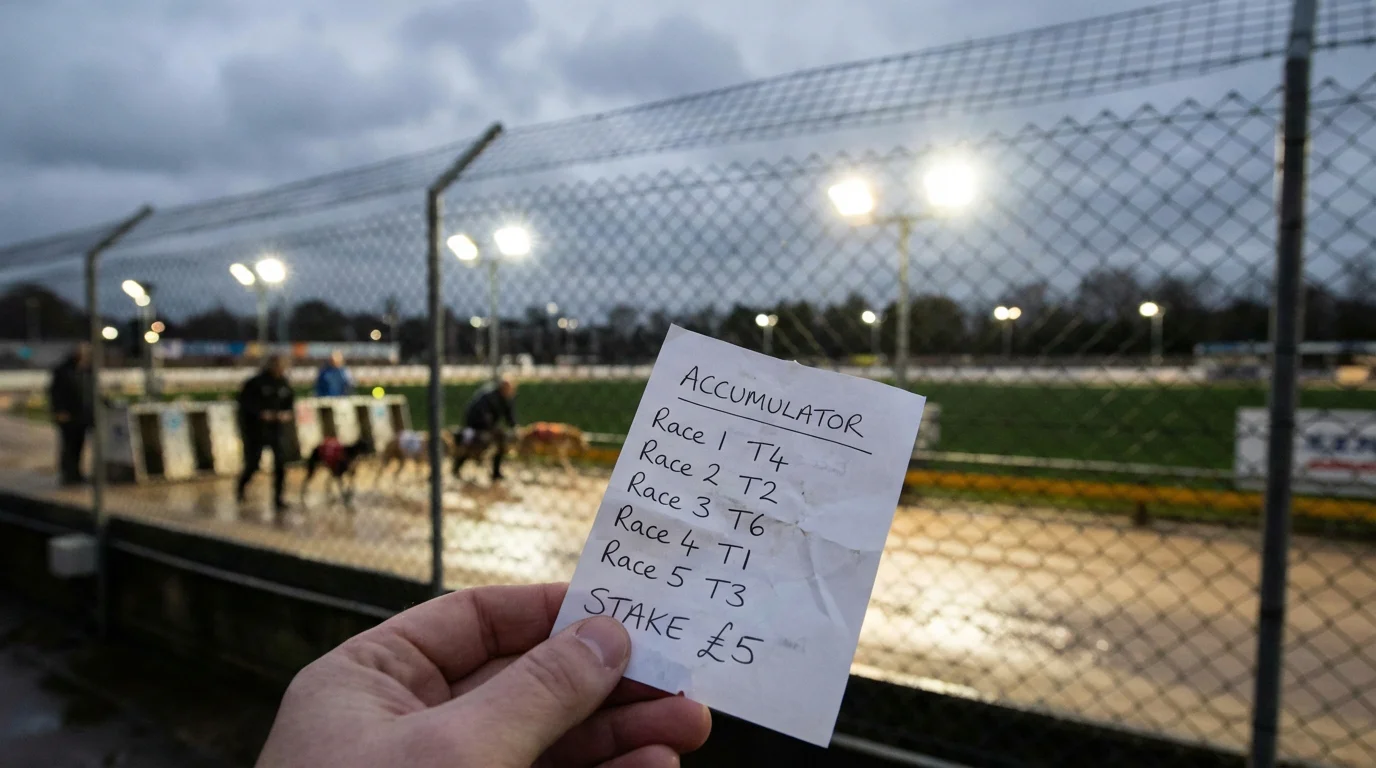
An accumulator is a single bet that links multiple selections together, with the winnings from each selection rolling into the stake on the next. The appeal is obvious: modest stakes can produce large returns because the odds multiply with every leg. A four-fold accumulator on four dogs at 2/1 each returns 80/1 — an £80 profit from a £1 stake. That kind of return is impossible from single bets at the same prices, and it’s the multiplication effect that makes accumulators one of the most popular bet types in greyhound racing.
What the headline return conceals is the probability. Four selections at 2/1 each imply a roughly 33% win probability per leg. The probability of all four winning is 33% multiplied four times: approximately 1.2%. You’re taking a bet that wins about once in every 83 attempts. At £1 per attempt, you’d spend £83 to win £80 — which means the expected value is marginally negative before bookmaker margins are even considered. Add the overround on each individual selection and the expected value deteriorates further.
This isn’t an argument against accumulators. It’s a statement of what they are: high-variance entertainment bets that trade probability for spectacle. The punter who backs four singles at 2/1 will, over time, generate more reliable returns than the punter who rolls them into a four-fold. But the punter backing singles will never experience the adrenaline of watching the fourth leg win and collecting 80/1 from a pound coin. Both experiences have value. The mistake is confusing one for the other — treating accumulators as a route to sustained profit rather than an occasional high-risk, high-reward play.
Greyhound racing is particularly suited to accumulator betting because of the frequency of racing. With meetings running afternoon and evening across multiple UK tracks, you can construct accumulators from a single venue or across several venues within the same time window. The density of available races means you’re rarely short of legs to add, which is both the opportunity and the danger: the temptation to add a fifth or sixth selection to a bet that was already speculative at four legs.
Doubles, Trebles and Four-Folds Explained
Accumulators come in specific sizes, each with its own name. A double links two selections. A treble links three. A four-fold links four, and so on up through five-folds, six-folds and beyond. The mechanics are identical in each case: the return from the first selection becomes the stake on the second, and so on through the chain. If any single selection loses, the entire accumulator loses.
Doubles are the most conservative form of accumulator. Two selections, two opportunities for failure. If both dogs are priced at 2/1, the double returns 8/1 — a meaningful uplift from the individual prices without the extreme improbability of larger accumulators. The probability of a 2/1 double landing is roughly 11%, which means you’d expect it to win about one in nine times. That’s speculative, but it’s within the bounds of a reasonable betting frequency. A punter who places ten doubles a week at £2 each can absorb the losses between winners without destroying their bankroll.
Trebles push the probability further. Three selections at 2/1 each return 26/1, with a win probability of approximately 3.7% — roughly one in 27 attempts. The returns are attractive enough to justify small stakes, but the failure rate is high enough that losing runs of 30 or 40 attempts are well within the range of normal variance. If you’re not prepared for extended dry spells, trebles will test your patience before they test your form analysis.
Four-folds and beyond enter genuinely speculative territory. The maths of multiplied probabilities means that every additional leg roughly halves the chance of the accumulator landing while roughly doubling the potential return. This ratio — double the reward for half the probability — sounds fair, but it’s illusory. The bookmaker’s margin on each leg compounds through the accumulator just as the odds do. By the time you reach a six-fold, the cumulative overround can represent a significant hidden cost that makes the bet structurally unfavourable regardless of your form analysis.
Building a Greyhound Acca: Selection Criteria
If you’re going to bet accumulators on greyhounds, the selection process matters more than in any other bet type — precisely because each weak selection compounds the damage to your overall probability. A four-fold where each selection has a 40% true win probability is a fundamentally different bet from a four-fold where each selection has a 25% true win probability, even if the prices are similar.
The first criterion is reliability. Accumulator legs should be selected from dogs with consistent form profiles — animals that reproduce their performance pattern race after race. A dog that has won three of its last five races from a favourable trap draw, running the same style each time, is a better accumulator leg than a dog with one brilliant win and four moderate efforts. The brilliant win might reflect the dog’s peak ability, but the inconsistency makes it a poor candidate for a bet type that requires every leg to win.
Trap draw is the second filter. Dogs drawn in their preferred trap position — a confirmed inside runner in trap 1 or 2, a wide runner in trap 5 or 6 — are more likely to reproduce their form than dogs drawn in unfamiliar positions. In accumulator betting, where one failed leg kills the entire bet, minimising avoidable risk on each leg is essential. A strong dog in a bad draw is a poor accumulator selection even if it would be a reasonable single bet.
Grade and class provide the third filter. Dogs that are well placed in their current grade — perhaps recently dropped after an unlucky run, or consistently competitive without being overmatched — represent more reliable selections than dogs stepping up in class or returning from breaks. Upward grade moves and comebacks introduce uncertainty, and uncertainty is the accumulator’s enemy.
Timing is the final consideration. If you’re building an accumulator across an evening card, consider the sequencing. Place your most confident selection in the first leg and your least confident in the last. This isn’t superstition — it’s practical. If the first leg loses, you know immediately that the accumulator is dead and you can redirect your attention. If the first three legs win and the fourth is a marginal selection, you can hedge on the exchange (laying the final dog to lock in a profit regardless of the result) rather than riding the full variance of the final leg.
Named Combination Bets in Accumulators
Beyond simple accumulators, bookmakers offer named combination bets that package multiple accumulators and singles into a single wager. These bets are designed to provide returns even when not every selection wins — a safety mechanism that pure accumulators lack.
A Trixie covers three selections in four bets: three doubles and one treble. If two of your three selections win, you collect on one double. If all three win, you collect on three doubles and the treble. The Trixie costs four times your unit stake (four separate bets), but it eliminates the all-or-nothing risk of a straight treble. The trade-off is reduced maximum returns — the treble component of a Trixie pays the same as a standalone treble, but the total stake is four units rather than one.
A Patent covers three selections in seven bets: three singles, three doubles and one treble. This is the most conservative combination bet for three selections — even a single winner produces a return, provided the odds are sufficient to cover the seven-unit stake. Patents are expensive (seven times your unit stake) but they provide a return from any winning selection, making them suitable for punters who want accumulator exposure without the high attrition rate.
A Yankee covers four selections in eleven bets: six doubles, four trebles and one four-fold. Two winners are needed for a return. A Lucky 15 covers the same four selections in fifteen bets, adding four singles to the Yankee structure — guaranteeing a return from a single winner. Bookmakers frequently offer bonuses on Lucky 15 bets, such as double odds for a single winner or a bonus percentage if all four selections win. These promotions can shift the expected value of a Lucky 15 into positive territory when normal accumulator maths would be negative.
The naming conventions extend further — Lucky 31 (five selections, 31 bets), Lucky 63 (six selections, 63 bets) and so on — but the principle is the same throughout: more bets means more cost, more coverage and a lower threshold for generating some return. For greyhound betting, Trixies and Yankees on three or four carefully selected dogs offer a practical middle ground between the all-or-nothing drama of a straight accumulator and the expense of full-cover bets.
Accas Are Entertaining — Treat Them That Way
The honest assessment of accumulator betting in greyhound racing is this: it is structurally disadvantageous for the bettor. The compounding of bookmaker margins across multiple legs, combined with the compounding of failure probabilities, means that accumulators have a lower expected value than the equivalent selections placed as singles. No amount of form analysis changes this structural reality. What form analysis can do is improve the probability of each individual leg, which in turn improves the probability of the accumulator landing — but the gap between accumulator EV and single-bet EV remains.
Treat accumulators as a defined portion of your betting activity — an entertainment line within your bankroll rather than a profit-generation strategy. A common approach among disciplined punters is to allocate 5% to 10% of their weekly betting budget to accumulators and keep the rest for singles, forecasts and other bet types where the structural maths are more favourable. This gives you the excitement of accumulator betting — the Friday-night four-fold, the weekend treble — without exposing your core bankroll to the high attrition rate.
When you do land a winner, the return will feel disproportionate to the stake, and that’s the entire appeal. Enjoy it. Just don’t let a winning accumulator convince you that accas are the optimal strategy. The maths hasn’t changed — you’ve experienced the positive end of the variance distribution, and the negative end is larger and more frequent. A winning accumulator is a good night. A good strategy is something you can repeat profitably over months and years, and that strategy is built on singles, disciplined staking and form-led selection — not on hoping that four dogs all win in sequence.