
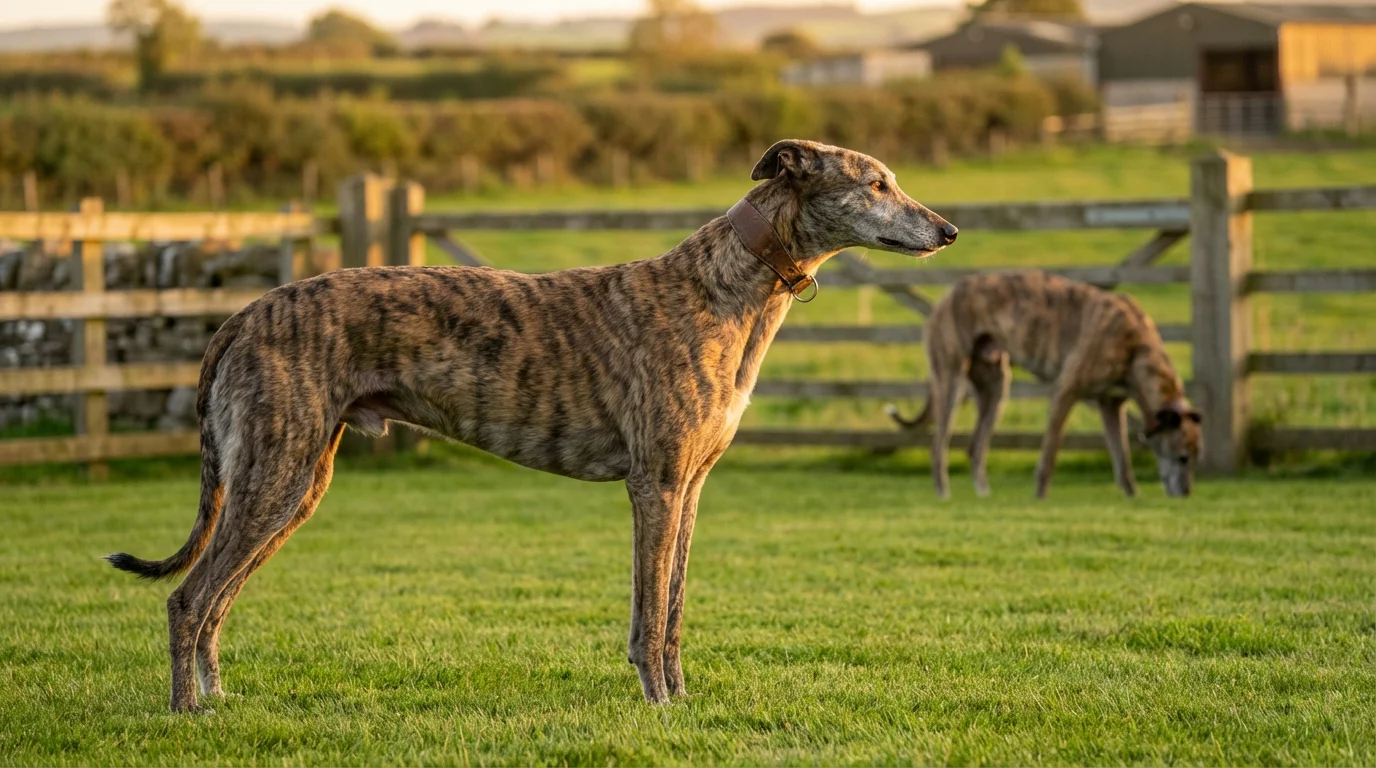
Bloodlines Shape Potential — They Don’t Guarantee It
Every racing greyhound carries a pedigree — a record of its sire (father), dam (mother) and extended family going back several generations. In the breeding industry, pedigree is everything: it determines a dog’s commercial value, its placement with trainers, and the expectations attached to it before it ever enters a trap. In the betting market, pedigree is something less certain. It tells you about potential and predisposition, not about the dog that’s actually standing in the trap tonight.
The tension between breeding potential and racing reality is the central question for any bettor considering pedigree data. A dog from an elite sire line carries the genetic capacity for speed, stamina, jumping ability and racing temperament — but so do its dozens of siblings, most of whom will never reach the top of the grading system. Pedigree creates a range of possible outcomes. Training, health, temperament and luck determine where within that range an individual dog ends up.
For bettors, pedigree is most useful at the margins — when other form data is limited or inconclusive. A puppy making its third career start has too little form to make a confident assessment. But if it’s sired by a dog whose offspring consistently show strong closing speed and develop into stayers, that information helps you assess which races and distances are likely to suit it as its career progresses. Pedigree fills in the gaps that limited form data leaves open, particularly in the early stages of a dog’s career.
How Sire and Dam Lines Influence Racing Ability
Greyhound genetics influence racing performance through multiple channels. Speed — the raw ability to cover ground quickly — is highly heritable. Dogs from sire lines with a track record of producing fast runners are more likely to produce fast offspring than dogs from slower lines. Stamina, the ability to maintain speed over longer distances, is also heritable but less predictably so: a sprinting sire can produce staying offspring if the dam line contributes stamina genes, and vice versa.
The sire’s influence on the offspring population is more visible than the dam’s, simply because individual sires produce many more racing offspring than individual dams. A popular stud dog might sire two hundred or more puppies in a single year, providing a large enough sample to identify statistical patterns in his offspring’s racing careers. A dam typically produces one or two litters of six to ten puppies across her breeding career, making it harder to draw firm conclusions about her genetic contribution.
Certain sire lines have become dominant in UK and Irish greyhound racing over the past decade. Dogs tracing back to these sire lines appear on racecards with high frequency, and their characteristics — early speed, running style, distance preferences — tend to cluster within the line. A dog from a sire line known for explosive trap speed is more likely to be an early-pace runner than a closer. A dog from a line known for stamina is more likely to excel over staying distances. These tendencies are statistical, not deterministic, but they provide a useful starting framework when assessing dogs with limited racing form.
The dam’s contribution, though harder to measure statistically, is equally significant genetically. The dam contributes half the offspring’s DNA and, through mitochondrial inheritance, passes on energy-production characteristics that affect stamina and recovery. Experienced breeders look at both the sire and dam records when assessing a litter’s potential, and bettors who incorporate dam-line analysis — particularly when the dam herself was a notable racer or a producer of multiple successful offspring — gain an additional layer of pedigree insight.
Breeding Trends in UK Greyhound Racing
The UK greyhound racing population is drawn from a relatively narrow genetic base. A small number of elite sires dominate the breeding landscape, and their influence is visible across racecards at every GBGB-licensed venue. This concentration of bloodlines has practical implications for bettors: once you learn the characteristics associated with the major sire lines, you can apply that knowledge to a significant proportion of dogs you encounter on any given racecard.
Irish-bred greyhounds dominate UK racing. The majority of dogs racing at British tracks were bred in Ireland, where the greyhound breeding industry is substantially larger and more commercially developed than in the UK. Irish breeders supply puppies to British trainers, and the quality of Irish breeding stock — supported by a deeper pool of stud dogs, more extensive pedigree databases and a larger racing population — has maintained Ireland’s position as the primary source of racing talent for the UK market.
Breeding trends shift over time as new sire lines emerge and older ones fade. A sire that dominates for three or four years may see his influence decline as his offspring age and his stud career winds down, replaced by a younger dog whose first crop of runners demonstrates superior racing ability. Tracking these generational shifts is mainly of interest to breeders and long-term pedigree analysts, but even casual followers of greyhound racing will notice when a new sire line begins to appear with increasing frequency on racecards, often accompanied by a distinctive running style or distance preference that marks the line out from its predecessors.
One practical trend worth noting: the influence of Australian and American bloodlines in UK racing has increased over the past decade. Breeders have imported stud dogs from both countries to widen the genetic pool, and some of these imported lines have produced offspring with characteristics that differ from traditional UK/Irish bloodlines — notably, stronger closing speed and greater adaptability across distances. When you see a dog whose sire is unfamiliar and appears to be of non-UK/Irish origin, the bloodline information may provide useful clues about the dog’s likely running style, particularly if its racing form is still developing.
Does Pedigree Data Help Bettors?
The honest answer is: sometimes, marginally, and in specific contexts. Pedigree data is not a primary betting tool. It will never replace form analysis, trap draw assessment or conditions evaluation as a route to finding value. The dog that’s standing in the trap tonight has a racing record, and that record — what it’s done, where it’s done it, under what circumstances — is more informative about tonight’s likely outcome than who its father was.
Where pedigree contributes is in situations where the racing record is incomplete or ambiguous. Puppy racing and early-career form assessment are the clearest examples. A puppy with two races on its card and a sire whose offspring consistently improve between their third and fifth starts is a reasonable candidate for patient monitoring — the breeding data suggests improvement is likely, even if the early results are modest. Without the pedigree context, you’d have no basis for that expectation beyond generic optimism.
Distance suitability is another area where pedigree adds value. When a dog is tried over a new distance — stepping up from middle distance to a staying trip, or dropping back to a sprint — its pedigree can indicate whether the distance change is likely to suit. A dog from a sire line that produces stayers is more likely to handle a distance increase than a dog from a pure sprinting line. The market doesn’t always price these distance experiments accurately, and pedigree knowledge helps you assess whether the transition is credible or speculative.
Hurdle racing is a third context. Some sire lines produce offspring with natural jumping ability — dogs that clear obstacles fluently and efficiently. If a dog is entered in a hurdle race for the first time and its sire’s offspring have a strong record over hurdles, the market might underprice its hurdle debut based on the absence of hurdle form. The pedigree tells you the jumping ability may be there even before the dog has demonstrated it in competition.
Track switches provide a fourth application. When a dog moves from a track it’s raced at regularly to a new venue, its form at the old track may not translate directly — different geometry, different surface speed, different bend profiles. If the dog’s sire line has a history of performing well at the new venue (visible through offspring results data), this lends credibility to the idea that the dog can adapt. Conversely, if the sire line’s offspring consistently underperform at tracks with tight bends, a move to Romford or Crayford is a warning sign that the market might not adequately reflect.
Breed the Question, Back the Answer
Pedigree is a question, not an answer. It asks: what is this dog capable of, based on its genetic inheritance? The answer comes from racing — from form, performance, and results under competitive conditions. Betting on pedigree alone is speculative. Betting on form that’s supported by pedigree tendencies is informed.
The practical integration of pedigree into your betting is minimal in terms of effort and focused in its application. Learn the three or four dominant sire lines on the UK racing circuit. Note their characteristic traits: early speed, stamina, distance preferences, running styles. Use that knowledge when form data is thin — for puppies, distance experiments and hurdle debutants — and set it aside when the form record is rich enough to speak for itself. The dog’s bloodline tells you what it might do. The form book tells you what it has done. Bet on the latter, and let the former refine the edges.