
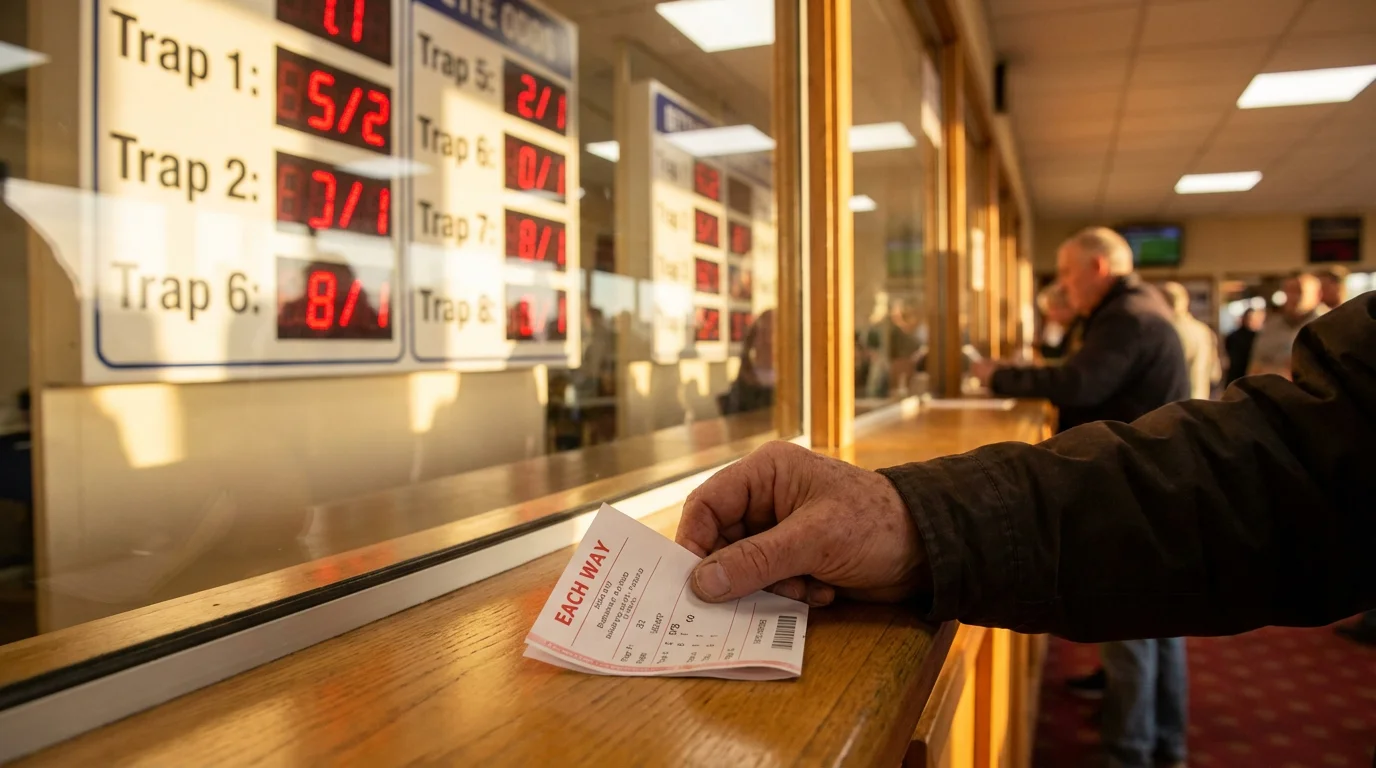
Each-Way in a 6-Runner Race Has Different Maths
Each-way betting in greyhound racing operates under conditions that are fundamentally different from each-way in horse racing, and the difference comes down to field size. Horse racing each-way bets typically cover fields of eight, twelve, or more runners, with place terms extending to second, third or even fourth depending on the number of runners and whether the bookmaker is offering enhanced terms. Greyhound racing runs six dogs per race. That smaller field compresses the place market and changes the maths in ways that matter for your returns.
The standard each-way terms for a six-runner greyhound race are one-quarter the odds for the first two places. Your each-way bet is two separate bets: one on your dog to win, one on your dog to finish in the first two. If the dog wins, both parts pay out — you receive the full win odds plus one-quarter of those odds for the place. If the dog finishes second, you lose the win part and receive only the quarter-odds place return. If it finishes third or worse, you lose both stakes.
Why does this matter? Because in a six-runner race with quarter-odds for two places, the place part of an each-way bet carries a higher theoretical margin against you than in larger fields. With only six runners, the probability of any given dog finishing in the first two is roughly 33% if all dogs were equal. But you’re being paid at one-quarter the win odds, which often underestimates that 33% probability — particularly for longer-priced selections. The result is that each-way bets on greyhounds can offer less inherent value in the place component than the same structure would in a twelve-runner horse race, where place terms of one-quarter odds for three places are more generous relative to the probability of placing.
None of this means each-way greyhound betting is a bad bet. It means you need to understand when the maths works in your favour and when it works against you. The place component adds a safety net, but that safety net has a cost — you’re staking twice your intended amount, and the place half only pays if the dog finishes in the top two. If your selection finishes third, you get nothing, and that third-place miss is more painful when you’ve doubled your outlay.
How Each-Way Terms Work in Greyhounds
The mechanics of each-way settlement deserve a clear walkthrough, because the maths trips up even experienced punters when they calculate returns quickly in their heads. An each-way bet at £5 on a dog at 6/1 is actually two bets: £5 to win at 6/1, and £5 to place at 6/4 (one-quarter of 6/1). Total stake: £10.
If the dog wins: the win bet returns £5 x 6/1 = £30 profit, plus £5 stake back = £35. The place bet returns £5 x 6/4 = £7.50 profit, plus £5 stake back = £12.50. Total return: £47.50 on a £10 total stake, giving a profit of £37.50.
If the dog finishes second: the win bet loses its £5 stake. The place bet returns £5 x 6/4 = £7.50 profit, plus £5 stake back = £12.50. Total return: £12.50 on a £10 total stake, giving a profit of £2.50.
If the dog finishes third or worse: both bets lose. Total return: £0 on a £10 total stake. Loss: £10.
Notice the asymmetry. A win produces a strong return. A place produces a modest return that barely covers the combined stake. A miss costs you the full doubled outlay. This profile means each-way bets on short-priced dogs are particularly unattractive. At 2/1, the place odds are just 1/2 — meaning a second-place finish returns £5 x 1/2 = £2.50 profit plus £5 stake = £7.50, against a total outlay of £10. You’ve lost £2.50 despite your dog finishing in the top two. At those odds, you’re essentially paying a premium for a safety net that doesn’t actually protect you.
The breakeven point for the place component of an each-way bet — the price above which a place-only finish produces a net profit across both parts of the bet — depends on the each-way terms. At quarter-odds for two places, you need your dog to be priced at 4/1 or above for the place return on a second-place finish to exceed the total stake. Below 4/1, a place-only result means an overall loss. This is the critical threshold for each-way greyhound betting: if you’re backing a dog at less than 4/1, an each-way bet only makes sense if you genuinely believe it will win, not just place. At those prices, a straight win bet is almost always the better option.
When Each-Way Offers Value
Each-way betting comes into its own at prices above 4/1, where the place return on a runner-up finish generates a net profit. At 6/1, a place-only result returns £2.50 profit on a £10 stake. At 8/1, it returns £5. At 10/1, it returns £7.50. The higher the price, the more the place part of the bet acts as genuine insurance rather than a costly extra.
The ideal each-way selection in greyhound racing is a dog with a strong chance of finishing in the first two but not necessarily the outright favourite for the race. This profile is more common than you might think. In a competitive six-runner race, you might have a clear favourite at 2/1, a second choice at 3/1, and then a cluster of three dogs between 5/1 and 8/1. If your form analysis suggests that one of those 5/1 to 8/1 shots is more likely to finish in the top two than its price implies — because of a favourable trap draw, improving form, or a running style that suits the conditions — an each-way bet captures value in both the win and place components.
Races with a dominant short-priced favourite are often the best environment for each-way value on the second and third choices in the market. When the favourite is 4/6 and dominates the market, the remaining dogs are pushed out to longer prices. If you believe the favourite is beatable, the each-way value on a dog at 6/1 or 7/1 can be substantial, because the place odds reflect the compressed market rather than the dog’s true chance of finishing in the top two.
Another scenario where each-way excels: trap-disadvantaged dogs with strong form. A dog returning from a winning run but drawn in a trap that historically underperforms at the venue might drift in the market to 5/1 or 6/1 despite being the best dog in the race on ability. The trap draw reduces its chance of winning outright, but its raw quality makes it highly likely to finish in the first two regardless of trap position. Each-way covers the risk that the trap draw costs it the win without abandoning the potential upside of a full win return.
Each-Way vs Win-Only: The Break-Even Calculation
The decision between each-way and win-only ultimately comes down to a simple comparison: does the additional cost of the place bet generate enough additional expected value to justify the doubled stake? This can be quantified, at least approximately.
Start with your estimated probability of the dog winning and your estimated probability of it finishing second. If you believe a 6/1 shot has a 15% chance of winning and a 20% chance of finishing second (35% total for the top two), you can calculate the expected value of each option.
Win-only at £10 on 6/1: Expected return = 15% x £70 (win return) = £10.50. Expected cost = £10. Expected profit = £0.50.
Each-way at £5 each-way (£10 total) on 6/1: Expected return from win = 15% x £47.50 = £7.13. Expected return from place only = 20% x £12.50 = £2.50. Total expected return = £9.63. Expected cost = £10. Expected profit = -£0.37.
In this example, the win-only bet has positive expected value while the each-way bet has slightly negative expected value. This happens because the place odds (6/4) don’t adequately compensate for the 20% probability of placing without winning. But change the probabilities — increase the place probability to 25% — and the each-way bet becomes the better option.
The practical takeaway: each-way bets favour dogs with a high probability of placing relative to their probability of winning. A strong closer that consistently finishes in the top two but rarely wins — because it always concedes too much ground early — is a natural each-way candidate. A fast-breaking front-runner that either wins or fades to fifth has no each-way profile. It’s a win-only proposition.
You don’t need to run these calculations before every bet. But understanding the principle helps you develop an instinct for when each-way is adding value and when it’s costing you money. Over time, that instinct becomes one of the quiet advantages that consistent punters have over casual ones.
Each-Way Is a Hedge — Use It Like One
Strip away the jargon and an each-way bet is simply a hedge: you’re paying extra to protect against a near-miss. Like all hedges, it has a cost, and the value depends on whether the protection is priced fairly relative to the risk.
In greyhound racing’s six-runner fields, the place market is tighter than in larger-field sports. Two places out of six means you’re getting paid for finishing in the top third of the field — a relatively generous threshold in absolute terms, but one that the quarter-odds place terms don’t always compensate for adequately. This is why selectivity matters. Each-way is a tool for specific situations, not a default bet type to apply to every selection.
Use it when the price is right (above 4/1 as a minimum, ideally 5/1 or above). Use it when the dog’s profile suggests a higher probability of placing than winning. Use it when the race structure — perhaps a dominant favourite compressing the market — pushes your selection to a price where the each-way terms become generous. And skip it entirely when you’re backing short-priced dogs, when the dog’s running style is win-or-bust, or when your conviction is high enough that the doubled stake would be better deployed as a larger win-only bet.
The best each-way punters don’t use it as insurance against being wrong. They use it as a structured way to extract value from races where the top two looks predictable but the exact finishing order doesn’t. That distinction is the difference between treating each-way as a comfort blanket and treating it as what it actually is: a separate bet with its own set of odds, its own expected value, and its own criteria for when it should and shouldn’t be placed.