
The Alphabet of Greyhound Form
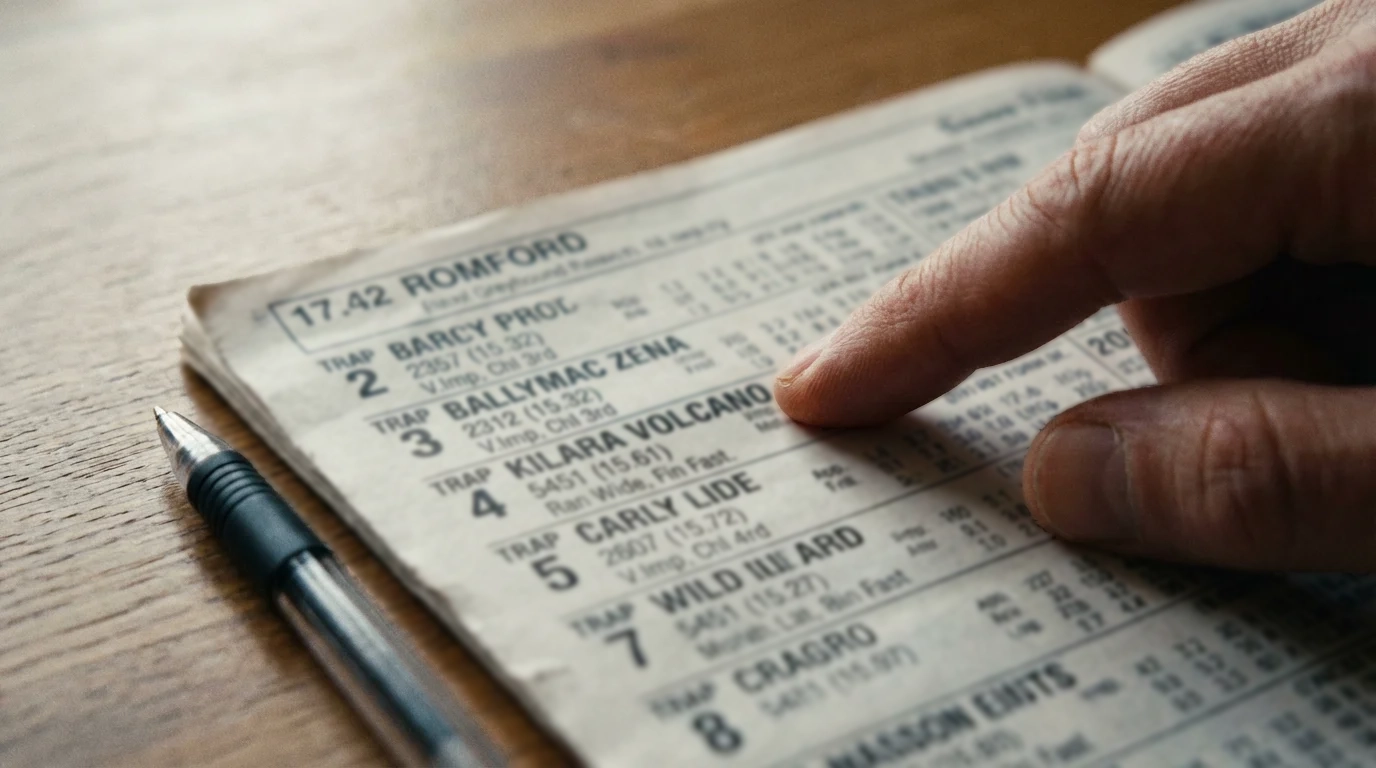
A greyhound racecard is dense by design. Every column, abbreviation and symbol serves a specific purpose, compressing a dog’s recent racing history into a format that fits a few lines of print. For newcomers, this compression creates a wall of unfamiliar characters. For experienced punters, it’s a language — and like any language, it becomes invisible once you’re fluent. The gap between those two positions is smaller than it looks, provided you learn the vocabulary systematically rather than by guesswork.
UK greyhound racecards follow a broadly consistent format across all GBGB-licensed venues, though presentation can vary between providers. Timeform, Sporting Life, the Racing Post and individual track websites all display the same underlying data, but the layout and level of detail differ. What remains constant is the abbreviation system. A “1” means first. An “m” means middle runner. A “SAw” means slow away. These codes are standardised across British greyhound racing, so once you learn them at one track, they apply everywhere.
The form line — typically showing a dog’s last six runs — is where most of the abbreviations cluster. Each run is represented by a finishing position and a set of comment codes that describe how the race unfolded for that dog. Reading these codes in sequence gives you a compressed narrative: where the dog was at each stage of the race, whether it encountered trouble, whether it showed early pace or finished strongly, and how the result compared to its recent pattern. It’s a lot of information packed into very few characters, and that’s exactly the point. The racecard is designed for speed of reading, not for explanation. This guide provides the explanation.
Position and Run Abbreviations
The most fundamental codes on any racecard are the finishing position numbers. These are straightforward: 1 through 6, indicating where the dog finished in its most recent races. A form line reading “2-1-3-4-1-2” tells you the dog finished second, then won, then third, fourth, won again, and second in its last six outings. The most recent run is on the right. This convention catches some people out — they read left to right as most recent first, but the racecard presents the oldest run on the left and the newest on the right.
Beyond the finishing position, run comment abbreviations describe the dog’s racing style and performance during each run. These are the codes you’ll see most frequently:
| Abbreviation | Meaning |
|---|---|
| EP | Early pace — led or prominent in the early stages |
| QAw | Quick away — fast out of the traps |
| SAw | Slow away — sluggish from the traps |
| Led | Led the race at some point |
| Ld | Led (shortened form used in tight layouts) |
| RnUp | Ran up — chased the leader closely |
| Crd | Crowded — impeded by other runners |
| Blk | Baulked — significantly impeded, lost ground |
| BCrd | Badly crowded — serious interference |
| Wide | Raced wide, typically through the bends |
| MsdBrk | Missed break — very slow from the traps |
| Fin | Finished strongly in the closing stages |
| RnOn | Ran on — sustained effort in the final section |
| Chl | Challenged — made a bid for the lead or a place |
| EvCh | Every chance — had a clear run, no excuses |
| Fdd | Faded — weakened in the latter stages |
| Stb | Stumbled during the race |
| Fell | Fell during the race |
These abbreviations appear in combinations. A run comment reading “QAw, Led, Fdd” tells you the dog broke fast, led the race, then faded — a front-runner that didn’t stay the trip or burned too much energy early. “SAw, Wide, RnOn” tells you the opposite story: slow start, forced wide, but finished strongly. The first comment suggests a dog that may need a shorter distance or a weaker field. The second suggests a dog with more ability than its finishing position implies, particularly if it draws a better trap next time.
Some comments carry more weight than others. “Crd” and “Blk” are interference notes — they tell you the result was compromised by factors beyond the dog’s control. “EvCh” is arguably the most telling two-letter code on the racecard. It means the dog had every chance and still didn’t win. There’s no excuse to attach, no bad luck to account for. The performance was a fair reflection of the dog’s ability on the night. When you see “EvCh” next to a poor finishing position, it’s a warning sign that the dog may be at its ceiling in this grade.
Race Code Letters Explained
Every race on a UK greyhound card carries a letter code that identifies its type. These codes appear next to the race distance and grade on the racecard header, and they’re essential for understanding what kind of competition you’re looking at.
The core codes are built around distance categories. “A” denotes a middle-distance race, which is the standard race type at most UK tracks — typically run over 380 to 500 metres and covering four bends. This is the most common code you’ll see, and the A-grade system (A1 through A10) applies specifically to these races. “D” denotes sprint races, run over shorter distances of 200 to 350 metres, usually covering just two bends. Sprint races demand explosive early speed, and the form dynamics are very different from middle-distance events.
“S” stands for staying races — longer contests over distances exceeding the standard, typically 600 metres or more. These races test stamina and pace judgement rather than raw speed. “M” can mean marathon distance at some tracks, though the letter also historically referred to maiden races (dogs that haven’t won). Context usually makes the distinction clear: if the distance is long, it’s marathon; if the grade is described as maiden, the dog hasn’t won a race yet.
“H” designates hurdle races, where dogs must clear low obstacles during the race. Hurdle racing has become less common in the UK but still features at selected meetings. “OR” stands for open race — the highest tier of competition, sitting above the standard grading system. Open races are subdivided into OR1 (Category One, the elite level), OR2 and OR3. “Hcp” or “HP” indicates a handicap race, where dogs start from staggered traps to equalise their chances based on assessed ability.
“N” and “P” appear in the context of novice and puppy races respectively. Puppy races are for dogs under 24 months, while novice events are for less experienced runners still establishing their form profile. These codes are important because the form generated in novice and puppy races should be treated differently from form in graded races — the dogs are still developing, and early results can be misleading indicators of long-term ability.
Weight, Trap and Condition Markers
Beyond the running comments and race codes, racecards contain several additional data points that carry their own shorthand. Weight is one of the most important. Each greyhound is weighed before every race, and the racecard shows the dog’s weight in kilograms alongside its form. Under GBGB Rule 52, any greyhound whose weight varies by more than 1kg from its previous race or trial must be withdrawn. This makes weight data a useful fitness indicator. A dog racing at a consistent weight, meeting after meeting, is likely in stable condition. A dog showing fluctuations approaching the 1kg limit may be in less settled form.
Weight trends matter more than absolute numbers. A dog that raced at 32.5kg, then 32.8kg, then 33.0kg across three consecutive outings is gradually putting on weight. This could signal a return to full fitness after an injury layoff, or it could indicate the dog is losing racing condition and carrying more body mass than is optimal. The context of the accompanying results determines the interpretation. If finishing positions are improving alongside a gradual weight increase, the dog is likely filling out and strengthening. If results are declining, the extra weight may be slowing it down.
Trap draw information is presented as a number 1 through 6, corresponding to the starting position. Some racecards also display the dog’s historical record from each trap, which is invaluable for assessing whether the draw is favourable. A dog with five wins from trap 2 and no wins from trap 5 is clearly more comfortable breaking from the inside. This trap history is not abbreviated but presented as a simple statistical line, often formatted as wins-seconds-thirds from each trap position.
Condition markers include indicators of the going — the state of the track surface. While greyhound tracks don’t use the elaborate going descriptions that horse racing employs, results services sometimes note whether conditions were unusually wet or dry. The going isn’t coded on the racecard the same way horse racing uses F (firm), GS (good to soft) and so on, but analysts who track times across meetings will note when a “slow” overall meeting time coincides with heavy rain, and adjust their form assessments accordingly.
Finally, the letter “R” on a racecard indicates a reserve runner — a dog substituted into the field after a withdrawal. Reserve runners are drawn from a separate pool and may wear an “R” on their racing jacket in addition to the trap number. Their form should be assessed with the caveat that they’ve been slotted into the race at short notice, possibly from an unfamiliar trap draw, which can affect their performance.
Once You Stop Looking Up, You Start Reading
The transition from decoding a racecard to reading it happens faster than most people expect. After a dozen evenings of checking abbreviations against this kind of reference, the codes become automatic. “SAw, Crd 2, RnOn” stops being a puzzle and starts being a picture: a dog that broke slowly, got squeezed at the second bend, then showed fight to close late. You see the story, not the shorthand.
That’s when the real work begins. Knowing what the abbreviations mean is the entry ticket. The skill lies in connecting one run to the next, spotting patterns across a six-race form line, and weighing the significance of each code in context. A single “Blk” in a form line might be bad luck. Three “Blk” entries in the last five runs suggest a dog that runs into trouble repeatedly — either because of its running style, its trap draw tendencies, or its inability to avoid interference. That pattern tells you something that no individual abbreviation can.
The same applies to positive trends. A form line showing “SAw, Mid, RnOn” in the earliest run, then “EP, Chl, RnOn” in recent runs, shows a dog that has been improving its trap speed and is now prominent early rather than playing catch-up. The abbreviations haven’t changed, but the sequence has — and the sequence is what matters for predicting what happens next.
Keep a mental or physical glossary for the first few weeks. After that, the abbreviations will read themselves, and your attention will shift to where it belongs: the patterns behind the codes and the betting decisions those patterns support.