
Hurdles Add a Dimension Flat Racing Doesn’t Have
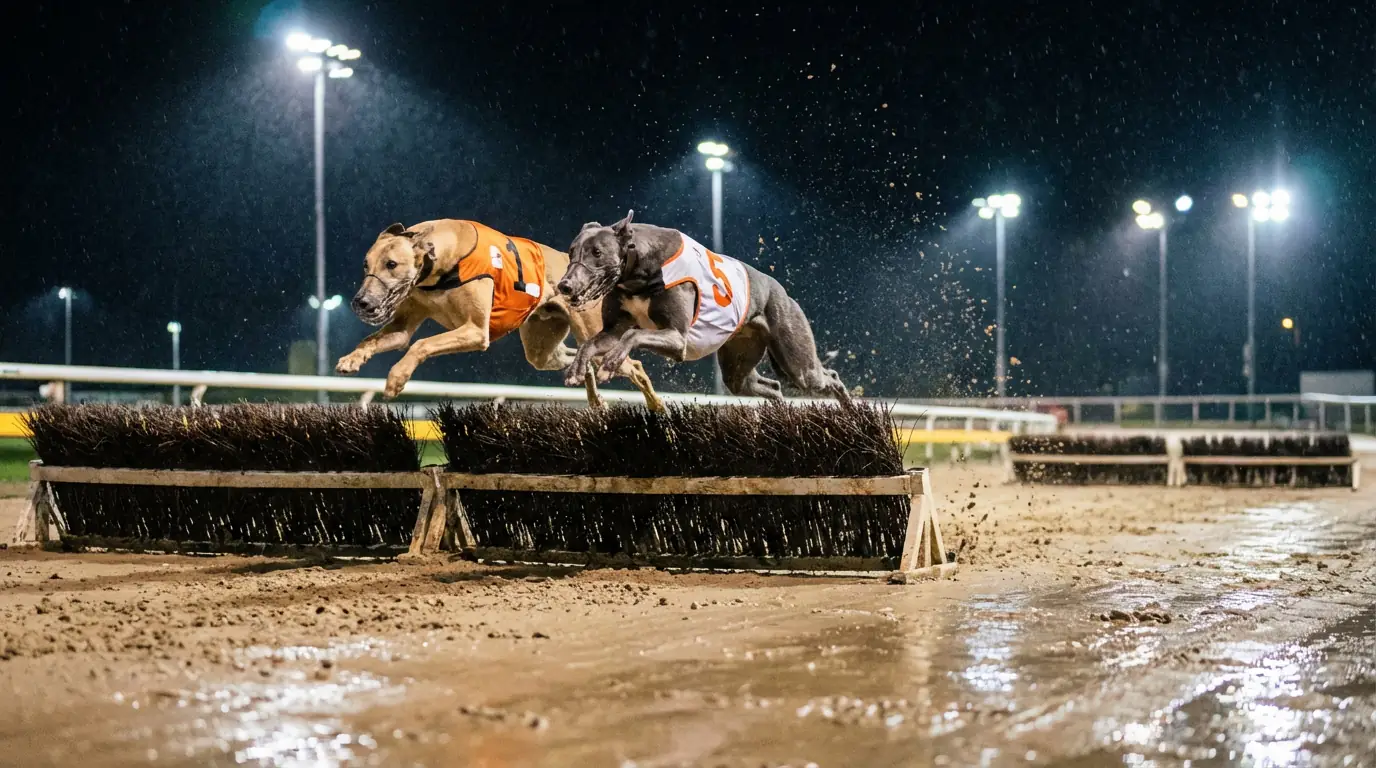
Flat greyhound racing is a pure speed contest. Six dogs break from the traps, run around four bends, and the fastest one wins. Hurdle racing adds a physical obstacle — a series of low barriers positioned on the track that the dogs must clear during the race — and that single addition changes the dynamics of the contest in ways that flat-racing form cannot predict. A dog that is brilliant on the flat may be a clumsy hurdler. A dog that looks moderate in graded company may be transformed by the additional dimension that obstacles provide.
Hurdle racing occupies a niche within UK greyhound racing. It’s run at a limited number of venues, features less frequently on the calendar than flat racing, and attracts a smaller but dedicated following. This relative obscurity has an important implication for bettors: the market is less efficient. Fewer punters analyse hurdle form seriously, fewer professional bettors focus on the discipline, and the bookmaker’s pricing is based on thinner data. In an environment where information edges are harder to find in the well-analysed flat-racing market, hurdle racing offers pockets of value that reward specialist knowledge.
The hurdles themselves are low — typically 25 to 30 centimetres in height — and made of lightweight materials designed to be displaced rather than rigid if a dog hits them. This is a welfare measure: the obstacles are designed to test the dogs’ jumping ability without creating a risk of serious injury on impact. Knocking a hurdle doesn’t disqualify a dog, but it does slow it down — sometimes by a significant margin if the impact breaks the dog’s stride or causes it to stumble. Clean jumping — clearing each hurdle fluently without breaking stride — is the most valuable skill a hurdle dog can possess, and it’s a skill that varies dramatically across the field.
How Hurdle Races Differ from Flat
The most fundamental difference is that hurdle racing is run over longer distances than standard flat races. The hurdles are positioned around the track at intervals, and the additional time required to jump them (even cleanly) means that hurdle races are conducted over distances that would otherwise fall into the staying category. This longer distance shifts the balance of qualities required: stamina and jumping technique become more important than pure flat speed, and dogs that lack the pace for top-grade flat racing can find their niche in hurdle company.
The jumping element introduces a skill variable that flat racing doesn’t have. On the flat, all six dogs are performing the same physical task: running as fast as possible around bends and down straights. In a hurdle race, each dog must also jump obstacles, and the efficiency of that jumping varies enormously between individuals. A dog that jumps cleanly — tucking its legs, gaining air, and landing in stride — loses almost no time at each hurdle. A dog that stutters before the hurdle, clips the barrier, or lands awkwardly loses tenths of a second per jump. Across four or more hurdles in a race, those small losses accumulate into a significant competitive disadvantage.
This jumping variation is partly innate and partly trained. Some dogs are natural jumpers — they approach the hurdle with confidence and clear it instinctively. Others need extensive schooling to develop even basic jumping competence, and some never become reliable hurdlers regardless of training. Trainers who specialise in hurdle dogs develop techniques for identifying puppies with natural jumping aptitude and for training flat-bred dogs to adapt to obstacles. The trainer’s hurdle experience is a more significant factor than in flat racing, where physical talent is the dominant variable.
Interference dynamics in hurdle races differ from flat racing as well. On the flat, interference typically occurs at bends where dogs jostle for position. In hurdle races, the hurdles themselves create additional pinch points: if one dog clips a hurdle and stumbles, the dogs immediately behind may be impeded, creating a cascading effect that can reshuffle the entire field mid-race. This means that hurdle-race form is noisier than flat-race form — the results are more susceptible to random interference events at the hurdles, and a single bad jump can turn a potential winner into a mid-field finisher.
Finishing times in hurdle races are naturally slower than equivalent flat-race distances because the jumping adds time to each lap. Comparing a hurdle dog’s finishing time directly against flat-race times at the same track is meaningless — the two disciplines run on different clocks. Instead, compare hurdle times against other hurdle races at the same venue to build a picture of relative speed within the discipline. A dog that runs a 29.50 hurdle race at a track where the average hurdle winner runs 29.80 is demonstrating the same kind of superiority as a flat dog that beats its meeting average by 0.30 seconds.
Key UK Hurdle Events
The Grand National has historically been the most prestigious hurdle event in UK greyhound racing, an original classic first staged at White City Stadium in 1928. Alongside it, the Champion Hurdle and the Springbok (for novice hurdlers) formed the trio of major hurdle competitions. These events attracted the best hurdle dogs in the country and generated the most sustained betting interest of any hurdle competitions. Finals were supported by qualifying rounds that built the form picture over several weeks. However, the closure of Crayford Stadium in January 2025 — the last UK venue regularly staging hurdle racing — effectively ended the discipline, with Star Pelaw exploring plans to reintroduce it.
Beyond the Grand National, major hurdle events included the Champion Hurdle and the Springbok novice hurdle championship, along with regional competitions such as the Kent National Hurdle. The calendar of hurdle racing was always thinner than flat racing — hurdle fixtures appeared less frequently — and the events were concentrated at venues with dedicated hurdle facilities. Historically, key hurdle venues included Crayford, Central Park, and Hove, with Kinsley also significant before its closure. The number of active hurdle venues declined steadily, reflecting the broader contraction of UK greyhound racing. Following the closure of Crayford in January 2025, hurdle racing effectively ceased as a regular fixture in the UK, though efforts are under way at Star Pelaw to revive the discipline.
The tracks that historically staged hurdle racing most regularly included Crayford, Central Park (Sittingbourne), and Hove, with occasional fixtures at other GBGB venues. Specialist hurdle trainer Ricky Holloway, who trained the GBGB Hurdler of the Year for eight consecutive years, dominated the discipline from his base at Central Park. The Crayford closure in January 2025 left no GBGB track with active hurdle facilities, though Star Pelaw in County Durham has since taken delivery of Crayford’s hurdle equipment with plans to introduce the discipline at its venue. If you’re interested in hurdle racing, monitoring developments at Star Pelaw and following any GBGB announcements about hurdle fixture approvals is the starting point for re-engaging with the discipline.
Some trainers specialise almost exclusively in hurdle dogs, and their runners dominate the results at hurdle meetings. These specialist kennels are worth monitoring, both for backing (when they run dogs at meetings where they have a strong record) and for opposing (when less experienced hurdle trainers enter dogs against them).
Betting on Hurdle Races
The key to profitable hurdle betting is recognising that flat-racing form translates imperfectly. A dog’s flat speed provides a baseline, but its jumping ability, stamina profile and hurdle experience modify that baseline in ways the market doesn’t always price correctly.
Previous hurdle form is the most reliable predictor. A dog that has completed three or four hurdle races with clean jumping and competitive finishes is a known quantity — you can assess its ability with reasonable confidence. A dog making its hurdle debut is a guess, regardless of how impressive its flat form looks. The market often underestimates the uncertainty of hurdle debutants, pricing them too short based on flat-racing speed that may or may not translate when obstacles are involved. Laying hurdle debutants at short prices — or simply avoiding them in your selections — is a straightforward edge in a discipline where jumping competence is the most important variable.
Conversely, experienced hurdle dogs with strong jumping records are sometimes available at generous prices because the market overweights flat speed relative to hurdling technique. A dog that finishes behind faster flat dogs in a hurdle race because it lost ground at every obstacle is not a contender regardless of its raw speed. A dog with moderate flat speed but fluent, time-efficient jumping can consistently outperform the market’s speed-based assessment.
The form comments in hurdle racing carry specific notations that don’t appear in flat form. “Cleared hurdles well” or “jumped fluently” are positive indicators. “Hit hurdle 3” or “lost ground at obstacles” are warning signs. These comments tell you directly about the dog’s jumping competence, and they should be weighted more heavily than finishing positions in your assessment. A dog that finished third but cleared every hurdle cleanly in a race where the first two were better flat dogs may be a strong bet next time if the flat speed in the field is weaker.
Forecast betting in hurdle races produces higher average dividends than in equivalent flat races, because the additional randomness of the jumping element creates more unexpected placing orders. A strong flat dog that clips a hurdle and finishes third instead of first opens the door for a longer-priced runner to fill the first two places, inflating the CSF dividend. If you’re looking for above-average forecast returns, hurdle races are structurally more likely to deliver them than the more predictable flat equivalent.
Hurdle Form Is Its Own Language
Hurdle racing requires you to learn a parallel form vocabulary. The speed ratings and sectional times that drive flat-race analysis are less relevant when four obstacles interrupt every lap. What matters instead is the dog’s jumping profile (clean, inconsistent, or poor), its stamina at the longer hurdle distances, and the trainer’s record in the discipline.
Punters who develop expertise in hurdle racing often find it more profitable per-bet than their flat-racing activity, precisely because the market is thinner and the analytical competition is lighter. Fewer people study hurdle form in depth, which means the pricing errors are larger and more frequent. The trade-off is volume — there are fewer hurdle races to bet on — but for punters who prefer quality of bets over quantity, the hurdle division offers a genuine niche where specialist knowledge creates sustainable value.