
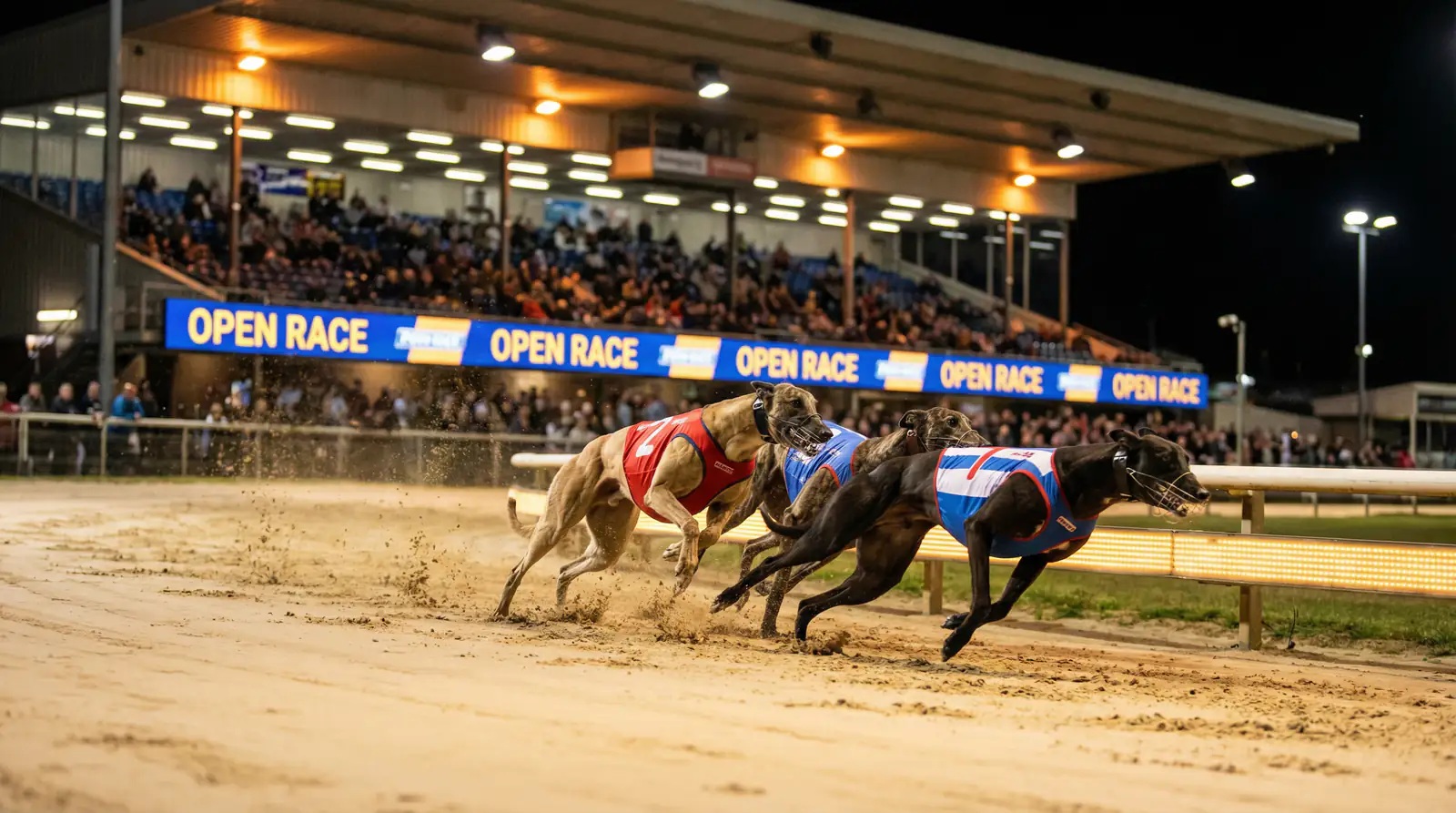
Open Races Sit Above the System
The standard grading system in UK greyhound racing — A1 through A10 for middle-distance races, with equivalent ladders for sprints and stays — organises dogs by demonstrated ability into progressively competitive tiers. Open races sit above this entire structure. They are invitation or entry-based events that bring together the best dogs in the country, regardless of their graded position, to compete for the largest prize money and the highest prestige the sport offers.
Where graded racing is the daily business of UK greyhound tracks — twelve races per meeting, six dogs per race, cards running afternoon and evening — open racing is the exceptional occasion. Open events appear on the calendar at specific times, often as feature races at major meetings or as standalone competitions with qualifying rounds. They attract the dogs that have outgrown the grading system: animals whose speed, consistency and class make them dominant in A1 or A2 company but who need a higher level of competition to be genuinely tested.
For bettors, open races present a different analytical environment from graded events. The quality of the field is uniformly high — there are no weak links, no dogs that are clearly outclassed, no easy races. Every runner has earned its place through sustained performance at the top of the grading structure or through direct qualification in preliminary rounds. The result is a more competitive, less predictable contest where margins are smaller and where the form analysis required to find value is more rigorous than in everyday graded racing.
The betting markets on open races tend to be more liquid and more keenly priced than on standard graded events. Bookmakers compete aggressively for custom on high-profile races, which means tighter margins, more competitive odds and better promotional offers. For the punter willing to invest the analytical effort, open races offer the best combination of market efficiency and information depth in UK greyhound betting.
OR1, OR2 and OR3 Categories Explained
Open races in UK greyhound racing are categorised into three tiers: OR1 (Category One), OR2 (Category Two) and OR3 (Category Three). The categorisation reflects the prestige and prize money of the event, with OR1 representing the absolute pinnacle of the sport.
OR1 races include the English Greyhound Derby, the St Leger, the Champion Stakes, the Cesarewitch and a small number of other major events. These are the competitions that define a greyhound’s career — winning an OR1 race places a dog in the historical record of the sport and significantly increases its commercial value for breeding purposes. Entry to OR1 events is typically through qualifying rounds that begin weeks before the final, creating a sustained competition that generates a rich body of form data for punters to analyse.
OR2 events are the second tier of open racing. They carry substantial prize money and attract fields of high quality, but they lack the historical weight and media profile of the OR1 competitions. Examples include regional feature races at major tracks, invitational events, and some established annual competitions that don’t quite reach the prestige threshold of OR1. OR2 races are often single-night events rather than multi-round tournaments, which means the form picture is narrower — you’re relying on each dog’s graded form and any recent open-race appearances, rather than the progressive data generated by a knockout competition.
OR3 races represent the entry level of open racing. They serve as a bridge between the top of the grading system and genuine open competition. Dogs that have been dominant at A1 or A2 level might receive their first open-race entry at OR3, testing their ability against a field that’s a step above their usual grade without throwing them straight into the deep end of OR1 company. For bettors, OR3 races are interesting because they often feature one or two dogs making their open debut alongside more experienced open-class runners, and the market can misprice these debutants in either direction — either overestimating them based on flashy graded form, or underestimating them because they lack open-race form.
The categorisation system is maintained by GBGB and published in their racing calendar. Each track has a list of approved open-race fixtures for the season, with the category confirmed in advance. Knowing the category of an open race before you bet tells you the likely quality of the field and the depth of competition you’re assessing.
How Dogs Reach Open Race Level
The pathway to open racing runs through the grading system. A dog that enters racing as a maiden, progresses through the puppy or novice ranks, and climbs the graded ladder from A6 or A7 to A1 has demonstrated sustained ability over a period of months. Only a fraction of dogs that begin this journey reach the top of the grading system, and a smaller fraction still have the class to compete at open level.
The transition from A1 graded racing to open-race competition is not automatic. Trainers nominate their dogs for open events, and entries are accepted based on the dog’s form, graded position and previous open-race record. A dog that has been winning consistently at A1 is the natural candidate for an OR3 entry, but the trainer’s decision to enter — and the timing of that entry — is a strategic choice. Some trainers push their best dogs into open company quickly, believing that the dog is ready and that the enhanced competition will sharpen its performance. Others wait, preferring to build a longer record of A1 dominance before stepping up.
For bettors, the trainer’s strategy around open-race entries is a useful signal. A dog entered in its first open race by a trainer with a strong record in open-class competition is more likely to be genuinely ready than a dog entered speculatively by a trainer whose kennel rarely operates at this level. The trainer’s open-race pedigree — tracked through historical results data — provides context that the dog’s individual form card can’t.
Some dogs reach open level not through the standard grading progression but through specific qualification events. The Greyhound Derby, for instance, accepts entries from dogs across a range of grades, and a fast-improving A3 or A4 dog can find itself in the Derby preliminary rounds if the trainer believes the dog is capable of competing at the top level. These outside entries occasionally produce surprise results — a relatively lowly graded dog that rises to the occasion of elite competition — and they tend to be available at longer prices than the established open-class runners because the market undervalues their potential at the higher level.
Betting on Open Races vs Graded Races
The analytical approach to open races requires adjustment from the methods that work in graded events. In a graded race, the field is designed to be competitive within a defined ability band. All six dogs should be roughly similar in class, and the differences between them — trap draw, running style, current form — determine the outcome. In an open race, particularly OR1 and OR2 events, the dogs may have come from different tracks, different grading systems, and different competitive environments. Comparing their form requires an additional layer of assessment: not just how they’ve been performing, but where they’ve been performing and against what quality of opposition.
Track-specific form is more important in open races than in graded events. A dog that has been dominant at its home track may find a different track configuration challenging. The bends may be tighter or wider, the run to the first bend shorter or longer, the surface faster or slower. If an open race is held at a venue where some runners have previous experience and others don’t, the dogs with venue form have a measurable advantage — they know the track, they’ve adapted to its characteristics, and their form there is a more reliable predictor than form from a different venue.
The market efficiency of open races is a double-edged consideration. On one hand, these races attract more attention from professional bettors and analysts, which means the odds are more likely to reflect each dog’s true chance accurately. On the other hand, the increased media coverage and promotional activity draws casual money that can distort the market — particularly on popular names or dogs with compelling narratives (a Derby favourite, a local hero, a young prospect stepping up). These distortions create pockets of value for form students who can separate the narrative from the data.
Forecast and tricast betting on open races tends to produce lower dividends than in graded events, because the tight market and compressed odds leave less room for large-paying combinations. The exception is when an outsider places: a 6/1 or 8/1 shot finishing second behind a 2/1 favourite can produce a healthy CSF dividend, because the second-placed dog’s longer SP inflates the calculation. Identifying which outsider has the best chance of placing, rather than winning, is a productive approach to open-race forecast betting.
The Elite Tier Rewards Preparation
Open races are the best-analysed, most thoroughly previewed events in UK greyhound racing. Expert commentary, published form analysis, media discussion and market intelligence are all at their most abundant around OR1 and OR2 events. This means the easy value — the obvious mispricings, the overlooked runners — is largely absent. The market is sharper, the competition is fiercer, and the returns for getting it right are more hard-won.
What open racing does reward is depth of preparation. The punter who has tracked a dog through its qualifying rounds, studied its replays at the specific venue, assessed its weight trend, evaluated the trainer’s big-race record and compared its sectional times against the field has a meaningful advantage over the punter who looks at the Racing Post preview and backs the favourite. The depth of available information makes this preparation possible; the quality of the competition makes it necessary.
If you’re going to bet seriously on open races, commit to the preparation they demand. They are not the place for casual selections or gut-feeling punts. They are the place where thorough form analysis, applied to the highest quality fields in the sport, produces the most satisfying — and occasionally the most profitable — outcomes in UK greyhound betting.