
Weight Changes Signal What Words Don’t
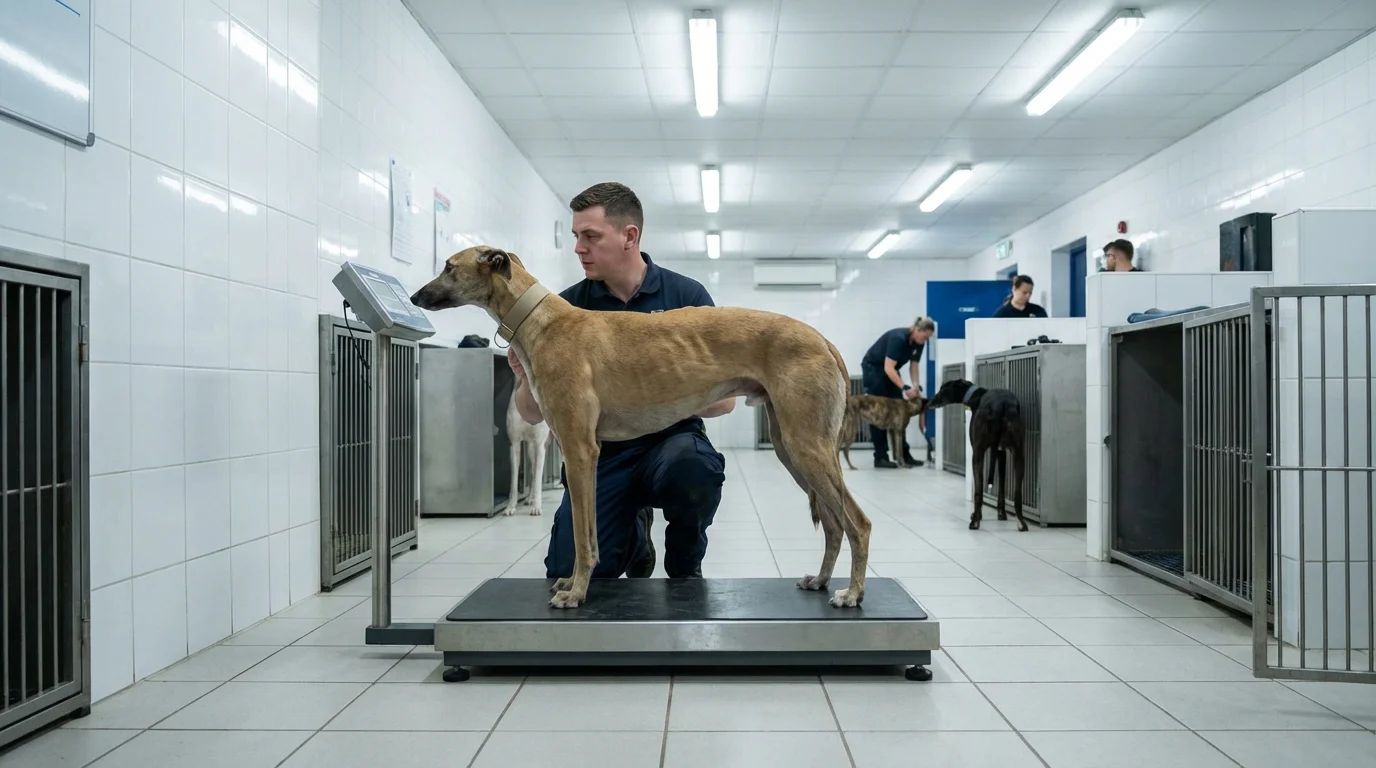
Every greyhound is weighed before every race. The number appears on the racecard alongside the form figures, the trap draw and the trainer’s name, and most punters glance at it without thinking. It’s just a number — 30.2kg, 32.8kg, 28.5kg — and in isolation it tells you nothing. But weight is not a standalone figure. It’s part of a sequence, and the sequence tells a story about the dog’s physical condition that no other racecard data provides.
A dog that raced at 31.0kg last week and weighs 31.8kg tonight has gained nearly a kilogram. That shift might mean the dog has been well fed and is carrying more energy into the race. It might mean the dog is losing fitness and putting on body fat. It might mean the dog has been recovering from a minor issue and is heavier as a result of reduced exercise. The weight change is the signal. The context — recent results, the gap between races, the trainer’s patterns — determines the interpretation.
Weight data is one of the few pieces of racecard information that isn’t generated by the race itself. Form figures, sectional times and finishing positions are all outcomes of competition. Weight is measured before the competition begins, which makes it a leading indicator rather than a lagging one. A dog’s weight can tell you something about its likely performance tonight that last week’s finishing position cannot — because the weight reflects the dog’s current physical state, while the form figures reflect its past performances under potentially different conditions.
The challenge is that weight is noisy. Small fluctuations — a quarter kilogram up or down — are normal and meaningless. The signal emerges when fluctuations become trends, or when a single large change occurs outside the dog’s established range. Learning to distinguish signal from noise in greyhound weight data is a specific skill, and it starts with understanding the regulatory framework that governs how weight is managed in UK racing.
The GBGB 1kg Rule and Why It Exists
Under GBGB regulations, any greyhound whose race-day weight differs by more than 1.0 kilogram from its last recorded racing weight must be withdrawn from the race. The rule exists to protect the welfare of the dogs and the integrity of the betting market. A large weight change can indicate illness, injury, changes in training regime, or deliberate manipulation — any of which could affect the dog’s performance and therefore the fairness of the contest.
The 1kg threshold is both a ceiling and a practical guide. It means that the maximum weight swing you’ll ever see in a dog’s consecutive racing weights is 1.0kg. Beyond that, the dog doesn’t race. Within that range, trainers have latitude to manage their dogs’ weight according to the animal’s needs and the trainer’s preparation strategy. Some trainers prefer their dogs to race at the lighter end of their natural range, believing that lower weight improves speed. Others prefer a slightly heavier racing weight, believing that the extra mass provides more power through the bends.
The rule also creates a withdrawal risk that bettors should be aware of. Dogs with a history of weight volatility — fluctuating by 0.7kg or 0.8kg between races — are at higher risk of exceeding the 1kg limit and being scratched on race day. If you’ve backed such a dog early at a good price, a weight-related withdrawal means your stake is returned (no harm done) but you lose the opportunity to profit from the price you’d secured. More significantly, Rule 4 deductions may apply to other bets in the same race, reducing the returns of bettors who backed different dogs.
The weigh-in takes place on the day of racing, typically several hours before the first race. The results are published on the racecard and are visible on bookmaker platforms and results services before betting markets open for the meeting. This means you have access to the weight data before you place your bet — provided you check. Many punters don’t, and that informational laziness is something you can exploit simply by incorporating weight into your pre-race assessment.
Reading Weight Trends Between Races
A single weight figure is data. A sequence of weight figures across several races is information. The distinction matters because trends are far more valuable than snapshots when assessing a dog’s physical trajectory.
The most positive weight trend is stability. A dog that races at 31.2kg, then 31.3kg, then 31.1kg, then 31.2kg across four consecutive outings is maintaining consistent condition. The tiny variations — within 0.2kg — reflect normal physiological fluctuations: hydration levels, meal timing, bowel movements. There’s no signal here beyond the good news that the dog is in settled physical shape, and settled physical shape correlates strongly with consistent performance.
A gradual upward trend — 30.5, 30.8, 31.0, 31.3 across four runs — requires more careful interpretation. If the dog is a young animal (under three years old), a gradual weight increase is normal developmental growth and often accompanies improving performance as the dog matures physically. If the dog is an experienced campaigner whose weight has been stable at 30.5 for months and is now drifting upward, the trend may indicate declining fitness: less exercise, more body fat, or a medical issue that’s reducing the dog’s activity levels between races.
A gradual downward trend tells the opposite story. A dog gradually losing weight might be in intensive training, being stripped of excess condition in preparation for a big race. Alternatively, it might be unwell, losing appetite, or being overworked. Again, the context determines the interpretation. If the weight drop is accompanied by improving form, the dog is likely being sharpened by the trainer. If the weight drop accompanies declining results, something is wrong.
Sudden changes — a dog that drops 0.8kg between races, or gains 0.9kg — are the loudest signals. A sharp weight drop from one race to the next often indicates the dog has had an illness, diarrhoea, or a stressful experience between races. A sharp gain often indicates the dog has been rested and well fed, potentially returning from a break. These sudden movements should prompt you to check whether the dog had any unusual gap between races, whether there was a trial in the interim, and whether the weight change corresponds with a change in the dog’s form comments.
Comparing weights within a race field is less useful than comparing each dog against its own history, but it provides one insight worth noting: in staying races, lighter dogs have a marginal advantage over heavier ones because they carry less mass over a longer distance. A 28kg stayer racing against a 34kg rival is, all else being equal, more efficient over 640 metres. This advantage is modest and easily overridden by differences in class, form and jumping ability in hurdles. But when two dogs of similar quality are separated by 3kg or more in a staying race, the lighter dog’s efficiency margin is a valid tiebreaker.
Weight in Context: Fitness vs Diet vs Condition
Weight is a proxy for physical condition, but it’s an imperfect one. Two dogs can weigh 31.0kg and be in completely different shape — one lean and muscular, the other carrying more fat around the ribs. The number on the scale doesn’t distinguish between muscle mass and body fat, between a well-hydrated dog and a slightly dehydrated one, or between a dog at peak fitness and a dog that’s been convalescing.
This is why weight analysis works best when combined with other form indicators rather than used in isolation. A dog showing a stable weight alongside improving finishing positions and faster closing sectionals is almost certainly in excellent condition. The weight stability confirms what the form data suggests: the dog is fit, healthy and performing to its ability. A dog showing stable weight alongside declining results and fading form comments might be maintaining its weight while losing its racing edge — perhaps through age, accumulated wear, or a subtle fitness issue that doesn’t affect appetite or weight but does affect speed.
Trainers use weight as a management tool, and understanding this helps interpret the data. Some trainers deliberately race their dogs slightly lighter before a targeted race, reducing food intake for a day or two to bring the dog in at the lower end of its range. The theory — debated but widespread — is that a leaner dog runs faster, the same way a lighter jockey gives a horse an advantage in racing. If you notice a dog weighing 0.3kg to 0.5kg below its recent average, and the race is a feature event or a step up in grade, the trainer may have specifically targeted this run.
Seasonal patterns also affect weight. Dogs tend to carry slightly more weight in winter (when cold weather increases calorie needs and reduces exercise opportunities) and slightly less in summer (when longer days, warmer weather and more training keep condition tighter). A 0.3kg seasonal swing is normal and doesn’t require the same scrutiny as a 0.3kg change between two races run a week apart in the same season.
Weight Is a Whisper — Learn to Listen
Weight data doesn’t shout. It doesn’t produce winners the way a sectional time or a trap draw analysis can. What it does is add a quiet layer of confirmation or concern to assessments you’ve already made through other means. You’ve studied the form, you’ve assessed the trap draw, you’ve checked the conditions — and then you look at the weight. If it confirms everything else, you bet with confidence. If it contradicts — a dog you fancy on form but whose weight has shifted sharply in the wrong direction — you pause. You reassess. Maybe you reduce your stake, or maybe you pass the race entirely.
That’s the role weight plays in a comprehensive betting approach: not a primary selection tool, but a filter. A final check before committing your money. Most punters skip it. The ones who don’t are making decisions with marginally more information, and marginal information advantages — applied consistently over hundreds of bets — are what separate profitable bettors from the crowd.