

Handicaps Level the Field by Moving the Start
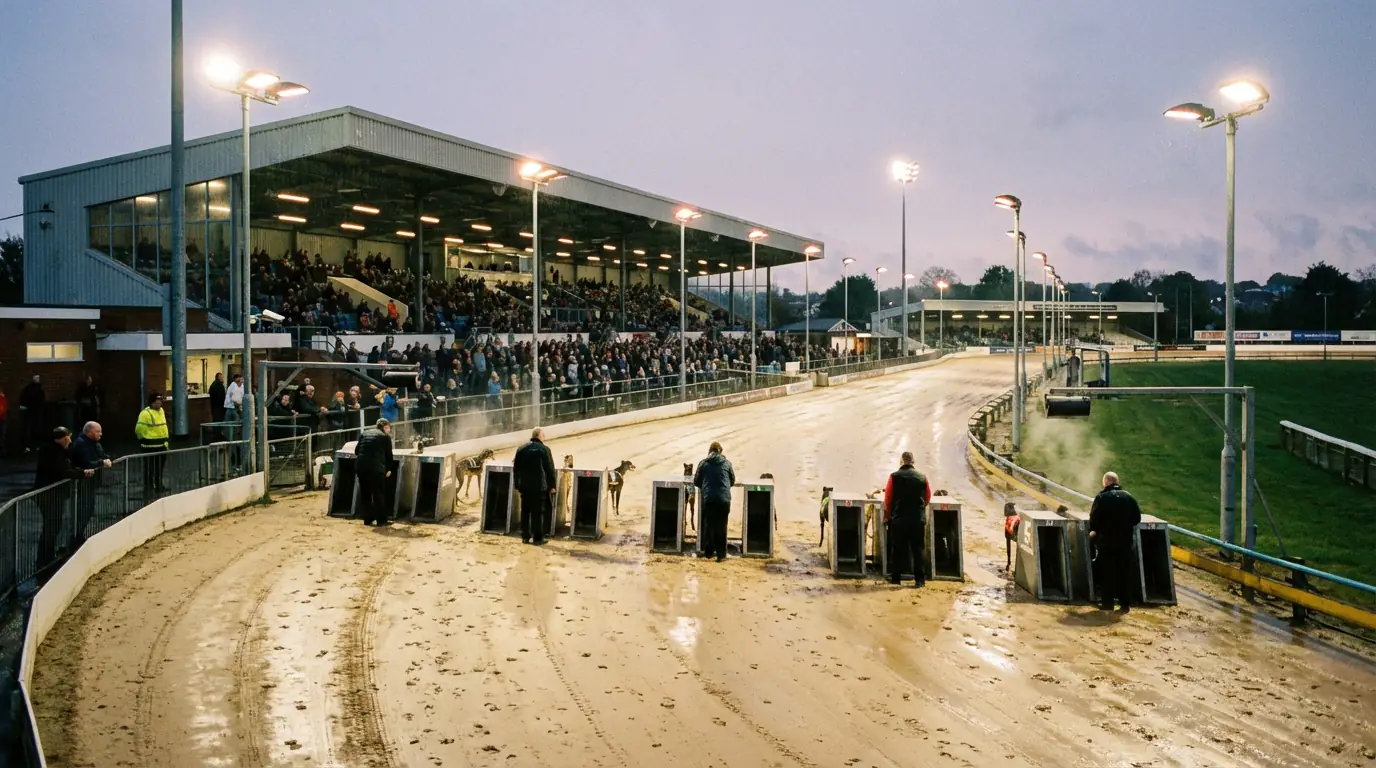
In standard graded greyhound racing, every dog breaks from the same line. The race is a pure contest of speed over the distance, and the grading system’s job is to ensure the six runners are closely matched in ability. Handicap races take a different approach. Instead of matching dogs by grade, they allow greyhounds of varying abilities to compete against each other by giving slower dogs a head start. The traps are staggered — the strongest dogs start further back, the weakest dogs start further ahead — so that, in theory, all six arrive at the finish line at roughly the same time.
The concept is borrowed from horse racing, where weight serves the same purpose that yardage serves in greyhound handicaps. But the mechanics are distinct. In a greyhound handicap, the track physically staggers the starting positions. A dog assessed as the best in the field might start from the “scratch” mark — the furthest back — while the weakest runner could have a head start of ten or fifteen metres. The stagger is calculated by the racing office based on each dog’s recent times and form, with the aim of producing a competitive finish regardless of the raw ability gap between the fastest and slowest dog in the race.
Handicap races appear less frequently on UK cards than standard graded events, but they occupy a specific and valuable niche. They allow trainers to run dogs that don’t fit neatly into the grading system — a staying dog too fast for S3 but not quite good enough for S1, for instance — in competitive races where they have a genuine chance of winning. For bettors, handicaps present a different set of challenges and opportunities compared to level-start racing, and the punters who profit from them tend to be those who understand how the handicap marks are set and where the system creates value.
How Handicap Marks Are Set
The racing office at each GBGB track is responsible for setting handicap marks. The process begins with the track grader assessing each dog’s recent form — primarily finishing times over the relevant distance, adjusted for grade of race, going conditions and any interference noted in the race comments. Based on these assessments, each dog is allocated a handicap mark expressed in metres, representing its head start (or lack thereof) relative to the scratch runner.
The scratch runner is the dog assessed as the fastest in the field. It starts at the standard distance with no advantage. Every other dog in the race starts ahead of it by an amount proportional to the perceived difference in ability. If the grader calculates that the weakest dog in the field is roughly one second slower than the scratch runner over the race distance, and one second equates to approximately ten metres at racing speed, that dog receives a ten-metre head start.
This is where the art meets the science. The grader’s assessment is based on data — times, positions, grades — but it also involves judgement calls. A dog whose recent times have been slow because of interference might be rated lower than its true ability warrants. A dog whose times have been fast but were achieved at a lower grade might be rated higher than it deserves for the company it’s now keeping. These judgement gaps are where betting opportunities hide. The grader is producing an estimate of relative ability, not a certainty, and estimates can be wrong in ways that a careful form student can identify.
Handicap marks are typically published on the racecard alongside the trap draw and form lines. They appear as a number of metres — 0 for the scratch runner, then positive numbers for the dogs starting ahead. Some cards also list the “adjusted time” the grader used to set the marks, which gives you a direct window into the reasoning behind the handicap. If you disagree with the adjusted time — because you think interference, a bad draw, or improving fitness means the dog is faster than its recent times suggest — you’ve identified a potential value bet.
One important detail: handicap races in greyhound racing are typically run over longer distances, often staying trips of 600 metres or more. This is partly practical — longer distances give the stagger more room to work without creating an absurdly bunched or spread-out start — and partly because the staying division is where ability differences between dogs tend to be largest, making handicaps the most effective way to produce competitive contests.
Reading Handicap Form Differently
Form from handicap races cannot be read the same way as form from level-start graded events. The finishing positions are still meaningful — a win is a win — but the context is fundamentally different. A dog that finishes first in a handicap has beaten its rivals after receiving a specific head start. Whether that’s an impressive performance depends entirely on the size of the start and the quality of the dogs it beat.
Consider two scenarios. Dog A wins a handicap off scratch — starting at the back with no head start — and overhauled the entire field to win by a length. That is a strong performance. The dog has given every other runner between five and fifteen metres and still won. Dog B wins the same handicap with the maximum head start of twelve metres and just holds on by a short head. That’s a much more pedestrian performance. The dog had every advantage and barely held its rivals off. The form figures show both dogs as winners, but the performances are not equivalent.
When you see handicap form in a dog’s overall form line, always check the handicap mark. A winning form figure from a handicap race has different implications depending on whether the dog was off scratch, off a moderate mark, or off a generous head start. Timeform and most detailed racecard services include this information, though it may be buried in the race details rather than displayed prominently in the abbreviated form line.
Another factor unique to handicap form is the “stagger effect” on running style. In a level-start race, every dog competes for the first bend from the same line, and early pace is a decisive factor. In a handicap, the dogs starting further back have a different tactical challenge: they need to make up ground progressively through the race rather than blazing from the traps. This means a dog that looks like a slow beginner in handicap form might actually be a competent front-runner in level-start races — it simply started too far back to lead. Conversely, a dog that “led” in a handicap may have only done so because it had a twelve-metre advantage, and in a level-start race it might be completely outpaced early.
Betting on Handicap Greyhound Races
The betting market for handicap races tends to be more compressed than for graded events. Because the staggered start is designed to equalise chances, the field is typically more open in the betting, with fewer short-priced favourites and more runners clustered between 3/1 and 7/1. This compression has direct implications for bet selection and value assessment.
From a strategic standpoint, the scratch runner deserves close attention in every handicap. This is the dog the grader rates as the fastest in the field. It’s also the dog carrying the biggest burden — starting at the back with no advantage. The question is whether the handicap mark is fair. If the scratch runner has been improving recently, or if its recent times include interference-affected runs that understate its true speed, the grader may have underestimated it. In that case, the dog is effectively well handicapped: it’s faster than its mark suggests, which means the head start its rivals receive isn’t large enough. These dogs often represent value, particularly if the market prices them in the 4/1 to 6/1 range based on the perceived difficulty of overcoming the stagger.
Equally, dogs on generous marks can offer opportunities. A dog allocated a twelve-metre head start that has been running poorly in graded races might look like a write-off. But if its poor recent form is attributable to running at the wrong distance or in the wrong grade, and the handicap trip suits it, the head start could turn a marginal dog into a genuine contender. Handicaps are specifically designed to accommodate these mismatches, and recognising when the accommodation overcompensates is a valuable skill.
Forecast and tricast betting on handicaps follows different logic than in graded races. Because the finish is designed to be close, multiple dogs crossing the line within lengths of each other is the expected outcome rather than the exception. This makes combination forecasts more attractive — the compressed finishing margins mean more races produce unexpected 1-2 combinations, driving CSF dividends up. If you’re going to place forecasts on handicap races, broader coverage (combination forecasts with three or four selections) tends to be more productive than straight forecasts, which require you to predict the precise 1-2 in what is deliberately designed to be an unpredictable finish.
One final tactical consideration: track the handicapper’s record. At venues that run regular handicap cards, the racing office’s tendency to favour certain types of dogs — front-runners, closers, inside-drawn runners — can become apparent over time. If the handicapper consistently underestimates strong closers, dogs with a stamina-based running style may be systematically well-handicapped. This is a narrow edge, but in a market where handicaps are priced as open races, a small systematic bias in the handicap marks can create consistent value.
When the Handicapper Gets It Wrong
Every handicap system makes errors. The greyhound racing office assesses ability based on available data, but data is backward-looking and incomplete. A dog returning from a six-week break might be significantly fitter than its pre-break times suggest. A dog that’s been running at an unsuitable distance might have been assigned a mark based on times that don’t reflect its ability over the handicap trip. A dog with a history of interference might be rated on results that were compromised by bad luck rather than a lack of speed.
These are the scenarios where handicap betting becomes genuinely profitable. When you can identify a dog whose handicap mark understates its current ability — because the grader has used compromised times, the wrong distance form, or hasn’t accounted for recent fitness improvements — you’ve found a bet where the odds are systematically in your favour. The dog has a better chance of winning than its handicap mark (and therefore its market price) implies.
The reverse is also true. Dogs that are over-rated by the handicapper — assigned a scratch mark or a small head start based on form that overstates their current ability — are poor bets. They carry the heaviest burden in the race, and if they’re not as fast as the grader believes, they have no margin for error. Identifying these over-rated dogs is just as valuable as spotting the under-rated ones, because it helps you eliminate selections that the market may still fancy based on headline form.
Handicap racing isn’t for everyone. It demands a deeper level of form analysis than graded racing, because you’re not just assessing which dog is the best — you’re assessing which dog is the best relative to its handicap mark. But for punters willing to invest the analytical effort, handicaps offer a betting environment where the rewards for accurate form assessment are proportionally higher than in the often-predictable world of graded events.
Get more race guides at latestgreyhoundresults.
Also see our grades breakdown.
