
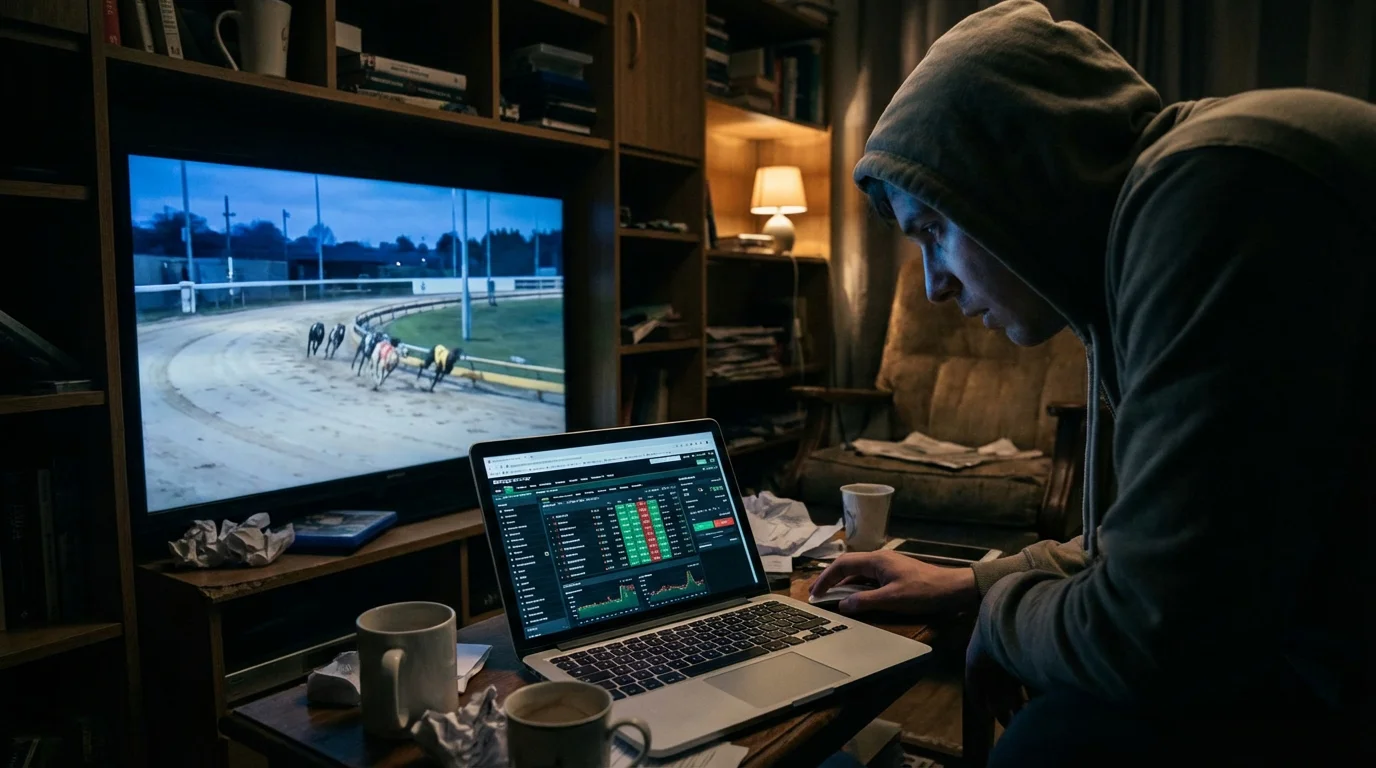
In-Play Greyhound Betting Moves at Track Speed
A greyhound race lasts between roughly sixteen and sixty seconds depending on the distance — sprint races over 270-280 m finish in about 16 seconds, standard 480 m middle-distance events in about 29 seconds, and marathon trips of 900 m or more can take well over 50 seconds. In-play betting on that race exists within the same window — a compressed burst of market activity where odds shift violently, positions change in fractions of a second, and the opportunity to place a bet opens and closes before most people have processed what’s happening. In-play greyhound betting is the fastest in-play market in UK sports, and it rewards a specific combination of preparation, speed and discipline that differs fundamentally from pre-race betting. UK greyhound races range from roughly 210 m sprints to 1,000 m+ marathons, with most standard cards built around the 480 m middle distance.
The Betfair Exchange is the primary platform for greyhound in-play betting. Traditional bookmakers generally suspend their markets once the traps open, but the exchange continues to match bets throughout the race. Odds update in real time based on the positions of the dogs on the track: the leader’s price shortens dramatically, the trailing dogs lengthen, and any incident — a bump, a check, a dog running wide — produces an instant readjustment across the entire field.
For most punters, greyhound in-play betting is too fast to be practically useful. The race is over before you can meaningfully assess what’s happening and place an informed bet. But for a specific subset of bettors — those with a low-latency data connection, fast exchange access, and a pre-race plan for how to react to specific race scenarios — in-play greyhound markets offer opportunities that don’t exist in any other format.
How In-Play Odds Move on Betfair
In-play odds on the Betfair Exchange are driven by two forces: automated trading algorithms and manual traders. The algorithms react to positional data (which dog is leading, by how far, at what point in the race) and adjust prices in milliseconds. Manual traders react to visual information from the live stream, which lags behind the actual race by two to five seconds. This latency gap between the data feed and the visual stream is one of the defining features of greyhound in-play markets.
At the start of a race, the moment the traps open, the in-play market activates. The dog that breaks fastest sees its odds shorten immediately — from perhaps 3.00 pre-race to 2.00 or 1.50 within the first two seconds — because the positional data indicates it’s leading. The dogs that break slowly see their odds lengthen correspondingly. This initial adjustment is aggressive and is dominated by automated systems that process the trap-break data faster than any human can.
Through the middle of the race, odds continue to adjust based on positions and margins. A leader that extends its advantage sees its price contract further. A closer that begins to make ground sees its price shorten as the algorithms calculate the probability of overtaking based on current speed and remaining distance. If an incident occurs — a dog is baulked, stumbles, or loses ground at a bend — the affected dog’s odds spike instantly while the other runners’ prices compress.
The final straight is where the most dramatic movements occur. A challenger closing on the leader produces a rapid odds swap: the leader’s price drifts as the probability of it being caught increases, while the challenger’s price shortens as its probability of winning rises. These movements happen in tenths of a second, and the latency between the data feed and the bookmaker stream means that by the time you see the challenger closing on your screen, the odds have already moved on the exchange. Betting based on what you see on the stream is, in most cases, betting on stale information.
Trap Challenge In-Play Angle
The most accessible in-play greyhound betting strategy doesn’t involve betting on individual races at all. Trap challenge in-play markets — where you bet on which trap number will produce the most winners across a meeting — move at a pace that humans can actually process, because the market updates between races rather than within them.
The strategy is simple. Let the first three or four races of a card play out without committing. Monitor which traps have produced winners and, more importantly, which traps have been running consistently — finishing second or third without winning. After a third of the card has been completed, assess which traps are likely to accumulate the most wins by the end of the meeting.
The in-play value often sits with traps that haven’t yet won but have been competitive. The market focuses on traps that are already on the scoreboard, shortening their prices and lengthening the prices of traps with zero wins. But a trap that has produced three seconds and a third from four races is arguably more likely to produce winners from the remaining eight races than a trap that produced one winner and three last-place finishes from the same four races. The in-play market doesn’t always make this distinction, and when it doesn’t, the overlooked consistent trap offers value.
The timing of your entry matters. Betting after three races gives you enough data to spot emerging patterns while leaving enough of the card remaining for those patterns to materialise. Betting after eight of twelve races gives you more data but less opportunity — there are only four races left for your chosen trap to accumulate wins, and the prices reflect this limited remaining opportunity.
When to Bet In-Play vs Pre-Race
The honest assessment for the majority of greyhound punters is that pre-race betting is more suitable than in-play betting. Pre-race markets give you time to analyse, compare prices across bookmakers, apply your selection process, and place your bet without time pressure. In-play markets demand split-second decisions based on incomplete visual information, and the latency disadvantage relative to automated systems means that the odds available to manual bettors are almost always less favourable than the “true” odds at any given moment during the race.
There are specific scenarios where in-play betting adds value, however. The most common is hedging a pre-race position. If you’ve backed a dog pre-race at 5/1 and it breaks well and leads into the first bend, its in-play price might contract to 1.50 or 2.00. Laying the dog in-play at this shorter price locks in a profit regardless of the final result — you’ve effectively sold your position at a higher implied probability than you bought it at. This hedging strategy requires exchange access, fast execution, and the discipline to take a guaranteed smaller profit rather than riding the full risk of the pre-race bet.
Another valid in-play scenario is backing a dog that encounters trouble at the first bend but has the closing ability to recover. If a strong closer is baulked at the first bend and its in-play price spikes from 4.00 to 15.00, the market may have overreacted — particularly in a staying race where there’s enough distance remaining for the dog to close. This requires genuine expertise in assessing whether a dog can recover from a specific type of trouble, and the time pressure of a live race makes this assessment extremely difficult to perform consistently.
For most punters, the optimal approach is to do your analysis pre-race, place your bets pre-race, and use in-play only for hedging opportunities on bets that have moved strongly in your favour. The in-play market is a tool for managing existing positions, not a primary betting environment. The exceptions — experienced exchange traders with low-latency setups and genuine in-play expertise — are a small minority of the greyhound betting population, and they operate with technological and informational advantages that casual in-play bettors cannot replicate.
There’s also a less obvious reason to favour pre-race betting: it preserves the quality of your analysis. Pre-race decisions are made in a calm, time-rich environment where you can weigh multiple factors without pressure. In-play decisions are made under extreme time pressure, with incomplete information, in an emotionally charged context (you’re watching the race with money on the line). The quality of decision-making degrades sharply under these conditions, and worse decisions produce worse results — regardless of how good your pre-race analysis was. The fifteen seconds of a greyhound race is the worst possible environment for making a considered betting decision, and most punters would improve their results by simply not betting in that window.
Speed of Market, Speed of Mind
In-play greyhound betting is the sharpest test of whether you’re betting with a plan or reacting emotionally. The speed of the market amplifies every impulse: the urge to back the leader because it’s leading, the urge to oppose the favourite because it broke slowly, the urge to chase a position that’s moved against you. These impulses produce fast decisions, and fast decisions in a fast-moving market are usually bad decisions unless they’re backed by a pre-determined plan.
If you engage with in-play greyhound markets, define your rules before the race starts. Know in advance at what price you’ll hedge. Know in advance under what circumstances you’ll place an in-play bet. Know in advance what your maximum in-play stake is. Without these predefined parameters, the speed of the market will overwhelm your analytical capacity and you’ll end up making decisions you wouldn’t have made with five more seconds of thought.
The race is fifteen seconds long. Your preparation should take considerably longer than that.