
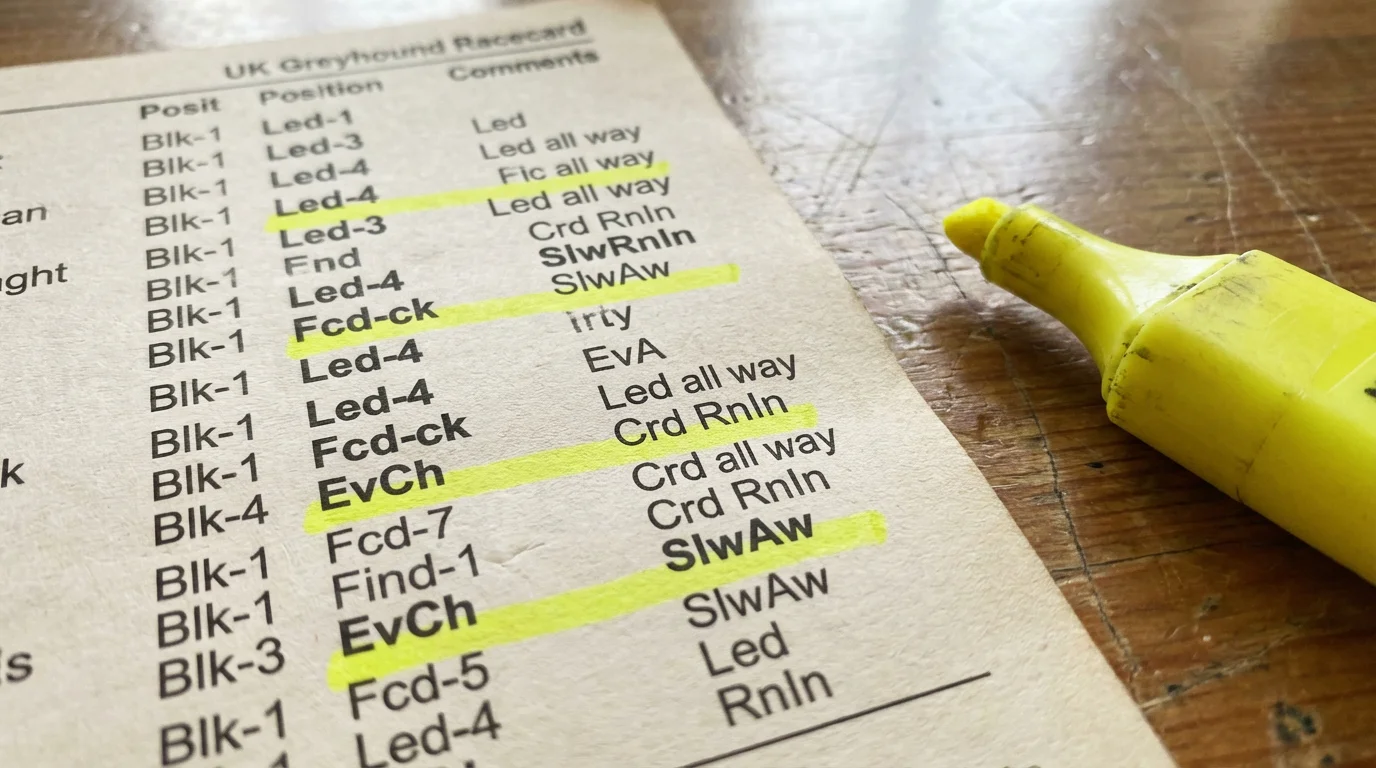
Running Lines Are the Race Written in Shorthand
Every UK greyhound race generates a set of running comments — a compressed account of what each dog did during the race, written by the grader or race commentator and published alongside the result. These comments describe each dog’s position at key stages of the race, any interference or trouble encountered, and the quality of the finishing effort. They appear on the racecard as a string of abbreviated terms — “QAw, Led, Unc” or “SAw, Crd 2, RnOn” — and they encode more information per character than any other element of the form card.
Running lines bridge the gap between the bare finishing position and the full race replay. A dog that finished third might have led for three-quarters of the race before being caught by two faster closers. Or it might have been baulked at the first bend, recovered to mid-pack, and finished strongly to salvage third from what looked like a hopeless position. The finishing position is the same in both cases, but the running lines tell you which scenario occurred — and the two scenarios have entirely different implications for the dog’s next race.
The skill of reading running lines is the ability to reconstruct the race from the comments, understand what happened and why, and assess whether the finishing position accurately reflects the dog’s ability or whether it was distorted by circumstances. This skill develops with practice, but it begins with understanding what each term means and how the terms combine to tell a story.
Common Running Line Terms Decoded
Running line comments are composed of positional indicators, pace descriptions, interference notes and finishing assessments. The positional indicators describe where the dog was at different stages of the race. “Led” means the dog was in front. “Disp” (disputed) means it was sharing the lead with another runner. “RnUp” (ran up) means it was close behind the leader, typically within a length or two. “Mid” means it raced in the middle of the field. “Rr” (rear) means it was at the back.
Pace descriptions tell you about the dog’s speed profile during the race. “EP” (early pace) indicates the dog showed speed in the first section, even if it didn’t lead. “QAw” (quick away) specifically describes a fast trap break. “RnOn” (ran on) means the dog sustained its speed or accelerated in the closing stages. “Fin” (finished) similarly indicates a strong final effort. “Fdd” (faded) means the dog weakened in the latter stages, losing ground to the field.
Interference notes are the comments that carry the most analytical weight, because they identify performances compromised by external factors. “Crd” (crowded) means the dog was impeded but not severely. “BCrd” (badly crowded) indicates significant interference that cost substantial ground. “Blk” (baulked) means the dog was blocked — its run was stopped or severely checked by another runner or by the track position of surrounding dogs. “Ckd” (checked) means the dog had to alter its stride or direction to avoid trouble. “Wide” means the dog raced wider than the ideal racing line, typically through the bends, which adds distance and costs energy.
The most telling comments combine positional, pace and interference information into a sequence that describes the entire race experience. “QAw, Led 1-3, Crd 4, Fdd” tells you the dog broke fast, led from the first to the third bend, was crowded at the fourth bend, and then faded. That’s a performance where the interference at bend four may have caused the fade — the dog was in a winning position until it was impeded. The running line suggests the dog is better than its finishing position, and a race without the bend-four incident might have produced a win.
Conversely, “Mid, EvCh, Fdd” is a comment that offers no excuse. The dog raced in mid-pack, had every chance to improve, and faded anyway. “EvCh” (every chance) is one of the most significant terms in the running-line vocabulary because it explicitly states that the result was a fair reflection of the dog’s ability. There was no bad luck, no interference, no positioning disadvantage. The dog simply wasn’t good enough. When you see “EvCh” alongside a poor finishing position, treat it as a reliable signal that the dog is at its ceiling in the current grade.
How Comments Reveal Hidden Form
The most valuable use of running line comments is identifying dogs that ran better than their finishing positions suggest. These are the dogs with the best chance of improving next time — not through any physical change but simply through a cleaner run, a better draw, or the absence of the interference that compromised their previous performance.
The pattern to look for is a strong positive comment attached to a poor finishing position. A dog finishing fifth with comments “SAw, Wide, RnOn” has been slow from the traps, raced wide through the bends, and still finished strongly. Every part of that race went wrong except the finishing effort, and the finishing effort is the one element the dog can control. If the trap break improves — through a better draw, a sharper dog, or a more favourable position in the field — the same dog finishing fifth might finish first or second.
Multiple interference comments across consecutive races are an even stronger signal. A dog that shows “Crd 1, Wide” in one race, “Blk 2, Ckd” in the next, and “BCrd 1, RnOn” in the third has been impeded in every recent outing. The form figures might read 5-4-4, suggesting a mid-pack performer stuck at its level. But the running lines tell you the dog has been physically prevented from showing its true ability three times in succession. The probability that all three incidents were the dog’s fault (running into trouble through its own racing line) decreases with each repetition. At some point, bad luck becomes the more likely explanation, and the market — which prices the dog on its finishing positions — is undervaluing it.
Running lines also reveal when a dog’s form is better than it looks because of the quality of the races it’s been running in. A dog finishing third in an A2 race with comments “Chl, RnOn” (challenged, ran on) was competitive at a high grade and finishing with effort. That performance might be superior to a dog winning at A5 with “Led, Unc” (led, unchallenged) — the A2 third is a stronger piece of form than the A5 win, and the running lines make this comparison possible in a way that finishing positions alone don’t.
Applying Running Lines to Future Races
The practical application of running line analysis is to adjust your probability estimates for each dog based on the quality of its recent performances rather than just the headline finishing positions. A dog with three fourths in its last three runs looks uninspiring. A dog with three fourths accompanied by “Crd, RnOn” in each of those runs looks like a dog that’s been unlucky and is due a clean race.
When a tracked dog — one whose running lines you’ve identified as better than its results — appears on a future racecard, check three things. First, is the trap draw better than in the races where it encountered trouble? A better draw reduces the probability of a repeat incident. Second, are the conditions similar to or better than the races where it showed strong closing efforts? Consistent conditions mean the running style translates. Third, does the price reflect the poor finishing positions or the underlying performance quality? If the market is pricing on the form figures rather than the running lines, you’ve found a value bet.
Combine running line analysis with trap statistics and conditions assessment for the sharpest form picture. A dog that finished fourth after being crowded twice, drawn tonight in its preferred inside trap at a track where it’s previously won, on a surface that suits its running style — that’s a convergence of positive factors that the form card alone wouldn’t reveal. The running lines provided the key insight; the trap draw and conditions provided the context; and the price, set by a market that’s focused on the form figures, provides the value.
Read Between the Lines — Literally
Running line comments are written by people — graders and commentators who watch six dogs simultaneously and compress a dynamic, fast-moving event into a handful of abbreviated terms. The comments are accurate but not infallible. Occasionally, a significant incident is missed or understated in the comments but visible in the replay. Occasionally, a comment overstates the severity of an incident because the grader’s attention was drawn to a moment that looked worse than it was.
This is why running line analysis works best as a screening tool rather than a standalone method. Use the comments to identify dogs worth investigating further, then validate your interpretation by watching the replay. The comment says “Blk 2” — the replay shows whether the baulking cost the dog two lengths or half a length, and that distinction determines whether the running line translates into a genuine value opportunity or a marginal one.
The punters who extract the most value from running lines are those who read them systematically across entire race cards rather than checking individual dogs in isolation. Scanning every dog’s comments across a twelve-race meeting, flagging the ones with strong positive indicators despite poor results, and adding them to a tracker list takes thirty minutes per meeting. The rewards — finding dogs that the market has undervalued because it’s pricing results rather than performances — justify the investment many times over.