

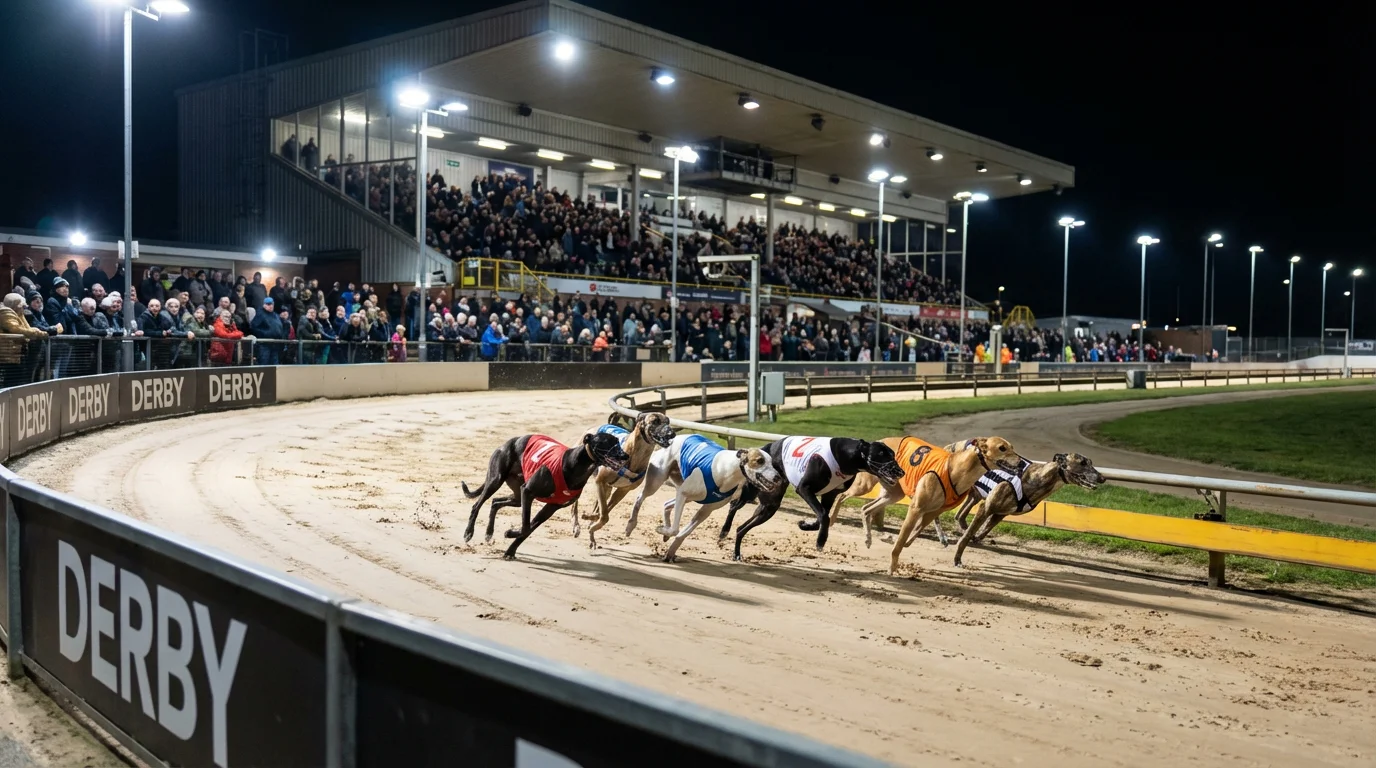
The Derby Is Where Greyhound Racing Peaks
The English Greyhound Derby is the single most prestigious race in British dog racing. It occupies the same cultural position for greyhound enthusiasts that the Epsom Derby holds for flat racing fans or the Grand National for jumps devotees — the one race that transcends the sport’s daily rhythm and becomes an event. Prize money, field quality, media attention and public interest all reach their annual high point when the Derby final comes around, typically in late June.
For bettors, the Derby represents something specific: a rare opportunity to engage with greyhound racing at its most visible and most heavily analysed. The ante-post market opens months before the first round, major bookmakers offer enhanced promotions through the qualifying rounds, and the depth of available form data is richer than for any other competition in the calendar. The combination of high stakes, elite-quality fields and sustained market interest makes the Derby the best environment in UK greyhound betting for punters who do their homework.
The competition format is a knockout tournament. Dozens of dogs enter the early qualifying rounds and are progressively eliminated over several weeks until six remain for the final. This structure means the form generated through the rounds is cumulative and directly relevant — you can watch a dog’s progression (or deterioration) across multiple races at the same venue, against increasingly strong opposition, building a layered picture that standalone graded races rarely offer. The Derby rewards sustained form reading more than any other event in the sport.
It also rewards patience. The ante-post market is open for weeks, prices fluctuate as dogs win or lose their heats, and the information advantage shifts as the tournament progresses. Backing a dog at 25/1 before the first round is a different proposition from backing the same dog at 7/2 after it’s coasted through three heats. Both bets can be profitable, but they demand different assessments and different levels of conviction.
History of the English Greyhound Derby
The Greyhound Derby was first run in 1927 at White City Stadium in London, just a year after organised greyhound racing was introduced to Britain at Belle Vue in Manchester. From the outset, it was positioned as the sport’s flagship event, with prize money and prestige designed to attract the best dogs from across the country. White City hosted the race for decades, establishing the Derby as a fixture of the London sporting calendar alongside events like Wimbledon and the Boat Race.
The race moved several times as tracks closed or circumstances changed. Wimbledon Stadium became the Derby’s home from 1985, and the last Derby there was held in 2016, before the stadium’s closure in March 2017 — a period that many fans consider the competition’s modern golden era. The closure of Wimbledon was a significant blow to the sport’s profile, and the Derby’s subsequent moves reflected the broader challenges facing greyhound racing in the UK. Towcester Racecourse hosted the event in 2017 and 2018, offering a unique dual-purpose venue (horse and greyhound racing), before financial difficulties forced the track into administration in August 2018. Nottingham took over for 2019 and 2020. Towcester returned in 2021 after restructuring and has served as the Derby venue since.
Through all these relocations, the Derby’s status has remained intact. The prize money for the winner has fluctuated but consistently ranks as the largest single payout in British greyhound racing. The roll of honour includes some of the most celebrated dogs in the sport’s history — names that resonate with anyone who has followed the dogs seriously. The Derby final remains the one greyhound race that regularly receives mainstream media coverage beyond the specialist racing press.
The competition format has evolved over the decades but retains its essential character: an open entry, multiple qualifying rounds at the host venue, and a six-dog final. The number of entries, the specific round structure and the qualifying criteria have been adjusted at various points, but the principle — the best dog over the Derby trip at the Derby track, tested through several weeks of competition — has never changed.
Recent Winners and Performances
The modern Derby has been dominated by a small number of elite trainers, with Irish-based operations particularly prominent. The ability to prepare a dog specifically for the demands of a multi-round knockout competition — peaking at the right time, handling the travel, adapting to the specific track — favours well-resourced kennels with experience of big-race campaigns. This concentration of success is worth noting for ante-post betting: trainer pedigree in the Derby is a stronger indicator than in everyday graded racing.
Recent finals have showcased the quality gap between genuine Derby-class dogs and the rest of the greyhound population. Winning times at Towcester tend to be significantly faster than the track’s standard graded racing times, reflecting the calibre of dog that reaches the final. More importantly for form students, the consistency of performances through the rounds is what distinguishes eventual winners. Dogs that produce fast, clean runs in every round — breaking well, avoiding trouble, maintaining pace — are far more likely to deliver in the final than dogs that scrape through heats on the back of a single strong performance.
The semi-final round is typically the most informative for betting purposes. By that stage, the field has been whittled down to twelve dogs across two semi-finals, and the form picture is dense: every survivor has multiple runs at the venue, in competition against high-quality opposition, with sectional times and running comments available for each performance. The semi-final is where you can most accurately assess which dogs are progressing and which are beginning to plateau or regress under the cumulative demands of the tournament.
One recurring pattern: dogs drawn in favourable inside traps in the final tend to outperform their pre-race odds. The Towcester track configuration gives inside runners a clean run to the first bend, and in a six-dog final where every runner is elite, that early positional advantage is often decisive. This doesn’t mean trap 1 always wins the Derby — the best dog usually prevails regardless — but it means the market sometimes underprices inside-drawn runners and overprices equally talented dogs drawn wide.
Ante-Post Derby Betting Strategy
The ante-post market for the Greyhound Derby is the most liquid and sustained futures market in UK dog racing. Bookmakers open prices weeks before the first qualifying round, and the market remains active throughout the competition, with odds adjusting after every round of heats. This creates a dynamic betting environment where price movements carry genuine information and timing matters as much as selection.
The first strategic decision is when to bet. Early ante-post prices — offered before the first round — represent the highest potential returns but also the highest risk. Dogs can be eliminated in any round, and at that stage your form assessment is based on graded racing and trial times rather than Derby-specific performances. Backing a dog at 20/1 or 33/1 before the competition begins is a speculative position that requires confidence in the dog’s raw ability and the trainer’s big-race credentials. If the dog progresses through the early rounds, that 20/1 will look generous. If it exits in the second round, it was an expensive education.
A more disciplined approach is to wait for the quarter-final or semi-final stage before committing significant stakes. By then, you’ve seen each surviving dog run two or three times at the Derby venue, against progressively stronger fields. The prices are shorter — a dog that was 20/1 might now be 5/1 — but the information advantage is substantial. You’re no longer guessing how a dog will handle the track, the competition level, or the demands of a multi-round tournament. You know, because you’ve watched it do exactly that.
Each-way ante-post betting on the Derby deserves consideration. The standard place terms for the final typically extend to the first two, but some bookmakers offer enhanced each-way terms through the qualifying rounds — paying out if your dog reaches the final, for instance. These promotions effectively give you an each-way insurance policy on the entire tournament, not just the final race. If your ante-post selection reaches the final but doesn’t win, you still collect the place portion. Given the high attrition rate through the rounds, this kind of promotion significantly improves the risk-reward profile of early ante-post bets.
Finally, consider the lay side. As the tournament progresses and dogs accumulate wins, the market can overreact to impressive performances in the early rounds. A dog that wins its first two heats by comfortable margins will shorten sharply, sometimes beyond what the form objectively supports. If you believe the market is getting carried away with an early-round impression, laying that dog on the exchange at a short price is a viable strategy — particularly if the dog is yet to face the step up in quality that the later rounds demand.
The Derby Changes Careers — Including the Bettors’
The Greyhound Derby is the one event where casual observers intersect with dedicated punters, where mainstream coverage meets specialist analysis, and where the ante-post market is deep enough to reward genuine form study over weeks rather than hours. It’s the closest greyhound racing comes to a festival atmosphere, and that atmosphere generates both opportunity and noise.
The opportunity lies in the depth of available form. By the time the final arrives, you have more data on each contender than you’ll ever have for a standard Tuesday-night graded race. Multiple runs at the same venue, against documented opposition, with detailed sectional times and running comments for every performance. If you can’t form a strong opinion on the final based on that body of evidence, you probably can’t form a strong opinion on any greyhound race.
The noise comes from casual money. The Derby final attracts bets from people who don’t normally follow greyhound racing — attracted by the media coverage, the prize money, the promotion. This influx of uninformed money can distort the market, typically shortening popular names and drifting value onto less fashionable runners. For punters who have followed the competition round by round and built their assessment from the form rather than the headlines, this distortion is the final piece of the edge.
Whether you bet the Derby at 33/1 before the first heat or at 3/1 in the final itself, the principles are the same as any other greyhound bet: assess the form, evaluate the price, manage your stake. The Derby just gives you more form to assess and a bigger stage on which to do it.
Get more race guides at latestgreyhoundresults.
Also read our greyhound open races explained.
