
SP Is the Price That Counts — Whether You Like It or Not
Take an early price or get paid at SP — either way, starting price drives the market. In UK greyhound racing, SP is the default settlement method for the majority of bets placed both at the track and online. It’s the price that determines forecast and tricast dividends. It’s the benchmark bookmakers use when calculating Rule 4 deductions. And it’s the number published next to every runner in the official results. Understanding SP isn’t optional for anyone who takes greyhound betting seriously. It’s foundational.
SP stands for Starting Price. It represents the odds available on a greyhound at the exact moment the traps open. Not the price you saw on your screen an hour before the race, not the odds when the market first opened — the price at the off. It’s a snapshot of where the collective money landed, and for anyone betting at SP rather than a fixed early price, it’s the number that determines the return.
The concept sounds simple, but its implications run deep. SP affects the value of your forecast bets. It affects whether your each-way bet returns a profit or a loss. It determines whether the Best Odds Guaranteed promotion your bookmaker offers actually kicks in. And crucially, it reflects the final judgement of the betting market about the relative chances of each dog in the race. That makes it both a settlement mechanism and, for those paying attention, a piece of information in its own right.
For many greyhound punters, SP is something that simply happens to them. They place a bet, the race runs, and the SP is what it is. But treating SP passively means missing an important strategic dimension. Whether to take an early price or wait for SP is a decision that directly affects your long-term profitability — and it’s a decision most casual bettors never consciously make.
How Starting Price Is Determined
SP is set by on-course bookmakers at the moment traps open. Unlike horse racing, where a team of independent assessors from the Starting Price Regulatory Commission formally records and verifies the SP, greyhound racing operates with a simpler mechanism. The SP is derived from the odds being offered by the on-course bookmakers present at the meeting. An official records the best available price on each runner at the off, and that becomes the returned SP.
At many UK greyhound meetings, particularly the midweek and afternoon cards broadcast via SIS, on-course bookmaking presence is minimal. This matters because a thin market — fewer bookmakers competing for custom — tends to produce less accurate SPs. The prices are more likely to reflect the bookmakers’ margin requirements rather than genuine market forces. By contrast, big meetings at major venues with strong crowd attendance generate SPs that are more competitive and more reflective of true implied probabilities.
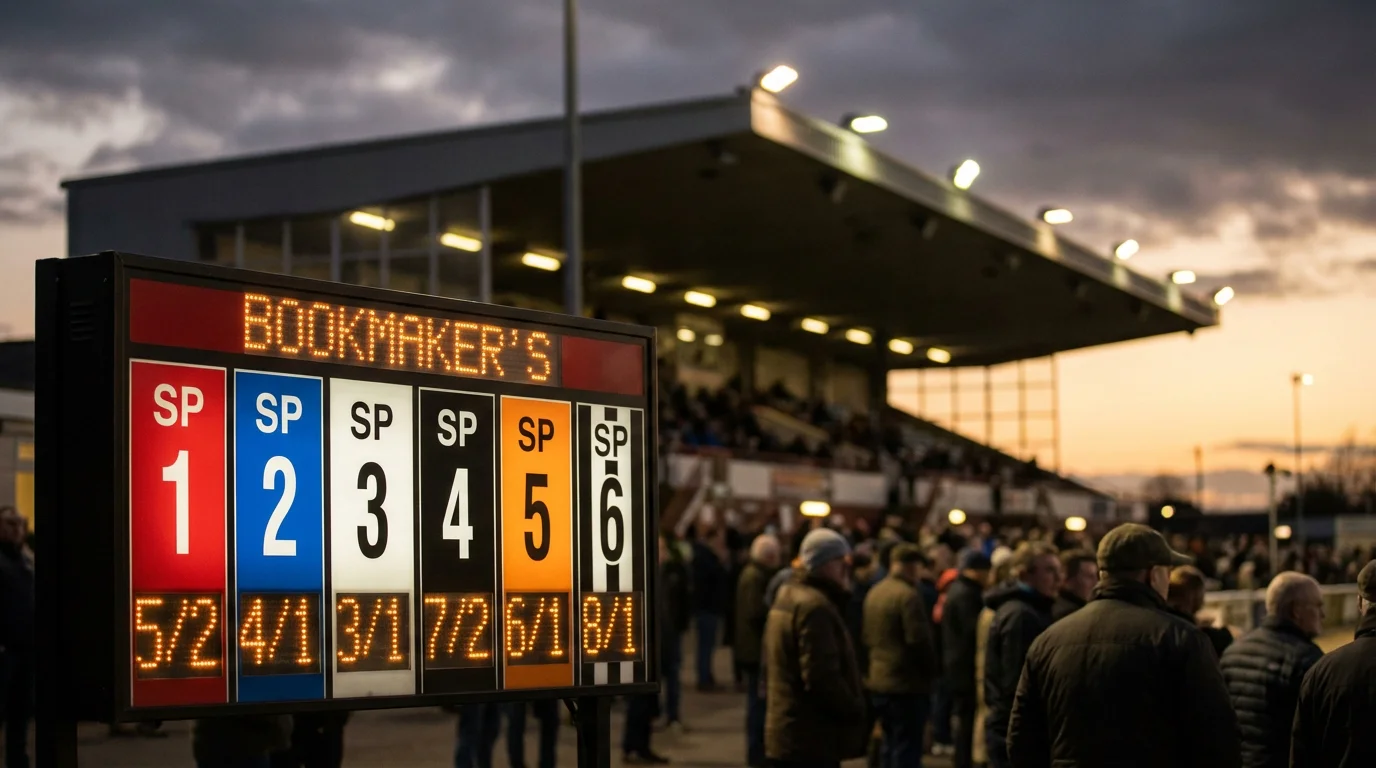
The mechanics work like this: each on-course bookmaker displays their prices on a board. As money comes in from punters at the track and as the bookmaker monitors off-course market movements, they adjust their odds accordingly. A dog attracting heavy support will shorten. One that the market is ignoring will drift. At the moment the traps open, an official takes a reading of the available prices. The returned SP is typically the best price on offer from the on-course layers at that instant.
One important nuance for greyhound bettors: SPs in dog racing can move sharply in the final seconds before the off. Greyhound races come around quickly — there might be fifteen minutes between races, and the market for each race is active for only a fraction of that time. Late money, whether from trackside punters or instructions passed from off-course layers, can shift a dog’s SP dramatically. A dog might be 5/1 two minutes before the off and return at 7/2 — or at 7/1 if smart money has gone elsewhere. These late swings are more common in greyhound racing than in horse racing, because the markets are smaller and more susceptible to concentrated support on a single runner.
It’s also worth noting that the SP applies to the official result. If a race is declared void, all SP bets are void. If a race is re-run, the SP from the re-run governs settlement, not the SP from the original void race. These procedural details matter because they occasionally catch out punters who assumed their early price would survive a void-and-rerun scenario.
SP vs Betfair SP: Two Different Numbers
The exchange market tells a different story from the ring. Betfair SP is a separate product from the traditional SP, and confusing the two is a common mistake. Traditional SP, as described above, is derived from on-course bookmakers at the track. Betfair SP is a volume-weighted price calculated from unmatched bets on the Betfair Exchange at the time the market is turned in-play.
The practical difference? Betfair SP is typically closer to the true probability of the outcome because it reflects a broader pool of opinion and money. The exchange market aggregates bets from thousands of users, including sophisticated bettors and trading algorithms, which tends to produce a more efficient price. Traditional SP, particularly at smaller greyhound meetings, can be influenced by a handful of on-course bookmakers who are managing their own risk rather than reflecting market consensus.
For punters, this distinction has direct financial consequences. Forecast and tricast dividends in greyhound racing are calculated using the traditional SP, not the Betfair SP. So even if you habitually bet on the exchange, the CSF and tricast returns published in the results are based on the on-course price. If you’re betting win-only at Betfair SP, your return will differ — sometimes significantly — from what a bookmaker punter at SP received for the same selection.
Betfair publishes its BSP alongside the traditional SP in results, and some results services like Timeform display both. Comparing the two for a given race can be instructive. When Betfair SP is notably shorter than the returned SP, it usually means the exchange market rated the dog’s chances more highly than the on-course ring did — suggesting the on-course price was generous. Over time, tracking these discrepancies can help you identify meetings and tracks where SPs tend to offer better or worse value relative to the exchange.
One further distinction: Betfair deducts commission from winning bets on the exchange, typically 5% for most users though this varies by account history. When comparing Betfair SP returns to bookmaker SP returns, the commission must be factored in. A Betfair SP of 4.0 with 5% commission delivers a net return equivalent to roughly 3.8 in decimal odds — which may or may not beat the bookmaker SP depending on the night.
When to Take Early Odds vs Waiting for SP
Taking SP is a decision, not a default. Every time you place a greyhound bet without locking in a fixed price, you’re making an implicit choice to accept whatever the market produces at the off. Sometimes that works in your favour. Often it doesn’t. The question is when to take the early price and when to let SP do the work.
The general principle is straightforward: if you believe the dog’s price is going to shorten before the off — because you expect other punters to back it, or because the early price reflects genuine value — lock it in. If you think the price will drift, SP may deliver better odds than the current quote. The difficulty is that greyhound markets are volatile and relatively opaque compared to horse racing, making drift-or-shorten predictions harder to call consistently.
There are some structural tendencies worth knowing. Favourites in greyhound racing tend to shorten from their early morning prices to SP. This is because the morning market is often based on tissue prices set by the bookmakers’ algorithms, and actual money flowing in closer to the off typically concentrates on the perceived best chance. If you fancy the favourite, taking an early price is usually the better move. For outsiders, the picture is reversed: early prices on longshots are sometimes artificially short (to balance the book), and SPs on outsiders often drift to more generous odds as the market settles.
Best Odds Guaranteed promotions, offered by several major bookmakers on greyhound racing, change this calculus entirely. If you’re betting with a BOG bookmaker, you can take the early price knowing that if the SP is bigger, you’ll be paid at the higher price. This effectively removes the downside of taking an early number, making BOG meetings the easiest scenario to navigate: always take the early price, and let the promotion protect you against drift.
For exchange users, the decision is different again. Betfair SP bets are placed without a fixed price — you’re submitting to the exchange’s calculated SP. Alternatively, you can place a limit order at a price you’re willing to accept and see if it gets matched before the off. Limit orders give you control; Betfair SP gives you convenience. The right approach depends on how actively you want to manage your positions and how much liquidity the market offers for the race in question.
The Number Behind the Number
SP tells you where the money went — and money is always more honest than opinion. Beyond its function as a settlement price, SP is a piece of diagnostic information. A dog that returns at a significantly shorter SP than its morning price attracted serious support. A dog whose SP drifts markedly from where it opened was, in the market’s final assessment, a weaker proposition than initially thought.
Tracking SP movements over multiple races for the same dog can reveal patterns. A greyhound that consistently beats its SP — that is, wins at a price shorter than its morning quote would suggest — is one the market respects. A dog that regularly runs poorly after being heavily backed (short SP) may be one the market keeps getting wrong about, or one that doesn’t handle the pressure of leading from a favourable draw.
None of this is conclusive on its own, but it adds texture to your form analysis. When you’re studying greyhound results, don’t just look at positions and times. Look at the SP. Ask yourself whether the market had this dog right. If it didn’t — if a dog that returned 8/1 produces a performance that suggests it should have been 4/1 — you’ve found something worth watching next time it runs. The price is a verdict. Your job is to decide whether the jury got it right.