
Six Traps, Dozens of Ways to Bet
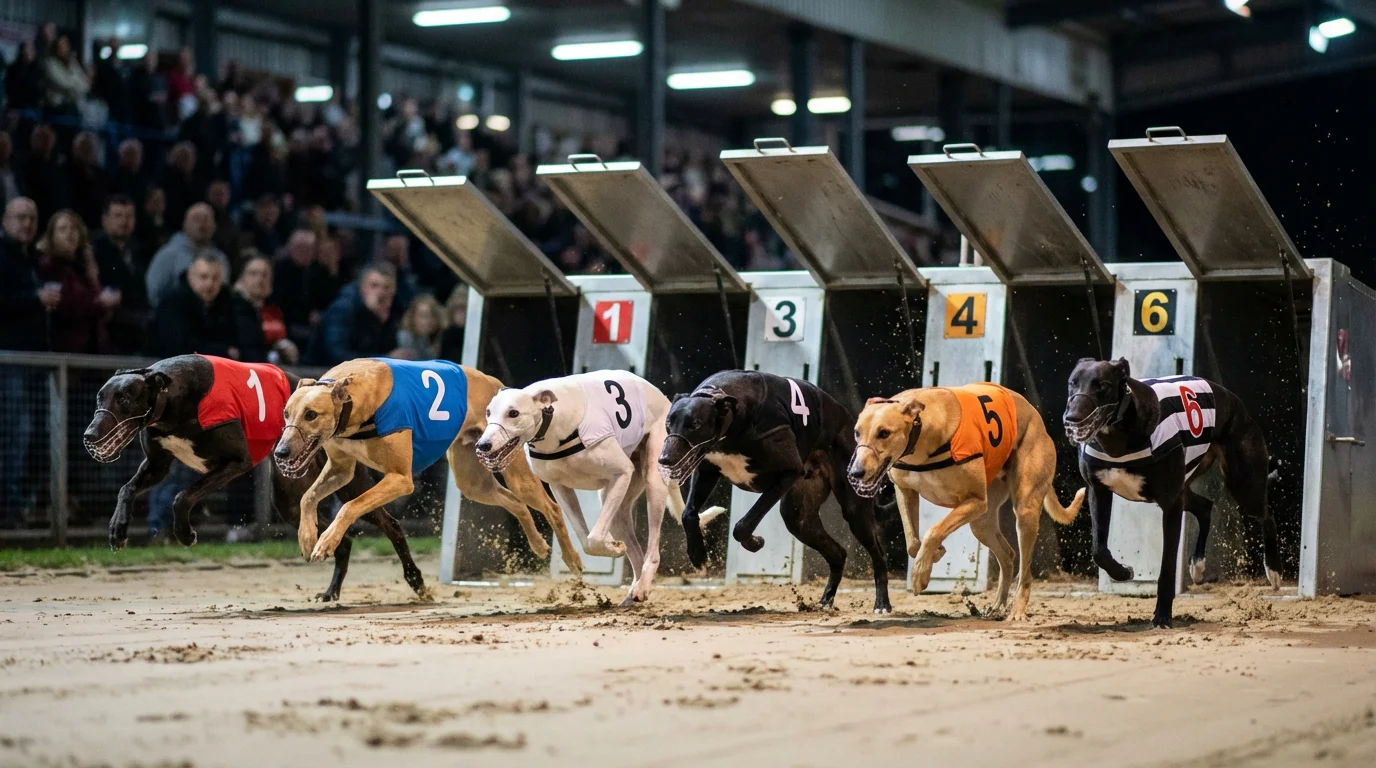
Greyhound fields are small — but the bet menu is anything but. A standard UK greyhound race features six runners. In horse racing, you might see fields of twenty or more. That stripped-back field size might suggest a simpler betting landscape, and in one sense it does: fewer runners means fewer possible outcomes. But the betting options built around those six dogs are surprisingly deep, and understanding them properly is the difference between casual punting and informed wagering.
The UK greyhound betting market covers everything from straightforward win bets to complex combination forecasts, named accumulators, and trap challenge markets that span an entire meeting. Each bet type carries its own risk profile, its own payout structure, and its own analytical demands. Backing a dog to win requires one judgement. Playing a combination tricast across the same race requires you to assess the probable finishing order of three dogs — a fundamentally different exercise.
This guide breaks down every standard bet type available on UK greyhound racing, explains how each one works mechanically, and — more usefully — explains when each one makes strategic sense. Because the right bet isn’t always the one that pays the most. It’s the one that matches your analysis of the race to the payout structure most likely to reward that analysis. If you’ve been defaulting to the same bet type regardless of the race in front of you, there’s a good chance you’ve been leaving value on the table.
Single Bets: Win, Place & Each-Way
Win betting is where everyone starts and where most of the long-term profit lives. The mechanics are as simple as betting gets: you pick a dog, and if it crosses the line first, you collect. Your return is calculated from the odds at the time your bet was struck — either the price you took early or the starting price (SP) returned at the off.
Place betting and each-way betting add a safety net, but the terms in greyhound racing are tighter than what horse racing punters are accustomed to. Understanding exactly how these bets work in a six-runner field is essential before you start staking.
Win Bets & Starting Price
A win bet is a single selection to finish first. You can take a fixed price offered by a bookmaker in advance of the race, or you can bet at SP — the starting price determined by the on-course market at the moment the traps open. Both approaches have merits. Taking an early price locks in value if you believe the dog will shorten in the market as money comes in. Betting at SP means you accept whatever the market settles at, which can go for or against you.
In UK greyhound racing, SP is derived from the on-course betting market, though for televised BAGS meetings (Bookmakers’ Afternoon Greyhound Service), the SP is often calculated from a combination of on-course and off-course activity. The Betfair SP — the starting price on Betfair Exchange — operates separately and reflects the exchange market’s assessment rather than the traditional bookmaking ring. Betfair SP is frequently different from the industry SP, sometimes significantly so, and for bettors who use the exchange it provides an alternative benchmark.
One strategic point about win betting on greyhounds: the six-runner field means every dog has a roughly 16.7% chance of winning if you assume a level field. In practice, fields are rarely level, but the small field size means that even a relatively unfancied dog has a legitimate mathematical chance. This creates a market dynamic where favourites are often shorter than they should be — because the casual money gravitates to form-toppers — and outsiders are longer than their actual winning probability warrants. Win betting at value prices, rather than simply backing the dog you think will win, is the foundation of profitable greyhound punting.
Each-Way in 6-Runner Fields
Each-way betting in greyhound racing is where many punters trip up. An each-way bet is two bets in one: a win bet and a place bet, at equal stakes. If your dog wins, both parts pay. If it finishes in a place position but doesn’t win, only the place part returns — calculated at a fraction of the win odds.
Here’s the critical detail for greyhound racing: standard place terms in a six-runner field are typically first and second only, at one quarter of the win odds. Compare that to horse racing, where an eight-runner handicap might offer each-way terms of first, second, and third at one fifth of the odds. The greyhound place market is tighter. Your dog needs to finish in the top two for the place portion to trigger, and the fractional payout is smaller than what you might be used to from the horses.
This makes each-way betting on greyhounds a more marginal proposition than it first appears. On a strong favourite at short odds, the each-way return if it finishes second can be miserable — you’re collecting a quarter of already-short odds on half your total stake. Each-way betting on dogs only makes mathematical sense when you’re backing a dog at longer odds where the quarter-odds place return still represents a meaningful payout. As a general rule, each-way on greyhounds works best at prices of 4/1 or longer, where the place component provides genuine insurance rather than just cushioning a loss.
Forecast Betting: Straight, Reverse & Combination
Forecast betting turns a race into a two-part puzzle. Instead of simply picking the winner, you’re predicting which two dogs will finish first and second. The payout is calculated from the starting prices of both dogs, using the computer forecast formula — a standardised calculation applied across UK greyhound racing. Forecast dividends can be substantial, particularly in open races where the market doesn’t have a strong view on the likely finishing order.
Greyhound racing is arguably the best sport in UK betting for forecast play. Six runners means only 30 possible exact first-and-second combinations, compared to hundreds in a large horse racing field. The field size makes the puzzle solvable with careful form analysis, and the payouts often overcompensate for the difficulty.
Straight Forecast Explained
A straight forecast requires you to name the first and second in the correct order. You select dog A to win and dog B to finish second. If that exact result occurs, you collect the computer forecast dividend. If the same two dogs fill the first two positions but in the reverse order — dog B wins, dog A second — your bet loses.
The computer forecast dividend is calculated from the SPs of the first two finishers using a formula set by the betting industry. The formula takes the win odds of both dogs and applies a mathematical model that reflects the probability of that specific combination occurring. In practice, the payout tends to be higher when one or both of the placed dogs are at longer odds, and lower when two market leaders fill the first two spots.
Straight forecasts are the purest form of forecast betting. They reward confidence in your form reading — you need a view not just on which dog wins, but on the exact dog most likely to chase it home. This is where detailed racecard analysis of running styles pays off. If you’ve identified a strong front-runner likely to lead and a confirmed closer likely to finish fast, the straight forecast gives you a higher-paying alternative to a simple win bet on either dog.
Reverse Forecast & Combination Forecast
A reverse forecast covers both orders of two selected dogs. You’re saying: these two dogs will finish first and second, but I’m not sure which way round. It’s effectively two straight forecasts in one bet, so your stake is doubled — a two-pound reverse forecast costs four pounds. The payout is the computer forecast dividend for whichever order materialises.
The reverse forecast is the natural fallback when your analysis narrows the first two places to two specific dogs but you can’t confidently separate them. It halves the potential profit compared to getting the straight forecast right, but it doubles your chance of landing. For races where two dogs are clearly the class of the field, the reverse forecast is often the smartest structural choice.
Combination forecasts extend the principle to three or more selections. If you fancy dogs A, B, and C to fill the first two positions — but any two of the three, in any order — you’re looking at a combination forecast covering six permutations (A-B, B-A, A-C, C-A, B-C, C-B). The cost scales accordingly: six units of stake. Combination forecasts are useful in wide-open races where you can identify a group of likely contenders but not pin down the precise first and second. The trade-off is cost. Each additional dog you add to the combination rapidly multiplies the stake required, and if the winning combination involves two shorter-priced dogs, the returned dividend might not justify the outlay.
A disciplined approach to combination forecasts means limiting them to races where the likely place-fillers are at bigger prices. If you’re including a 2/1 favourite in a three-dog combination, the scenarios where that favourite wins and is joined by another short-priced runner may return less than your total stake across the six permutations. Run the numbers before committing.
Tricast Betting: Straight, Reverse & Combination
Tricasts pay big because they’re hard — and harder than most people realise. A tricast bet requires you to predict the first three finishers of a race. In a six-runner greyhound field, there are 120 possible exact-order permutations for the first three home. A straight tricast asks you to name the correct one. That’s a 0.83% probability on a random-selection basis, which is why tricast dividends can run into three figures from modest stakes.
Like forecast bets, tricast returns in UK greyhound racing are calculated from the SPs of the placed dogs using a computer tricast formula. The dividend reflects the improbability of the specific combination and scales with the odds of the runners involved. Three outsiders filling the first three places can produce enormous returns. Three short-priced contenders finishing in the expected order produces a more modest, sometimes disappointing, payout.
Straight Tricast Mechanics
A straight tricast names three dogs in exact finishing order: first, second, and third. Your selection of dog A to win, dog B second, and dog C third must be precisely correct. Any variation — even if the same three dogs fill the places but in a different sequence — means the bet loses.
The skill in straight tricast betting lies in reading race dynamics, not just form quality. You need a view on how the race will unfold: which dog leads, which dog closes into second, and which dog plugs on for third. Running styles, trap draws, and pace maps all factor in. A confirmed front-runner from an inside trap, chased home by a prominent racer from the middle boxes, with a hold-up dog picking up the pieces in third — that’s a tricast narrative you can construct from racecard data.
Straight tricasts are high-risk, high-reward bets. They’re not for every race. They work best when you have a clear picture of the probable running and can separate three dogs from the field with a specific finishing sequence in mind. In competitive graded races where all six dogs have comparable form, straight tricasts are closer to guesswork than analysis — and guesswork at a low strike rate is an expensive habit.
Combination Tricast: Costs & Coverage
A combination tricast covers all possible finishing orders of your selected dogs. If you pick three dogs for a combination tricast, you’re covering six permutations (3 factorial = 6). The cost is six times your unit stake. Select four dogs and the permutations jump to 24. Five dogs gives you 60 permutations. Cover all six and you’re paying for 120 units — at which point you’re guaranteed to land the tricast, but the dividend almost never covers the stake.
The sweet spot for combination tricasts is three or four selections. A three-dog combination at one pound per line costs six pounds and gives you full coverage of every finishing order for your chosen trio. If the tricast dividend returns forty pounds, that’s a healthy profit. Four dogs at a pound per line costs twenty-four pounds, which requires a bigger dividend to justify the outlay — but it also gives you significantly more margin for error in your form reading.
Reverse tricasts sit between straight and full combination. A reverse tricast on three named dogs covers all six permutations of those specific three runners — functionally identical to a three-selection combination tricast. The terminology varies between bookmakers, but the mechanics are the same.
The most common mistake with combination tricasts is over-inclusion. Adding a fourth or fifth dog “just in case” might feel like prudent coverage, but the cost escalation is brutal. Before placing a combination tricast, always calculate the total stake and ask yourself whether the likely dividend range — based on the probable SP range of your selections — will cover that stake with room for profit. If you’re including three well-fancied dogs, the answer is often no.
Multiples: Doubles, Trebles & Accumulators
Accas are the entertainment wing of greyhound betting. A double links two selections across two different races — both must win for the bet to pay. A treble links three. An accumulator, or acca, links four or more. The returns compound: each winner’s payout rolls into the next leg as the new stake, so the final return can be dramatically larger than any single bet at the same initial stake.
The maths is seductive. Three selections at 3/1 in a treble return 63/1 (4 x 4 x 4 minus the stake). Four selections at the same price in an accumulator return 255/1. The potential payout from a modest stake makes accumulators the most popular bet type on any Saturday evening greyhound card. The catch, of course, is that every additional leg you add reduces your probability of success. A single bet on a 3/1 shot has an implied probability of 25%. A four-fold acca on four 3/1 shots has an implied probability of around 0.4% — and that’s before you account for the bookmaker’s margin.
Doubles and trebles across the same meeting card are the most sensible multiple bet structure for greyhound racing. You’re dealing with small fields and short-priced favourites, which means individual legs have reasonable win probabilities. The compounding effect across two or three races produces a payout that’s meaningfully bigger than a single without pushing the overall probability into lottery territory.
Longer accumulators — four legs and above — are harder to justify analytically. Every additional leg isn’t just adding risk; it’s multiplying it. Professional greyhound bettors rarely play accumulators with more than three legs, and when they do, they tend to structure them with one or two strong-opinion selections at bigger prices rather than stringing together a series of short-priced favourites. The latter approach sounds safer, but it produces small returns relative to the difficulty of landing all legs, and a single beaten favourite wipes the entire bet.
If you’re going to play accumulators on greyhounds, be honest about what they are: high-entertainment, low-probability bets. Budget accordingly, treat them as a separate line in your staking plan, and don’t confuse the excitement of a potential big payout with an expectation of actually collecting.
Named Bets: Trixie, Patent, Yankee & Beyond
Every named bet is just a shorthand for a combination you could build yourself. Named bets package multiple selections into structured combinations of doubles, trebles, and accumulators — sometimes with singles included, sometimes without. They exist for convenience, not magic. Understanding their structure stops you from over-staking or misunderstanding what you’re actually betting on.
A Trixie involves three selections and consists of three doubles and one treble — four bets in total. All three selections must feature in at least one winning double for any return. If only one of your three selections wins, the entire Trixie loses. A Patent adds three singles to the Trixie structure, making it seven bets. The patent guarantees a return if just one selection wins, though that return — a single winner at its individual odds — will rarely cover the seven-unit total stake.
A Yankee involves four selections and consists of six doubles, four trebles, and one accumulator — eleven bets. A Lucky 15 adds the four singles to the Yankee, totalling fifteen bets. Lucky 15s are popular because some bookmakers offer consolation bonuses: enhanced odds on the single if only one selection wins, and a bonus payout if all four land. These promotions change the maths in specific cases, so it’s worth checking the terms before dismissing them.
Beyond these, there are Super Yankees (five selections, 26 bets), Heinz bets (six selections, 57 bets), and progressively larger structures that quickly become impractical for anything other than big-meeting specials. For regular greyhound betting, Trixies and Patents on three-dog selections across a meeting card are the most commonly used named bets, and they serve their purpose: spreading risk across related legs while maintaining a compounding upside that flat singles don’t offer.
The key discipline with named bets is knowing your total stake. A one-pound Yankee costs eleven pounds. A one-pound Lucky 15 costs fifteen pounds. These numbers add up quickly across multiple races, and because named bets disperse your stake across numerous permutations, the required return from each successful combination is higher than it might first appear. Always calculate total outlay before confirming the slip.
Trap Challenges & Distance Betting
Trap challenges keep you in the game across an entire meeting card. A trap challenge bet asks you to pick the trap number that produces the most winners across a series of races at a meeting — typically the full evening card. If trap 1 wins three races and no other trap wins more than two, trap 1 wins the challenge.
This is a different analytical exercise from picking individual race winners. You’re assessing the track’s trap bias for that meeting — which side of the track is likely to be favoured given the going, the weather, and the card’s composition. Tracks with tight first bends tend to favour inside traps in general, but specific meeting conditions can shift that bias. If the rail is running deep after rain, inside traps lose their advantage. If the going is firm and fast, early pace from the lids matters more, which can favour wide runners at certain circuits.
Most bookmakers offer trap challenge betting at prices ranging from 2/1 to 5/1, depending on the number of races and the perceived bias. It’s a fun market with a genuine analytical angle — you’re betting on the track more than on any individual dog — and it spreads your interest across every race without requiring you to find a winner in each one.
Distance betting is a more niche market offered on certain televised meetings. It involves predicting the aggregate winning distances across a card, sometimes expressed as an over/under market. This is a statistical bet that rewards punters who understand how competitive each race is likely to be. Cards packed with tight graded races tend to produce shorter winning distances. Cards featuring open races or mismatched grades tend to produce wider margins.
Choosing the Right Bet for the Race
The bet type should match the race, not your mood. This is the principle that separates thoughtful punters from habitual ones. Most people have a default bet: they always back to win, or they always play forecasts, or they always lump on the favourite each-way. That’s not strategy. That’s routine wearing a strategy costume.
Certain race profiles suit certain bet types. A race with one clear standout — a dog dropping in grade with strong recent form and a favourable trap draw — is a win bet race. The value is in backing that dog at the best available price. Playing a forecast in that race makes less sense because you’re adding a second prediction to a situation where your edge lies entirely with the first selection.
Conversely, a competitive A4 grade race where three dogs have similar recent form and the outcome likely comes down to the first bend is a forecast or tricast race. You can’t separate the field for a win bet with any conviction, but you might have a strong view on which two or three dogs are most likely to be involved at the finish. The forecast structure rewards that multi-runner assessment without requiring you to nail the winner.
Open races with larger-priced runners across the field are tricast territory. The dividends compensate for the difficulty, and the less predictable finishing order means your analysis of running styles and pace scenarios — rather than simple form reading — becomes the edge. Wide-open races are also where combination bets earn their keep, because the cost of coverage is justified by the higher average dividend.
Multiple bets across a meeting make sense when you’ve identified two or three strong selections in different races but don’t want to commit the full stake that flat singles on all three would require. A Trixie or Patent on your three best picks of the night gives you compounding upside while spreading your risk across the card.
The meta-skill here is flexibility. Before placing any bet, ask: what am I most confident about in this race? If it’s the winner, bet to win. If it’s the two most likely place-fillers, play a forecast. If it’s three dogs who’ll dominate but in uncertain order, use a combination tricast. If you’re not confident about anything, the best bet is no bet at all. That option is always on the menu, and profitable punters use it more often than casual bettors realise.
Stake Smart, Not Just Bet Smart
The right bet at the wrong stake is still the wrong bet. Staking is the unsexy side of betting, which is exactly why most people ignore it. They’ll spend twenty minutes reading a racecard and two seconds deciding what to put on. That imbalance catches up with everyone eventually.
The simplest effective staking approach for greyhound betting is level stakes — the same amount on every qualifying bet. It removes emotion from the equation and forces you to rely on the quality of your selections rather than the size of individual wagers. If your analysis is sound, level stakes will produce a steady return over time. If it isn’t, level stakes will expose the problem without the distortion of occasionally getting lucky with a big-stake punt.
For punters who want a more sophisticated approach, percentage staking ties your bet size to your available bankroll. A common model is staking between one and three percent of your total betting bank on any single bet, with the percentage varying by confidence level. Strong-confidence win bets at value prices might warrant two to three percent. Speculative tricasts with longer odds might warrant one percent or less. The key is that the stakes are proportional to both your confidence and your bankroll, so no single losing bet can cause significant damage.
What you should avoid — categorically — is chasing losses by increasing stakes after a losing run. Greyhound racing produces short, frequent betting opportunities, which makes the temptation to chase particularly acute. A losing run across four or five races in an evening is entirely normal, even with solid analysis. If your response to that run is to double up on the final race, you’re not betting — you’re gambling on your own frustration. The card doesn’t know or care about your previous results. Every race is a separate event, and your stake should reflect the value in that specific bet, not the balance sheet from earlier in the evening.
Set a session budget before you start. Know your total exposure for the meeting. Allocate stakes across your selected bets in advance, and stick to the plan. If the card produces no value selections, walk away with the budget intact. That’s not a failed evening — that’s discipline, and over time it’s the single biggest contributor to a sustainable betting habit. The bet types in this guide give you the tools. Staking discipline determines whether you’ll still be using them six months from now.