
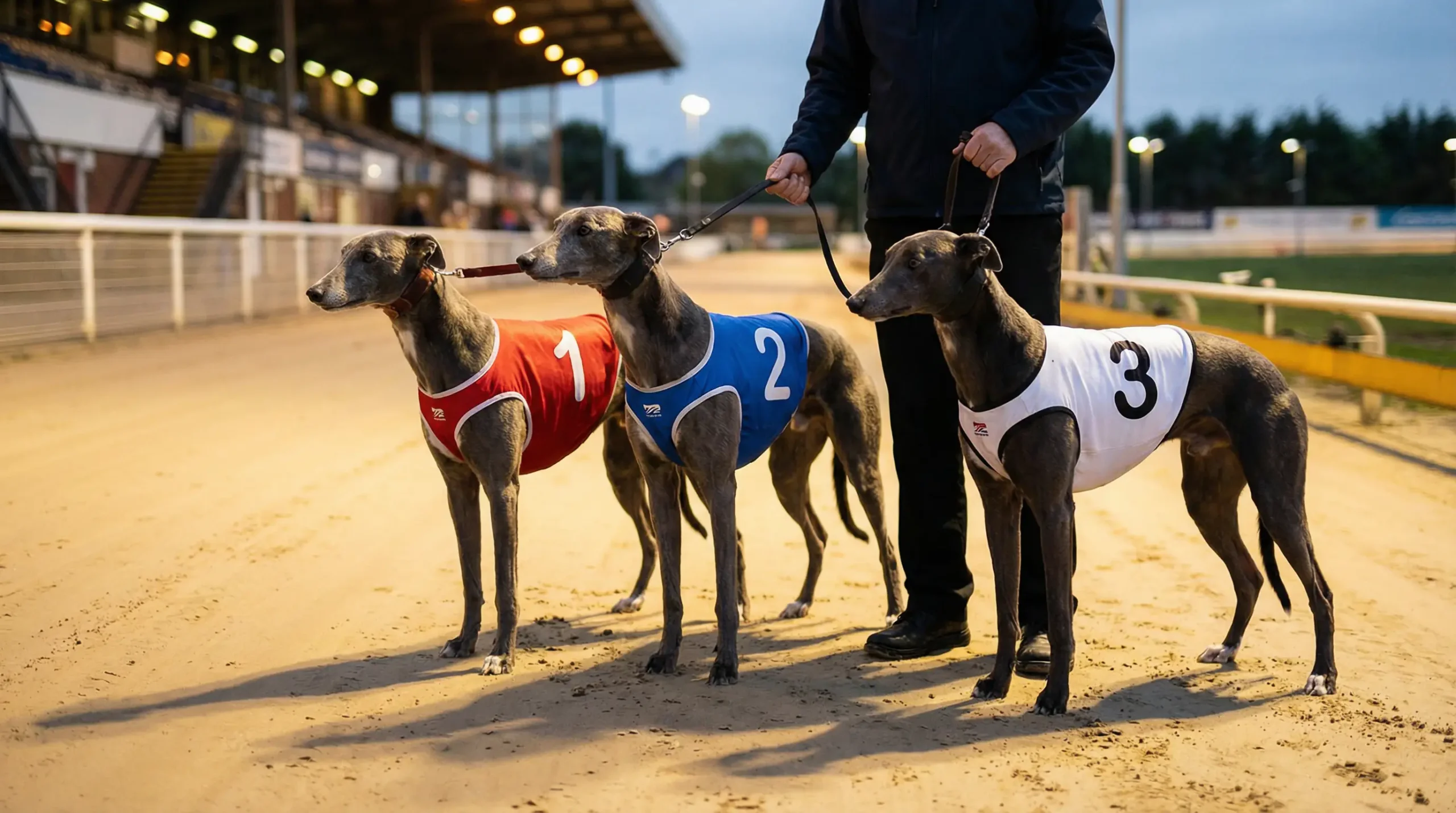
Every Greyhound Gets a Number — and a Ceiling
The grading system decides which dogs race each other before a single trap opens. Every greyhound competing at a GBGB-licensed track in the UK is assigned a grade by the track’s racing manager. That grade determines who it runs against, what standard of competition it faces, and — whether most punters realise it or not — how its form should be interpreted by anyone thinking about placing a bet.
Grades exist for a practical reason: to produce competitive racing. Without them, the fastest dogs in the country would be mixing with novices, and races would be processions rather than contests. The grading system groups dogs of roughly similar ability together, so that a six-runner field has a reasonable spread of chances. This is good for the sport, good for the spectacle, and essential for the betting market to function properly.
But the grading system is not a permanent label. Dogs are re-graded after almost every performance. Win a race, and you’ll likely go up. Get beaten repeatedly, and you’ll come down. This constant reshuffling means that a dog’s grade is a snapshot of its recent competitive level — not a fixed measurement of talent. The distinction matters enormously. A dog graded A3 today might have been A1 six months ago and might be A5 in six months’ time. The grade tells you where the dog is now, and from a betting perspective, that’s what counts.
Understanding the full grading structure — from the bottom of the A-grade ladder through sprint, staying, and open race classifications — gives you a framework for interpreting every result on the card. It tells you why a dog is racing at this level, what a move up or down means for its chances, and when a grade change creates an opportunity that the market hasn’t yet priced in.
How the UK Grading System Works
Grades aren’t a ranking — they’re a sorting mechanism. The UK greyhound grading system is managed individually by each licensed track’s racing office. There is no single centralised authority that assigns grades across all venues. Each track maintains its own grading structure based on the quality of dogs racing at that circuit, and the standard of each grade can vary between tracks. An A1 at one venue is not automatically equivalent to an A1 at another.
This decentralised approach means the grading system is both flexible and occasionally inconsistent. A dog moving between tracks may find itself regraded to reflect the different competitive standard at its new venue. This is normal, expected, and one of the first things any serious form student needs to account for when analysing results across multiple circuits.
A-Grades: A1 to A10 at Standard Distance
The A-grade ladder is the backbone of UK greyhound racing. A-grades cover the standard distance at each track — typically the circuit’s primary trip, which varies between approximately 450m and 500m depending on the venue’s configuration. A1 is the highest graded standard-distance race below open level. A10 is the lowest.
In practice, most tracks don’t use the full A1 to A10 range. A busy Category One track might run grades from A1 down to A8 or A9, while a smaller venue might have a narrower band. The number of active grades depends on the volume of dogs racing at the track and the spread of ability within the greyhound population available to the racing office.
Each A-grade represents a band of recent racing performance. A dog in A1 has demonstrated the fastest calculated times and strongest recent form at that venue’s standard distance. A dog in A7 has been performing at a level consistent with that lower grade. The boundaries between grades are set by the racing manager and are typically based on calculated race times, finishing positions, and winning margins from recent performances.
One detail that trips up newcomers: A-grades are track-specific and distance-specific. They apply to the standard distance at a particular track. When a dog races at a different distance — a sprint or a staying trip — a different grading code applies. The A-grade is not a universal rating of the dog’s ability; it’s a classification for one distance at one track.
How Dogs Move Between Grades
Grade movement is the engine that keeps the system competitive. After each race, the racing manager reviews the result and decides whether any runners should be regraded. The general principle is straightforward: winners go up, and dogs that finish consistently poorly come down. But the application is more nuanced than that simple rule suggests.
A dog that wins by a wide margin might jump two grades rather than one. A dog that wins narrowly in a slow time might go up only one grade or, in rare cases, stay at the same level. Conversely, a dog that finishes last in a race well below its usual standard might be dropped more aggressively. The racing manager exercises judgement, considering the time, the quality of the race, the margin, and the dog’s recent trajectory.
For bettors, grade movement is one of the most important signals on the racecard. A dog stepping up from A4 to A3 is facing stiffer competition. Its recent form was achieved against A4 standard — will it be fast enough at A3? The form figures might look impressive, but the context has shifted. Conversely, a dog dropping from A2 to A3 is meeting weaker opposition. The reason for the drop determines whether the move is a warning or an opportunity — a distinction that becomes central to betting strategy, as we’ll cover later.
Sprint, Middle Distance & Staying Grades
Distance changes everything — including the grade code. The A-grade ladder covers only the standard distance at each track. When dogs race over shorter or longer trips, separate grading codes apply. These distance-specific grades operate on the same principles as A-grades — performance-based, track-specific, managed by the racing office — but they cover distinct pools of dogs with different running characteristics.
Sprinters are a fundamentally different breed of racer from stayers. The traits that produce a fast 270m time — explosive trap speed, raw early pace, the ability to reach top speed in the shortest possible distance — are not the same traits that win over 640m, where stamina, bend technique, and the ability to sustain speed through multiple turns become decisive. The grading system reflects this by maintaining separate ladders for each distance category.
D-Grades: Sprint Racing Decoded
Sprint races at UK greyhound tracks cover the shortest available distances, typically ranging from around 262m to 300m depending on the venue’s configuration. These races are graded using the D prefix — D1, D2, D3, and so on — though the specific coding convention can vary between tracks. Some venues use different lettering for their sprint grades.
Sprint racing is all about the break and the first bend. Over a two-bend trip, there’s minimal time to recover from a slow start or a poor trap draw. Dogs that ping the lids — exploding out of the traps with maximum acceleration — dominate sprint grades. Running style barely matters beyond those first fifty metres; if you’re not at the front by the first bend, the race is effectively over at sprint distance.
From a grading perspective, sprint specialists often have a narrower form profile than standard-distance dogs. Their times cluster more tightly, the margins between runners are smaller, and the influence of the trap draw is amplified. A dog graded D1 at a tight circuit is usually the fastest trap-to-turn runner at that venue. The grade tells you something very specific about one skill: early pace.
S and M Grades: Staying & Marathon
Staying grades cover the longer distances — typically 600m and above. These grades are coded with an S prefix at most tracks, though the terminology varies. Marathon or extended-distance events, which cover trips of 800m or more, exist at selected venues and represent the endurance end of greyhound racing.
The characteristics that matter in staying races are different from those in sprint or standard-distance events. Stamina is obvious, but bend technique becomes critical over four or more turns. A dog that loses half a length on every bend through a wide-running style will be several lengths adrift by the end of a staying trip, regardless of its raw speed. Staying-grade dogs tend to be smoother through bends, more economical in their running, and less reliant on explosive early pace.
For punters, staying races present a different analytical challenge. Form is often thinner because fewer races are run over staying distances, meaning dogs might have only two or three recent runs at the trip. Grade assessment relies more heavily on time performance and less on volume of recent form. The smaller pool of staying specialists also means that grade movement can be more abrupt — a dog winning a couple of staying races might be promoted quickly through the grades simply because the population at that distance is smaller.
Open Races: The Top Tier
Open races are where the grading ladder ends and pure ability takes over. These events sit above the standard grading structure and are reserved for the best dogs in the country — or, at minimum, the best dogs available at that particular track. Open races don’t carry an A-grade number. They operate outside the usual promotion-and-relegation system, and entry is typically by invitation from the racing manager or through qualification standards.
The atmosphere around open races is different from a standard graded card. Prize money is higher, market interest is sharper, and the quality of the field is visibly superior. For punters, open races present a paradox: the form is deeper and more reliable because the dogs are proven performers, but the competition is tighter, which makes separating the field genuinely difficult. There are fewer easy answers in an open race.
OR1, OR2, OR3 & Category Races
Open races are sometimes sub-classified as OR1, OR2, and OR3, reflecting tiers within the open race category itself. OR1 represents the highest level — the elite of a track’s greyhound population or, for major events, the elite nationally. OR2 and OR3 step down from that peak but still represent quality well above the top A-grade.
Category races are a related but distinct classification. The GBGB categorises licensed tracks by size, quality, and status. Category One tracks are the major venues. Category races — particularly Category One open events — attract the best fields because the prize money and prestige are highest. These are the races that produce the names casual fans recognise, and they’re the races where the betting market is most efficient because the dogs have deep, well-documented form profiles.
For analytical purposes, the OR sub-classification tells you the ceiling you’re working with. A dog competing in OR1 at a Category One venue is operating at the highest level the sport offers domestically. Its form is achieved against the strongest possible competition, and any time or position in that context carries more weight than a similar number achieved in an A3 at a smaller circuit.
How Dogs Qualify for Open Races
There’s no single automatic pathway from the grading ladder into open races. In most cases, a dog reaches the top A-grade at its home track and demonstrates times or performances that the racing manager considers open-race standard. The racing office then invites the dog to compete in open events. Some major competitions have specific qualification criteria — time standards, semi-final rounds, or regional heats — but for regular open race cards, the racing manager has discretion.
Trainers also play a role. A kennel might request open-race entries for a dog they believe is ready, particularly if the dog has been performing strongly at a different venue. Inter-track movement at the open level is more common than in standard grades because the best dogs often campaign across multiple circuits. This means open-race form can span several venues, making cross-track time comparison more relevant — and more difficult — than at lower grades.
Hurdle Racing Grades
Add four obstacles and the form book changes shape entirely. Hurdle racing is a distinct discipline within UK greyhound racing, run over longer distances with jumps set at intervals around the track. Not every venue offers hurdle racing — it requires specific track infrastructure and a pool of dogs trained to jump — but where it exists, it produces its own grading structure and its own betting dynamics.
Hurdle grades operate on similar principles to flat grades: dogs are classified by performance over hurdles and move up or down based on results. However, the hurdle-racing population is smaller, which means the grading pool is shallower. A dog can move through the hurdle grades more quickly than through flat grades simply because there are fewer competitors at each level.
From a betting perspective, hurdle racing introduces an additional variable that flat racing doesn’t have: jumping ability. A fast flat dog that’s a poor jumper will lose momentum at every obstacle, and that lost momentum compounds over a four-hurdle trip. Conversely, a moderate flat dog that jumps fluently and gains ground at every hurdle can outperform its time-based rating. The form book for hurdle races needs to be read differently — the running comments and sectional data matter even more than usual because they reveal whether a dog gained or lost position at the hurdles.
The major hurdle events, such as the Champion Hurdle, attract specialist hurdlers whose entire careers are built around the jumping game. These dogs’ flat form is often unremarkable, but their hurdle technique transforms them into competitive racers at a level their basic speed wouldn’t reach. Grading reflects this: a dog might be graded as an average flat performer but rank highly in the hurdle grades.
Handicap Racing & Staggered Starts
Handicaps are the grading system’s pressure valve. In standard graded racing, the six dogs in a field are supposed to be of roughly similar ability — the grading system has done the sorting. In handicap races, the field deliberately includes dogs of different abilities, and the starting positions are staggered to compensate. Faster dogs start behind slower ones, and the handicapper’s job is to set the distances so that, in theory, all six dogs should cross the line at the same time.
In practice, they never do — which is exactly what makes handicap racing interesting for bettors. The handicapper works from calculated race times and grade history to set each dog’s starting mark. But handicap marks are based on past performance, and dogs’ form fluctuates. A dog on an improving trajectory might be set a mark based on its previous slower runs, giving it an advantage the mark doesn’t reflect. A dog that’s past its peak might carry a mark based on its best performances, leaving it with more ground to make up than its current ability warrants.
Reading handicap races requires a different analytical approach from standard graded events. The key question shifts from “who’s fastest?” to “who’s best handicapped?” — meaning which dog’s mark underestimates its current ability. Form trends matter more than absolute form figures in handicaps. A dog that has been improving steadily, posting faster times each week, might be competing off a mark that hasn’t yet caught up with its current level. That gap between mark and ability is where handicap betting value lives.
Handicap races are not run at every meeting. They tend to feature on larger cards and at bigger venues, and they carry their own grading identifiers on the racecard. When you see an H-prefix or a “Handicap” label in the race type, the analysis changes. Ignore the staggered start at your own expense.
Puppy & Novice Grades
Every champion started in puppy grades — and most punters ignored them there. Puppy races are restricted to greyhounds under a specific age threshold, typically under two years old, though exact rules can vary. These races use their own grading structure, often identified by a P-prefix, and they serve as the entry point for young dogs beginning their racing careers.
The defining characteristic of puppy racing, from a betting standpoint, is volatility. Young dogs are inconsistent. They’re still learning to race — learning to break from the traps, handle bends at speed, deal with the proximity of other runners, and maintain concentration over the full distance. A puppy that looks like a world-beater one week can run below par the next because of inexperience, greenness, or simply a bad night. The form book for puppies is thinner and less reliable than for mature dogs, and grade assessments are based on a smaller sample of performances.
Novice races, sometimes labelled introductory or IT grades, serve a similar function for dogs making their first competitive appearances at a particular track. A novice might be an experienced dog that has moved from another venue, or it might be a young dog making its career debut. Novice grades give the racing office a chance to assess the dog’s ability before slotting it into the main grading ladder.
For punters willing to do the work, puppy and novice racing offers opportunity precisely because the markets are less informed. With less public form to go on, the casual money tends to follow whichever dog has the most recent win, regardless of context. Kennel form, trial times, and trainer reputation carry extra weight in these races — the dogs haven’t built a deep enough public record for the market to price them accurately. If you have access to trial information or know which kennels are producing strong young dogs, puppy grades can be fertile ground.
Seeding: Rails, Wide & Middle
Seeding is the invisible hand behind the trap draw. When the racing manager assembles a graded race, they don’t just group dogs by grade — they also consider each dog’s preferred running style and assign trap positions accordingly. This process is called seeding, and it’s designed to produce safer, more competitive racing by reducing the chance of early crowding and bend interference.
Dogs are typically seeded into three categories: railers, middle runners, and wide runners. Railers are dogs that naturally gravitate towards the inside rail — they break from the traps and aim for the shortest route around the first bend. These dogs are seeded into the lower trap numbers, usually traps 1 and 2. Wide runners naturally run towards the outside of the track, taking wider lines through bends. They’re seeded into traps 5 and 6. Middle runners, who don’t have a strong preference, fill traps 3 and 4.
Seeding is not a rigid formula, and the racing manager has discretion. A dog seeded as a railer might occasionally be drawn in trap 3 if the race composition requires it, or a wide runner might end up in trap 4. But the general pattern holds across most graded races, and understanding it gives you a significant edge in reading the racecard. If you see a confirmed railer drawn in trap 5, something is unusual — either the racing office has made a judgement call, or the dog’s recent running style has changed. Either way, it’s a data point worth investigating.
Seeding also explains why certain trap statistics look the way they do. Trap 1 might have a high win percentage at a particular track not because the track is biased towards the inside, but because the best railers — dogs with strong early pace and first-bend technique — are consistently drawn there. The stat reflects the quality of the dogs seeded into that trap as much as the track geometry itself.
What Grades Mean for Your Betting
Grade moves are the biggest single factor most casual punters completely overlook. When a dog appears on the racecard, its current grade is printed clearly. What’s less obvious — and far more important — is whether that grade has changed since the dog’s last race. A dog running in A3 tonight that was A5 two weeks ago is facing a completely different competitive landscape from its recent form, and the market doesn’t always adjust adequately.
Dogs being promoted up the grades carry an inherent question mark. Their recent form was achieved against easier opposition. The speed figures might look strong, but those times were run against A5 company — will they hold up against A3 runners? Sometimes yes, because the dog is genuinely improving and the grade system is catching up to its ability. Sometimes no, because the dog peaked against weaker fields and can’t sustain that level against faster rivals. Your job as a form reader is to assess which scenario is more likely.
Dogs dropping through the grades carry a different kind of signal. A drop from A2 to A3 might indicate declining form — the dog has been beaten at A2 and the racing manager has lowered its classification. But it might also indicate a dog that had one unlucky run at A2 — bumped, crowded, slowly away — and has been dropped despite its underlying ability remaining intact. If the drop was mechanical rather than performance-driven, the grade change creates value. The dog is now meeting weaker opposition while being priced as though the drop reflects its true level.
The most profitable grade-based angle in greyhound betting is identifying dogs whose grade change doesn’t match the reason for their recent results. A dog dropped after trouble in running. A dog promoted after winning a weak race that happened to be graded higher than its actual quality. A dog re-graded after moving between tracks, where the grade at the new venue doesn’t yet reflect its true ability. These mismatches between grade and reality are where the betting edge sits, and the racecard gives you enough information to spot them — if you know what grade movement means.
Grade Doesn’t Guarantee — It Contextualises
Knowing a dog’s grade tells you what to expect; watching it tells you what to believe. The grading system is the best available tool for sorting hundreds of racing greyhounds into competitive fields. It works well at what it’s designed to do. But it has limits, and treating it as something more precise than it is will cost you money.
Grades don’t account for everything. They don’t capture a dog’s current physical condition, its response to a change of track surface, its temperament on a cold night, or whether the trainer has been working on a specific aspect of its performance since its last race. They measure recent results — and recent results are influenced by variables the grading system doesn’t track.
The most common grading-related betting mistake is assuming that a dog at a higher grade is automatically better than a dog at a lower grade when they meet in the same race. In handicap events, this is obviously untrue — the staggered start compensates for ability differences. But even in standard graded races, where all dogs are nominally at the same level, the reality is that some are heading up through that grade, some are heading down, and some have been sitting in it for weeks. The direction of travel matters at least as much as the current position.
Use grades as your starting framework, not your final answer. They tell you the competitive context, the standard of opposition, and the trajectory of each dog in the race. From there, the detailed form, the trap draw, the going, and the race-day conditions do the rest. The grade gets you to the right part of the map. Your analysis determines whether you find anything worth backing once you’re there.