
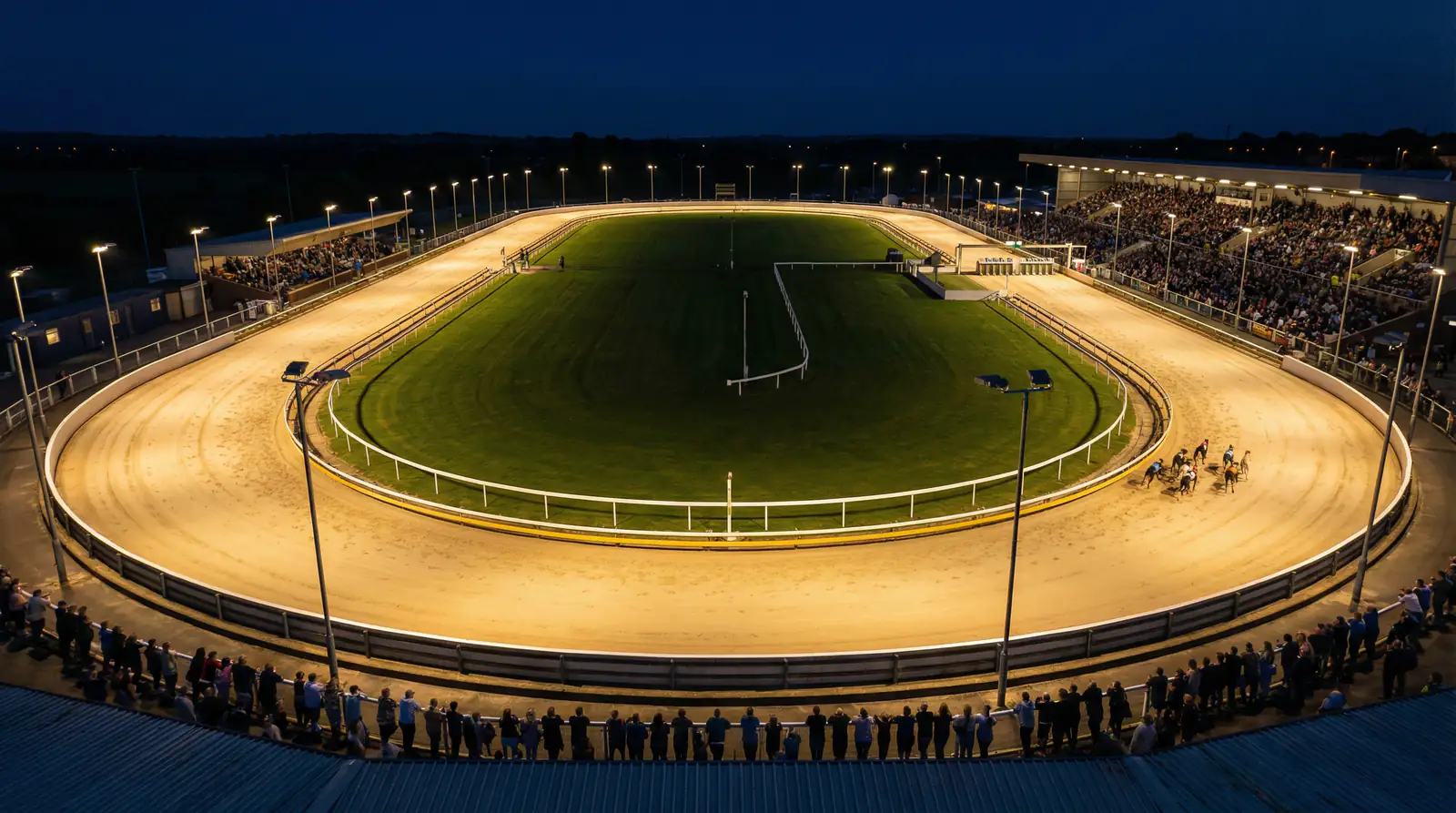
Not All Ovals Are Created Equal
Two tracks can run the same distance and produce completely different racing. A 480m trip at Nottingham is not the same animal as a 480m trip at Monmore. The bend profiles differ. The sand composition differs. The trap-to-first-bend geometry differs. And all of those differences change which dogs thrive, which dogs struggle, and ultimately which dogs you should be backing.
UK greyhound racing operates across a network of GBGB-licensed venues, each with its own physical characteristics, grading standards, and competitive personality. Some tracks favour early-pace dogs that blast out of the traps and lead into the first bend. Others reward strong finishers that pick up dogs through the closing stages. Some tracks have notoriously tight bends that amplify the inside rail advantage. Others have sweeping curves that allow wide runners to maintain their speed without losing ground.
Knowing these differences — and factoring them into your analysis — is one of the most underappreciated edges in greyhound betting. A dog with strong form at one track might be poorly suited to another, and the racecard won’t tell you that directly. It shows the results, the times, the grades. But interpreting those results requires understanding the venue where they were achieved and the venue where the dog is racing tonight. This guide covers the licensed tracks, their distances, their trap statistics, and the specific characteristics that matter when you’re studying the card.
Licensed UK Greyhound Tracks: Overview
Eighteen licensed venues under GBGB — each with its own character. The Greyhound Board of Great Britain (GBGB) licenses and regulates all professional greyhound racing in England, Scotland, and Wales. Each licensed track operates under GBGB rules, files results through the official system, and maintains its own racing calendar, grading structure, and card programming.
The licensed tracks span the country, from Newcastle and Sunderland in the North East to Brighton and Hove on the South Coast. The major Category One venues — tracks like Nottingham, Monmore Green, and Romford — host the biggest meetings, the best fields, and the most valuable open races. Category Two and Three tracks provide the regular weekly racing that forms the backbone of the sport, with BAGS fixtures generating the bulk of the televised product that bookmakers use for afternoon and evening betting.
Track availability is not static. Venues close and new licences are issued over time, so the exact number of operational tracks can shift from year to year. What remains consistent is the spread: enough geographical coverage that most kennels can reach at least two or three licensed tracks within reasonable travelling distance, and enough variety in track configurations that dogs with different running styles will always have somewhere that suits them.
For bettors, the practical takeaway is that the UK circuit is large enough to reward specialisation. You don’t need to know every track intimately. Focusing on three or four venues — learning their distances, their trap biases, their going characteristics, and the quality of their regular graded fields — gives you a deeper understanding than a surface-level familiarity with all eighteen. Depth beats breadth in greyhound track knowledge, and the information compounds over time.
Track Distances & Standard Configurations
The standard distance is the one the grading system is built around. Every UK greyhound track designates one distance as its standard — the trip at which the majority of graded races are run and the A-grade ladder is calibrated. This standard distance varies between tracks because track circumference, trap positions, and bend geometry all differ. There is no single “standard distance” for UK greyhound racing as a whole; each venue sets its own.
Beyond the standard distance, most tracks offer at least one sprint option and one staying option, giving racing managers the flexibility to programme varied cards. Some larger venues offer four or five different trip lengths, covering everything from short sprints to marathon stays. The distance menu at each track shapes the type of dogs that race there and, consequently, the betting opportunities available.
Sprint Distances (200m–350m)
Sprint trips are the shortest races on the card, typically covering two bends. Distances range from around 238m at the shortest venues up to approximately 300m at others. The exact sprint distance at each track depends on the position of the starting traps relative to the first bend — tracks with traps placed closer to the bend produce shorter sprints, while those with a longer run to the first turn offer slightly longer sprint trips.
Sprint racing is fast, frenetic, and heavily influenced by the trap draw. Over two bends, there’s minimal time to recover from any positional disadvantage. Dogs that break fastest and reach the first bend in front have a structural advantage that’s difficult to overcome in such a short race. This means sprint results are more closely tied to the trap draw than results at any other distance, and sprint times are the most tightly clustered — the difference between first and sixth can be fractions of a second.
For bettors, sprint racing rewards a focus on early pace and trap speed. The detailed form lines and running comments are essential here, because a dog’s ability to break cleanly from the specific trap it’s drawn in tonight matters more than its overall time rating.
Middle Distances (380m–500m)
Middle distances encompass what most people think of as “standard” greyhound racing. These trips run over four bends and cover the range where the standard A-grade system operates. The exact distance varies: Romford’s standard is 400m, Monmore’s is 480m, Nottingham’s is 500m. These differences look small on paper but produce meaningfully different races.
A 400m four-bend trip at a tight circuit puts more emphasis on first-bend pace than a 500m trip at a track with sweeping bends. The extra distance gives dogs more time to recover from early trouble, more opportunities to gain ground on the straights, and more scope for stamina to play a role. Form comparisons across tracks at middle distances demand caution — the track profile shapes the result as much as the dog’s ability.
The middle-distance range is where greyhound racing has its deepest pool of competitors and its most competitive fields. The grading system is most refined at this distance because the most races are run here. For punters, this means the form book is richest at middle distances — more data points, more recent runs, and more reliable grade assessments.
Staying Distances (500m+)
Staying races begin where the standard-distance range ends, typically from around 575m upward. These trips cover six bends or more and test qualities that shorter races never touch: stamina, race craft over multiple turns, the ability to sustain speed through the second half of a race when rivals are tiring.
Not every track offers staying distances, and among those that do, the trip lengths vary significantly. The longest flat trips in UK racing approach 900m at selected venues. Hurdle races, which are run over longer trips by their nature, extend the staying category further. Staying-race specialists form a distinct subset of the greyhound population — dogs that may look unremarkable over four bends but come alive when the trip stretches their rivals.
Staying racing produces thinner form because fewer races are programmed at these distances. A dog might have two or three staying-trip runs in its recent form compared to five or six at standard distance. This means the data is less robust, grade assessments are less precise, and the market is less informed. For punters who understand staying-race dynamics — particularly the importance of bend economy and late stamina — these races offer genuine opportunity.
Trap Statistics: Winning Percentages by Track
Trap stats tell you how the track is shaped — not which dog will win. Trap statistics aggregate thousands of race results to show the winning percentage for each trap number at a given venue. They’re one of the most frequently cited data points in greyhound betting, and they’re also one of the most frequently misused.
At most UK tracks, the inside traps — particularly trap 1 — show a higher overall winning percentage than the outside traps. This is intuitive: the dog drawn on the inside rail has the shortest distance to travel to the first bend, and if it reaches that bend in front, it has the racing line. But the size of the inside-trap advantage varies enormously between venues. At tracks with tight, sharp first bends, the advantage is pronounced. At tracks with sweeping, generous curves, it’s less significant, and middle or outside traps can show competitive win rates.
The critical caveat with trap statistics is that they’re partly a product of the seeding system. Racing managers seed confirmed railers — dogs with strong early pace and inside-running styles — into the lower traps. So when trap 1 shows a 22% win rate against a 14% rate for trap 6, part of that difference reflects the track’s geometry, but part of it reflects the fact that better-suited dogs are being placed in the inside positions. The stat captures both the track bias and the seeding effect, and separating the two is impossible from the aggregate numbers alone.
Used properly, trap statistics provide a baseline expectation for each trap position at a specific venue. If trap 1 at a particular track wins 20% of races over the standard distance, that’s the starting point. A dog drawn in trap 1 tonight that’s also the highest-rated runner in the field is in a favourable position. A dog drawn in trap 1 that’s a known wide runner seeded out of position faces a different scenario entirely. The trap stat gives you the context; the individual dog’s profile determines whether that context helps or hinders.
Trap statistics also shift over time. Track maintenance, surface changes, and even weather patterns across a season can alter the relative advantage of different trap positions. A track that historically favours inside traps might see that bias reduce if the rail runs deep after persistent rain, because the inside route — normally the fastest — becomes the one with the heaviest going. Checking recent trap statistics rather than all-time figures gives you a more accurate picture of current conditions.
Track Profiles: Key Venues
Each track has tendencies that repeat over thousands of races. What follows is a profile-style overview of selected UK venues, highlighting the characteristics that matter most for betting analysis. This is not an exhaustive catalogue of every track — it’s a representative sample of the venues that account for a significant share of UK greyhound racing and the ones where understanding the track profile makes the biggest difference to your form reading.
Romford, Monmore & Nottingham
Romford is one of the busiest tracks in the country and a staple of the BAGS circuit. Its standard distance of 400m over four bends produces quick, competitive races where early pace is king. The first bend comes up fast after the traps, making the break critical. Inside traps historically carry a meaningful advantage at Romford, and the tight bend profiles mean wide runners can lose ground on every turn. If you’re studying Romford form, the trap draw and first-bend comments are the two most important elements on the card.
Monmore Green in Wolverhampton runs its standard distance at 480m and has a reputation as a fair track that doesn’t heavily favour any particular running style. The bends are more generous than Romford’s, allowing wide runners to compete without the same degree of disadvantage. Monmore hosts strong Category One meetings and open races that attract quality fields. Trap statistics are more evenly distributed here than at tighter circuits, which means the individual dog’s form and running style matter more than the trap number.
Nottingham, with its 500m standard distance, is one of the larger circuits in UK greyhound racing. The extra distance compared to Romford and Monmore gives races more shape — there’s time for hold-up runners to make ground, time for early leaders to tire, and more opportunity for class to tell. Nottingham’s staying-distance programme is well-established, and the track regularly hosts competitive open events. Form achieved at Nottingham tends to translate well across other larger circuits, though the specific times remain non-comparable due to track-specific calculations.
Towcester, Hove & Perry Barr
Towcester is unique among UK greyhound venues. It’s the only track that stages hurdle racing as a regular feature, and its staying-distance programme is among the most comprehensive in the country. The track itself has a distinctive configuration with features that set it apart from conventional circuits. Dogs that thrive at Towcester tend to be specialists — the venue rewards stamina and jumping ability in a way no other track replicates. If you’re betting on Towcester for the first time, discard your assumptions about trap bias and running styles from other tracks. This is a venue that operates on its own terms.
Hove, on the South Coast near Brighton, runs a standard four-bend trip and is known for producing competitive racing on the BAGS circuit. The track has a relatively tight configuration that tends to favour inside runners, though the extent of that bias has fluctuated over the years depending on surface maintenance. Hove’s regular card produces steady form data for dogs in its catchment area, making it a solid track for form-based analysis if you’ve built up familiarity with the venue.
Perry Barr in Birmingham operates as a busy mid-tier venue with a full card programme. The track runs several distance options and has a standard trip that slots between the shorter and longer circuits. Perry Barr is a good general-purpose track for greyhound betting — it doesn’t have extreme characteristics that dramatically favour one running style over another, which means form assessment tends to be more straightforward than at quirkier venues.
Crayford, Newcastle & Sunderland
Crayford in South-East London is a tight, sharp circuit where the first bend arrives quickly. Early speed matters enormously at Crayford, and the inside traps carry a notable advantage over the standard distance. Dogs that break fast and rail the first bend are disproportionately successful here. Wide runners and hold-up performers face a structural disadvantage that the form book reflects: you’ll see dogs with strong form at other venues posting disappointing results when they visit Crayford for the first time and find the track geometry doesn’t suit them.
Newcastle and Sunderland serve the North-East’s greyhound racing community. Both tracks provide regular BAGS racing and support graded fields drawn from the regional kennel population. These venues are particularly useful for punters who follow trainer form in the North-East — the same kennels race at both tracks, and dogs frequently alternate between them. If a dog has been winning at Newcastle and switches to Sunderland, or vice versa, understanding the differences between the two circuits helps you assess whether the form will transfer.
Neither Newcastle nor Sunderland has the headline profile of the major Category One venues, but both produce consistent racing that rewards careful form study. The markets tend to be less efficient at smaller tracks because public interest and money flow are lower, which means mispriced dogs are more common. For bettors who put in the analytical work, mid-tier tracks often offer better value than the flagship venues.
How Track Conditions Vary by Venue
The sand isn’t the same everywhere. UK greyhound tracks use sand-based surfaces, but the specific sand type, depth, and maintenance regime differ from venue to venue. These differences produce meaningful variation in going conditions that directly affect race times, running styles, and — ultimately — results.
Some tracks run a consistently firm surface that produces fast times and rewards dogs with raw speed. Others maintain a deeper, softer surface that saps pace and favours dogs with stamina and strength. Weather affects every track, but the impact varies: a heavy downpour on a well-draining surface might change conditions temporarily, while the same rainfall on a poorly draining track can transform the going for an entire evening’s racing.
Going reports are published before most meetings and describe the current surface condition. Terms like “normal,” “slow,” and variations between them give you a baseline. But the report describes the track at a specific point in time — conditions can change during a meeting, particularly on wet evenings when the surface absorbs more water as the night progresses. Later races on a rain-affected card may run on materially different going from the first race.
The practical lesson is that times recorded at one venue cannot be directly compared to times at another, even over the same distance. A 29.40 at one track and a 29.40 at another might represent completely different levels of performance because the surfaces are different. Even times at the same track need context — a 29.40 on a firm night and a 29.40 on a slow track are different achievements. Always check the going before you compare times, and always treat cross-track time comparisons with scepticism.
Matching Dogs to Tracks
A dog’s best track is the one that suits its running style — not the one closest to its kennel. Every greyhound has a running profile: how fast it breaks from the traps, whether it naturally gravitates to the rail or runs wide, how well it handles bends, and whether its strength lies in early pace or late stamina. Every track has a physical profile that either complements or conflicts with those characteristics.
A confirmed railer with explosive early speed is perfectly suited to a tight circuit where the first bend comes up fast and inside runners dominate. Put the same dog on a sweeping track where the run to the first bend is longer and the geometry doesn’t punish wide runners, and its advantage shrinks. The dog hasn’t changed — the track has.
When a dog moves between tracks — and this happens regularly, especially for dogs with trainers who campaign across multiple venues — the form transfer isn’t automatic. A dog with four consecutive wins at one circuit might be drawn at a different venue for the first time, and if the track profile doesn’t suit its running style, those four wins are less relevant than they appear. The racecard shows the results and the venues. Your job is to assess whether the form achieved at venue A is likely to translate to venue B.
The most reliable indicators for track suitability are the dog’s running style, its bend performance, and its historical results at the track in question. If the dog has raced at tonight’s venue before and the results were consistently good, that’s strong evidence of suitability. If this is the dog’s first visit, look at the track profile and compare it to the venues where the dog has performed well. Similar geometries, similar surfaces, and similar distance configurations suggest a reasonable chance of form transfer. Radically different profiles warrant caution.
The Tracks That Reward Research
Some venues are betting playgrounds; others are graveyards for favourites. The tracks that reward research most are the ones where track-specific knowledge provides the biggest edge over the general market. These tend to be venues with distinctive characteristics that casual punters overlook — tight first bends that amplify trap bias, unusual distance configurations, surfaces that change character in wet weather, or grading pools that produce unexpectedly uncompetitive fields at certain grades.
The flagship venues, where the biggest meetings and the most money flow through the market, tend to have the most efficient pricing. The major Category One tracks attract sharp money, bookmakers pay closer attention to the market, and the form book is deeper. Finding genuine value at these venues requires more work and more nuance than at smaller circuits.
The mid-tier and smaller tracks, by contrast, often present richer pickings for form students. Less public interest means less money in the market, which means the odds are set with less precision. A dog that’s ideally suited to a specific smaller circuit might drift in the market because the general betting public doesn’t know the track well enough to recognise the advantage. If you’ve done the work — studied the trap statistics, understood the track’s geometry, learned which running styles it rewards — you’ll spot these opportunities where casual punters see nothing special.
The best approach is to build deep knowledge of a small number of tracks rather than shallow knowledge of many. Pick two or three venues that suit your schedule — tracks you can follow regularly, ideally with BAGS coverage you can watch — and learn them properly. Study the trap stats over different periods. Watch how conditions change across seasons. Note which trainers send runners from outside the local area, and how those runners perform on their first visit. Over months, that accumulated understanding becomes a genuine analytical advantage that no amount of quick pre-race research can replicate.